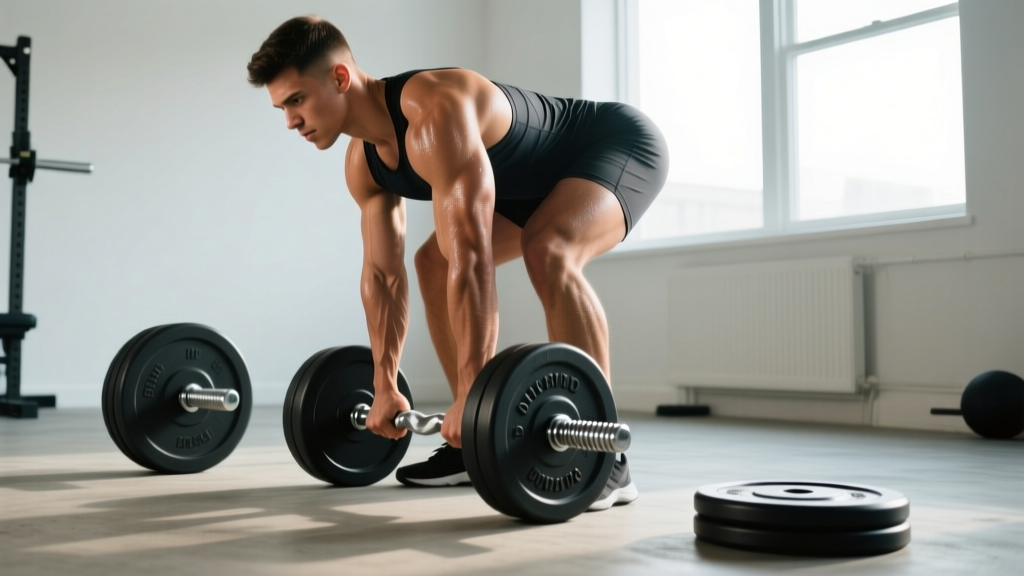
Dumbbell Romanian Deadlifts GIF Analysis: Form & Plate Mistakes
Troubleshoot your hip hinge with our dumbbell Romanian deadlifts GIF guide. Fix Olympic vs standard plate mistakes ruining your range of motion.

The Home Gym Compatibility Crisis: Standard vs. Olympic
Building a home gym often involves piecing together equipment over several years. By 2026, the secondary market is flooded with affordable cast-iron weight plates, but this accessibility has spawned a widespread compatibility crisis among amateur lifters. The most common and dangerous error? Conflating Olympic weight plates (featuring a 2-inch or 50.8mm center hole) with Standard weight plates (featuring a 1-inch or 25.4mm center hole).
While mixing these two formats might seem like a minor logistical headache solvable with cheap plastic adapter sleeves, it fundamentally alters the biomechanics of your lifts. Nowhere is this more evident than in the hip hinge. When lifters attempt to load plate-adjustable dumbbell handles for posterior chain work, the physical dimensions of standard versus Olympic plates dictate the success, safety, and range of motion (ROM) of the exercise.
⚠️ CRITICAL WARNING: Never use 1-inch standard plates on a barbell equipped with Olympic-to-Standard sleeve adapters for heavy hinge movements. The adapters introduce lateral wobble and shift the center of gravity outward, placing extreme shear stress on your wrists and lower back during the eccentric phase of a deadlift.Dumbbell Romanian Deadlifts GIF Breakdown: Spotting Equipment-Induced Form Faults
When you pull up a dumbbell romanian deadlifts gif to study the eccentric loading phase of the hip hinge, you are likely looking for the hallmark signs of good form: a neutral spine, soft knee bend, and a deep hamstring stretch achieved by pushing the hips back. However, fitness professionals and physical therapists increasingly note that what appears to be a "mobility restriction" in a lifter's RDL is often an equipment-induced fault.
According to biomechanics data cataloged by ExRx.net, the dumbbell RDL requires the weight to travel closely along the vertical line of the mid-foot to maintain balance and maximize hamstring tension. If your equipment forces you to alter this bar path, the lift breaks down.
The Diameter Dilemma: Why Standard Plates Ruin Range of Motion
The most glaring difference between Olympic and Standard plates is not just the hole size—it is the outer diameter of the smaller increment plates. The International Weightlifting Federation (IWF) mandates that all Olympic bumper plates and standard Olympic iron plates weighing 10 lbs and above share a uniform diameter of 450mm (17.7 inches). This ensures that regardless of the weight loaded, the barbell or dumbbell handle sits at the exact same height off the floor.
Standard 1-inch plates do not follow this rule. A 10-pound standard cast-iron plate is incredibly small, often measuring just 6.5 inches in diameter. If you are using 1-inch plate-loaded dumbbell handles and load them with 10lb or 15lb standard plates to perform RDLs, the dumbbell will physically strike the floor before your hamstrings reach a meaningful stretch. You end up performing a shallow, quarter-rep hinge, completely defeating the purpose of the exercise.
| Plate Type & Weight | Approx. Diameter | Impact on RDL Range of Motion |
|---|---|---|
| Standard 10 lb (1-inch hole) | 6.5 inches | Severe ROM restriction; hits floor prematurely. |
| Standard 25 lb (1-inch hole) | 9.5 inches | Moderate ROM restriction; limits deep stretch. |
| Olympic 10 lb Bumper (2-inch) | 17.7 inches (450mm) | Optimal ROM; allows full hamstring stretch. |
| Olympic 45 lb Iron (2-inch) | 17.7 inches (450mm) | Optimal ROM; standard for heavy hinging. |
Troubleshooting Plate-Loaded Dumbbell Handles for Hinges
If you are committed to using plate-loaded dumbbell handles for Romanian Deadlifts, you must troubleshoot the inherent mechanical flaws of the equipment. As detailed in comprehensive equipment reviews by BarBend, the structural integrity of standard versus Olympic gear varies wildly under load.
Failure Mode 1: Collar Slippage and Eccentric Torque
The Romanian Deadlift is characterized by a slow, controlled eccentric (lowering) phase, usually lasting 3 to 4 seconds. When using 1-inch standard dumbbell handles secured with threaded star-lock collars, the rotational torque generated by the plates shifting against the sleeve can gradually loosen the collar. Mid-set slippage results in plates sliding outward, instantly shifting the center of mass and risking a severe wrist sprain or lower back tweak.
The Fix: Upgrade to Olympic dumbbell handles (like the Titan Fitness Olympic Dumbbell Handles) which utilize spring-clip or clamp collars. The 50.8mm sleeves are machined to tighter tolerances, preventing rotational play and keeping the plates locked tightly against the inner sleeve lip.
Failure Mode 2: The Adapter Sleeve Width Penalty
Many lifters attempt to use their 1-inch standard plates on Olympic dumbbell handles by sliding a plastic or chrome adapter sleeve over the 2-inch post. This is a critical troubleshooting error. Adapters add 0.5 to 1 inch of lateral width to each side of the dumbbell. For an exercise like the RDL, where the dumbbells must graze the thighs and track closely to the body's center of gravity, this added width forces your arms into an unnatural, flared-out position. This lateral flare places excessive valgus stress on the elbows and reduces lat engagement, which is vital for spinal stability during the hinge.
2026 Buyer’s Framework: Fixing Your Weight Plate Arsenal
If your home gym is currently bottlenecked by standard 1-inch plates, here is the most cost-effective troubleshooting framework to upgrade your arsenal for heavy hinges in 2026:
- Liquidate Standard Iron: Standard cast iron plates currently average $1.00 to $1.50 per pound on the used market. Sell your 1-inch plates to beginners building starter kits.
- Invest in Olympic Bumpers for Hinges: Purchase a pair of 10lb and 25lb Olympic bumper plates. Because bumpers maintain the 450mm diameter across all weights, you can perform deficit RDLs or standard RDLs with perfect floor clearance even when warming up with just 20 lbs per hand. Expect to pay between $3.00 and $4.50 per pound for high-quality virgin rubber bumpers from reputable manufacturers like Rogue Fitness.
- Consider Adjustable Alternatives: If floor space is at a premium and you cannot store multiple Olympic bumper plates, pivot away from plate-loaded handles entirely. Adjustable dumbbells (such as PowerBlock Pro series or Nuobell) offer a fixed, blocky chassis that sits at a consistent height off the floor, mimicking the ROM benefits of Olympic bumpers without the sprawling footprint.
"The hip hinge is unforgiving of equipment asymmetries. If your plates force you to compromise your grip width or your range of motion, you aren't training your posterior chain—you are just managing your equipment's limitations." — FitGearPulse Biomechanics Testing Team
Frequently Asked Questions
Can I use standard plates for dumbbell RDLs if I stand on an elevated platform?
While standing on a 2-inch to 4-inch elevated platform (like a step-plate or low plyo box) artificially increases your range of motion and bypasses the premature floor-strike of small standard plates, it introduces a new problem: balance. Balancing on a raised surface while holding unstable, narrow-grip plate-loaded handles increases the risk of ankle rolling during the eccentric descent. It is a band-aid fix; upgrading to uniform-diameter Olympic plates is the proper solution.
Why do Olympic plates feel more stable on dumbbell handles?
Olympic plates feature a 50.8mm center hole that mates perfectly with a 50mm Olympic dumbbell sleeve. The 0.8mm difference allows for smooth loading while eliminating the "clanking" and rotational wobble inherent in 1-inch standard plates, which are often cast with less precise molds and feature larger tolerance gaps on the sleeve.
Are urethane Olympic plates better than rubber bumpers for RDLs?
For pure RDL work, yes. Urethane Olympic plates are typically cast in the traditional multi-grip "pancake" or standard 12-sided iron shape, but coated in dense urethane. They are much thinner than rubber bumpers, allowing you to load heavier weights onto the short sleeves of an Olympic dumbbell handle without running out of physical sleeve space. However, they are significantly more expensive, often costing upwards of $4.00 per pound.
More gear to consider
All reviews
How to Add More Weight to Dumbbells: Rubber Hex vs Urethane Longevity

Rack Guide: Power vs Squat Rack vs Stand + Dumbbell Workout Arms Abs

Bumper vs Iron Plates: A Dumbbell Plot of Cost & Durability
Dumbbell Lat Raise: Beginner's Step-by-Step Form Guide
Dumbbell Push Jerk Setup: Power Rack vs Squat Rack vs Squat Stand
