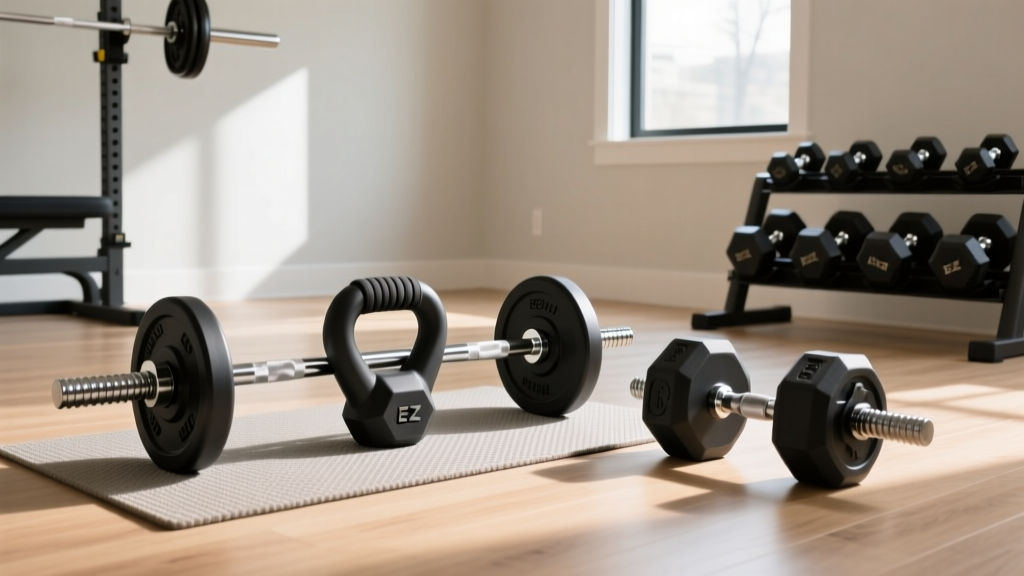
EZ Curl Bar vs Straight Bar & Dumbbell Sumo Squats for Glutes
We compare the EZ curl bar vs straight bar for bicep hypertrophy, and break down why dumbbell sumo squats for glutes dominate lower body leg day routines.

Building the Ultimate 2026 Upper/Lower Free Weight Arsenal
Designing a comprehensive home or commercial gym in 2026 requires more than just a power rack and a standard Olympic barbell. True hypertrophy and strength development demand specialized tools that target specific biomechanical pathways. In this expert hands-on review, we are diving deep into two critical corners of the free weight room: the upper body isolation debate of the EZ curl bar vs straight bar, and the undisputed lower-body king of posterior chain development, the heavy dumbbell sumo squat.
Whether you are trying to maximize bicep peak while preserving your radioulnar joints, or you are looking to build massive legs, understanding the mechanical nuances of your equipment is non-negotiable. Let us break down the gear, the science, and the programming.
The Upper Body Showdown: EZ Curl Bar vs Straight Bar
The debate between using a straight barbell and an EZ (Easy) curl bar for bicep isolation has raged for decades. The answer is not about which is universally 'better,' but rather which tool aligns with your specific anatomical structure and hypertrophy goals.
Straight Bar Mechanics: Peak Supination and Tension
A standard 47-inch or 59-inch straight bar forces your wrists and forearms into full supination (palms facing completely upward). According to biomechanical analyses outlined by ExRx.net Barbell Curl Mechanics, this full supination places the biceps brachii—specifically the short head—in its most mechanically advantageous position to generate force. The result? Maximum peak tension and a superior bicep 'pump.' However, this comes at a cost. For lifters with limited wrist mobility or a history of medial epicondylitis (golfer's elbow), the valgus stress placed on the elbow and wrist joints can lead to severe connective tissue fatigue.
EZ Bar Mechanics: Joint Preservation and Brachialis Focus
The EZ curl bar features a zig-zag shaft with multiple angled grip positions, typically ranging from 120 to 150 degrees of supination. This semi-supinated grip drastically reduces torque on the distal radioulnar joint. While it slightly reduces the peak contraction of the biceps brachii, it shifts a significant portion of the load to the brachialis and brachioradialis. Over time, building the brachialis pushes the biceps brachii upward, creating the illusion of a thicker, more peaked arm. For lifters training heavy into their 30s and 40s, the EZ bar is often the superior longevity tool.
Expert Callout: The Knurling Factor
When comparing bars in 2026, pay close attention to the knurl depth. A straight bar designed for curls often features a 'medium' or 'aggressive' knurl to prevent slipping during heavy 8-rep max sets. Conversely, premium EZ bars often utilize a 'light' or 'mountain' knurl pattern to prevent tearing the calluses on the inner palms during high-volume drop sets.
2026 Gear Comparison Matrix
| Feature | Rogue Curl Bar (Cerakote) | Titan Fitness 47" Straight Bar |
|---|---|---|
| Price (Approx.) | $135.00 | $89.99 |
| Bar Weight | 22 lbs | 15 lbs |
| Grip Angles | Multi-angle (120° & 145°) | 0° (Full Supination) |
| Knurl Type | Medium / Volcano | Aggressive / Sharp |
| Best For | Joint longevity, Brachialis | Peak Bicep Tension, Heavy Loads |
The Lower Body Counterpart: Dumbbell Sumo Squats for Glutes
You cannot build a complete physique by only training arms. A balanced free-weight arsenal requires heavy, unilateral or bilateral lower-body compound movements. While barbell back squats are phenomenal for overall central nervous system (CNS) loading, the dumbbell sumo squat glutes activation profile is remarkably high due to the external hip rotation required by the wide stance.
Why the Sumo Stance Dominates Glute and Adductor Hypertrophy
When you adopt a sumo stance (feet placed 1.5x to 2x shoulder-width apart with toes flared out at 45 degrees), you fundamentally alter the length-tension relationship of the hip extensors. The adductor magnus, which acts as a powerful hip extensor when the hip is flexed, is placed under a massive loaded stretch at the bottom of the squat. Furthermore, the external rotation of the femur aligns the gluteus maximus fibers to contract more forcefully during the concentric (upward) phase.
Using heavy dumbbells—such as the Rogue Rubber Hex Dumbbells (priced around $2.50/lb in 2026)—allows for a deeper range of motion than a traditional barbell sumo deadlift or squat, as the dumbbells can travel past the knees without hitting the floor, provided you have adequate mobility.
"To maximize glute recruitment during the dumbbell sumo squat, focus on 'screwing' your feet into the floor outward without actually moving them. This creates external rotation torque at the hip, instantly engaging the glute medius and maximus before you even begin the descent."
Step-by-Step Execution for Maximum Glute Bias
- The Setup: Grab a pair of heavy hex dumbbells (50-100 lbs each depending on your strength level). Stand with your feet roughly 1.5 times wider than shoulder-width.
- The Toe Flare: Point your toes outward at a 30 to 45-degree angle. Ensure your knees will track directly over your toes.
- The Descent: Hinge slightly at the hips, then break at the knees. Lower the dumbbells straight down between your legs, keeping your torso relatively upright (unlike a Romanian deadlift). Aim for a depth where your hip crease drops below your knee.
- The Hole: Pause for 1 second at the bottom to eliminate the stretch reflex. Feel the deep stretch in your adductors and glutes.
- The Drive: Push the floor away, driving your knees outward to maintain alignment. Squeeze the glutes hard at the top without hyperextending the lumbar spine.
Programming Both Into Your 2026 Split
How do we integrate specialized arm bars and heavy dumbbell leg work into a cohesive routine? The Upper/Lower split remains the gold standard for intermediate to advanced lifters in 2026. Here is how you can program these specific tools for optimal hypertrophy and recovery.
Sample Lower Day (Glute & Adductor Focus)
- Primary Compound: Barbell Romanian Deadlifts (3 sets x 6-8 reps)
- Secondary Compound: Dumbbell Sumo Squats (3 sets x 8-12 reps, 2 RIR)
- Accessory: Bulgarian Split Squats (3 sets x 10-12 reps per leg)
- Isolation: Lying Hamstring Curls (3 sets x 15 reps)
Sample Upper Day (Arm Hypertrophy Focus)
- Primary Compound: Incline Dumbbell Bench Press (3 sets x 8-10 reps)
- Secondary Compound: Weighted Pull-Ups (3 sets x 6-8 reps)
- Bicep Isolation 1: EZ Bar Preacher Curls (3 sets x 10-12 reps)
- Bicep Isolation 2: Straight Bar Standing Curls (2 sets x 12-15 reps, slow eccentric)
- Tricep Isolation: Overhead Cable Extensions (3 sets x 12-15 reps)
Frequently Asked Questions (FAQ)
Can I use an EZ bar for squats or lower body movements?
No. The EZ bar is typically 47 inches long and rated for 150-250 lbs of maximum static load. It lacks the tensile strength, sleeve length, and structural integrity to be racked on a power cage for squats. Stick to standard 7-foot Olympic bars or specialized safety squat bars for lower body loading, and use dumbbells for sumo squats.
Is the dumbbell sumo squat better than the barbell sumo squat?
It depends on the goal. The barbell sumo squat allows for absolute maximum systemic loading and CNS adaptation. However, the dumbbell sumo squat is superior for targeted glute and adductor hypertrophy because it allows for a deeper range of motion, removes the compressive spinal loading of a barbell, and fixes bilateral asymmetries if performed as a single-leg variant.
Why do my wrists hurt on the straight bar curl?
Straight bar curls require maximum supination, which compresses the radioulnar joint and strains the medial elbow connective tissue. If you experience pain, switch to the ExRx.net EZ Bar Curl variations or use rotating neutral-grip dumbbell curls to spare the joints while maintaining bicep tension.
More gear to consider
All reviews
Bumper vs Iron Plates: Best for Lower Pectoral Dumbbell Exercises?

Leg Day Exercises Performed While Holding Dumbbells: 2026 Adjustable Guide
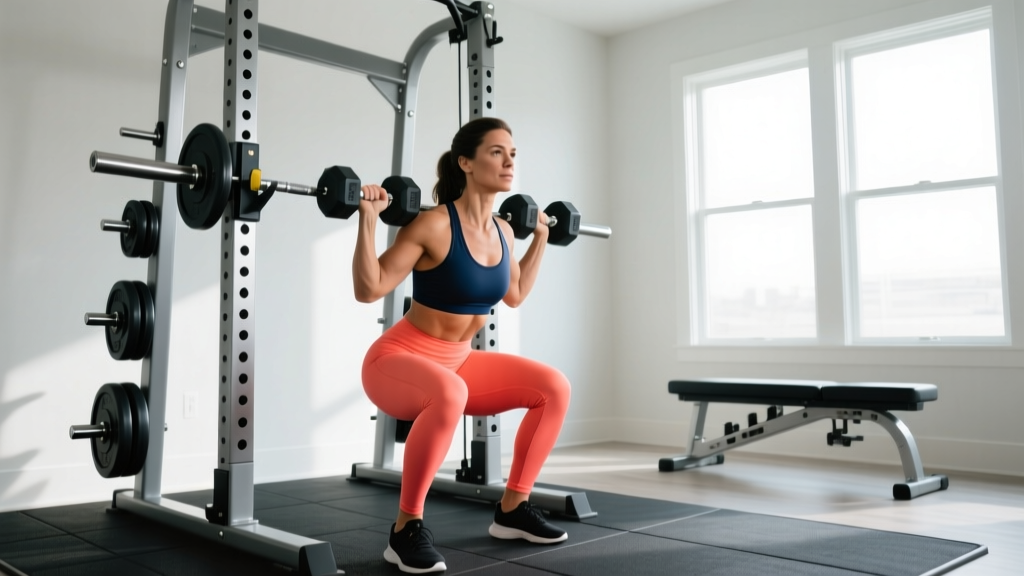
Power Rack vs Squat Stand: Female Dumbbell Gym Mistakes

Power Rack vs Squat Rack Setup: Tricep Workout With One Dumbbell

Rack Longevity: Storing the Biggest Dumbbell in the World
