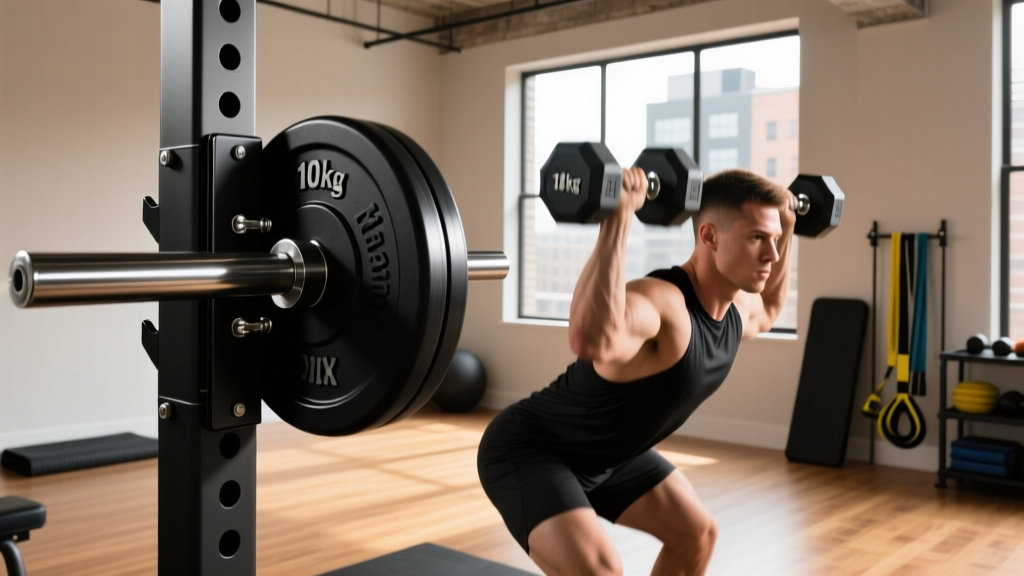
Olympic vs Standard Weight Plates & Best Ab Workouts with Dumbbells
Compare Olympic vs standard weight plates for your home gym, then master your core with our expert guide to the best ab workouts with dumbbells.

Building a comprehensive home gym in 2026 requires more than just buying the cheapest iron you can find. It demands a strategic approach to both your foundational loading equipment and your targeted accessory work. Two of the most common hurdles for home gym owners are choosing the right weight plate format for their racks and figuring out how to effectively train the core without relying on bulky cable machines. In this guide, we break down the critical differences between Olympic and standard weight plates, complete with real-world pricing and failure modes. Then, we transition to the mat for a masterclass on the best ab workouts with dumbbells to build bulletproof core stability.
The Foundation: Olympic vs Standard Weight Plates Decoded
The choice between standard and Olympic plates dictates the entire ecosystem of your gym—from the barbells you buy to the storage racks you install. While they may look similar to the untrained eye, their engineering, tolerances, and load capacities are worlds apart.
Standard Plates (1-Inch Bore)
Standard plates feature a 1-inch (25.4mm) center hole and are designed to fit on lightweight, solid steel or hollow-core barbells. In 2026, the market is flooded with two main types of standard plates: cast iron and cement-filled vinyl.
- Cast Iron (e.g., CAP Barbell): Priced between $1.50 and $2.00 per pound. These are durable, relatively compact, and ideal for light-to-moderate home use.
- Cement-Filled Vinyl (e.g., Yes4All): Priced around $1.00 to $1.25 per pound. While budget-friendly, they are incredibly bulky—taking up up to 30% more volume per pound than iron—and prone to cracking if dropped.
Olympic Plates (2-Inch Bore)
Olympic plates feature a 2-inch (50.6mm) center hole, designed for Olympic barbells with rotating sleeves. This rotation is crucial; as biomechanical analyses from Stronger By Science highlight, rotating sleeves reduce torque on the lifter's wrists and forearms during dynamic movements like cleans and snatches.
- Cast Iron / Deep Dish: $2.00 to $3.00 per pound. Excellent for powerlifting where bar whip and deadlift geometry matter.
- Rubber Bumper Plates: $2.50 to $3.50 per pound. Made with a durometer rating usually between 88A and 90A, allowing them to be dropped safely from overhead.
- Calibrated Steel (e.g., Eleiko, Rogue): $4.50 to $6.00+ per pound. These guarantee a strict 1% weight tolerance, essential for competitive lifters.
Head-to-Head Comparison Matrix
| Feature | Standard Plates | Olympic Plates |
|---|---|---|
| Hole Diameter | 1 inch (25.4mm) | 2 inches (50.6mm) |
| Barbell Compatibility | Solid/Hollow fixed bars | Olympic bars (bushing/bearing) |
| Max Safe Load | ~250 lbs (bar dependent) | 700 to 1,500+ lbs |
| Drop Tolerance | Low (will crack floors/plates) | High (specifically bumpers) |
| Average Cost (2026) | $1.00 - $2.00 / lb | $2.50 - $5.00+ / lb |
Decision Framework: Matching Plates to Your Goals
Do not buy standard plates if you plan to lift over 200 lbs. The cost savings are quickly negated by the need to replace bent bars and the lack of resale value. Olympic plates are the undisputed standard for serious lifters. However, if you are outfitting a low-budget apartment gym strictly for high-rep floor presses, goblet squats, and light isolation work, a set of standard cast-iron plates paired with adjustable dumbbells is a space-saving, cost-effective compromise.
The Core Connection: Best Ab Workouts with Dumbbells
Once your rack is loaded with the right Olympic plates for heavy compound lifts, it is time to address the core. Heavy squats and deadlifts build isometric core strength, but targeted hypertrophy and multi-planar stability require direct work. According to core stabilization protocols outlined by ACE Fitness, the abdominal wall must be trained through anti-extension, anti-rotation, and lateral flexion. Here are the best ab workouts with dumbbells to achieve exactly that.
1. The Dumbbell Pull-Through (Anti-Rotation)
This movement forces your obliques and transverse abdominis to resist rotational forces while maintaining a rigid plank.
- Setup: Assume a high plank position with a 15–25 lb dumbbell placed on the floor just outside your left hand.
- Execution: Reach underneath your torso with your right hand, grab the dumbbell, and pull it across your body to the right side. Keep your hips completely square to the floor—imagine balancing a glass of water on your lower back.
- Prescription: 3 sets of 10 pulls per side. Use a 2-second pause at the top of each pull to maximize time under tension.
2. Asymmetric Weighted Dead Bugs (Anti-Extension)
The dead bug is a staple in physical therapy, but adding an asymmetric dumbbell load elevates it to an elite core builder.
- Setup: Lie supine on the floor. Hold a 20–30 lb dumbbell in your right hand, pressing it straight up toward the ceiling. Your left hand is empty, resting on your stomach to feel the engagement.
- Execution: Slowly lower your left leg and your right arm (the one holding the dumbbell) toward the floor. The offset weight forces your left oblique to work overtime to keep your ribs pinned to the floor.
- Prescription: 3 sets of 8 reps per side, utilizing a strict 3-1-1 tempo (3 seconds down, 1 second pause, 1 second up).
3. Single-Arm Suitcase Carry (Lateral Flexion)
Recommended heavily by the National Strength and Conditioning Association (NSCA) for functional core stability, the suitcase carry builds the quadratus lumborum (QL) and obliques.
- Setup: Grab a heavy dumbbell (40–60 lbs for beginners, 80+ lbs for advanced lifters) in one hand. Stand tall with your shoulders perfectly level.
- Execution: Walk slowly for 30 to 40 yards. Do not let the weight drag you down to one side. Brace your core as if preparing for a punch.
- Prescription: 4 sets per arm, resting 60 seconds between sets. Focus on heel-to-toe walking mechanics to challenge your pelvic stabilizers.
Expert FAQ: Plates and Core Training
Can I use 1-inch to 2-inch adapters for my Olympic plates?
Yes, you can buy plastic or steel bushing adapters that slip onto a standard 1-inch bar to accept Olympic plates. However, this is a temporary hack. The standard bar itself will still lack the tensile strength and rotating sleeves required for safe, heavy lifting, making it a dangerous setup for anything beyond light floor work.
How heavy should my dumbbell be for ab workouts?
The core responds best to a mix of high-rep endurance and heavy, low-rep stability work. For anti-rotation movements like pull-throughs, use a moderate weight (15–25 lbs) that allows for perfect hip alignment. For carries and weighted dead bugs, push closer to your 10-rep max for upper body pressing to truly challenge the deep stabilizers.
More gear to consider
All reviews
Bumper vs Iron Plates: 2026 Trends & Dumbbell Chest Press Analytics
Dumbbell Kickbacks Form: Rubber Hex vs Urethane Dumbbells Reviewed

Best Loadable Dumbbells for the Dumbbell Flye: 2026
Collar & Clamp Comparison: Best Exercises for Lats with Dumbbells

Fix Your Dumbbell Cossack Squat: Adjustable Dumbbell Review