Power Rack vs Squat Rack vs Stand: Close-Grip Dumbbell Bench Press
Compare power racks, squat racks, and stands to find the safest setup for the close-grip dumbbell bench press and heavy barbell lifts in 2026.

When outfitting a home gym, most lifters obsess over barbell clearances and pull-up bar heights. However, the true test of a rack's versatility often lies in its compatibility with heavy dumbbell movements. The close-grip dumbbell bench press is a premier triceps and inner-pectoral builder, but it presents unique spatial and safety challenges that expose the flaws in poorly designed gym equipment. If your upright spacing is too wide or your spotter arms are too short, a failed rep doesn't just mean a missed lift—it means a 100-pound dumbbell crashing into your sternum.
In this 2026 buying guide, we dissect the structural differences between power racks, squat racks, and squat stands, using the biomechanics and safety requirements of the close-grip dumbbell bench press as our ultimate stress test.
The Biomechanical Challenge of the Close-Grip Dumbbell Bench Press
Unlike a standard barbell bench press where the hands are fixed and the bar rests on J-cups, dumbbell pressing requires independent stabilization, a deeper range of motion (ROM), and a specific elbow tuck. According to biomechanical analyses from ExRx.net, bringing the dumbbells closer together shifts the mechanical load heavily onto the triceps brachii and the clavicular head of the pectoralis major, while reducing anterior deltoid strain.
However, this tucked elbow position changes the spatial footprint of the lift. Your elbows drop lower and track closer to your torso, meaning the dumbbells travel in a narrower, deeper arc. If you are using a rack with wide uprights and short safety spotter arms, the safeties will not intersect the path of the dumbbells. Furthermore, the American Council on Exercise (ACE) emphasizes that controlling the eccentric phase of the dumbbell press is critical for hypertrophy, meaning you must have a reliable fail-safe to push to absolute muscular failure safely.
Power Racks (Full Cages): The Gold Standard for Dumbbell Safety
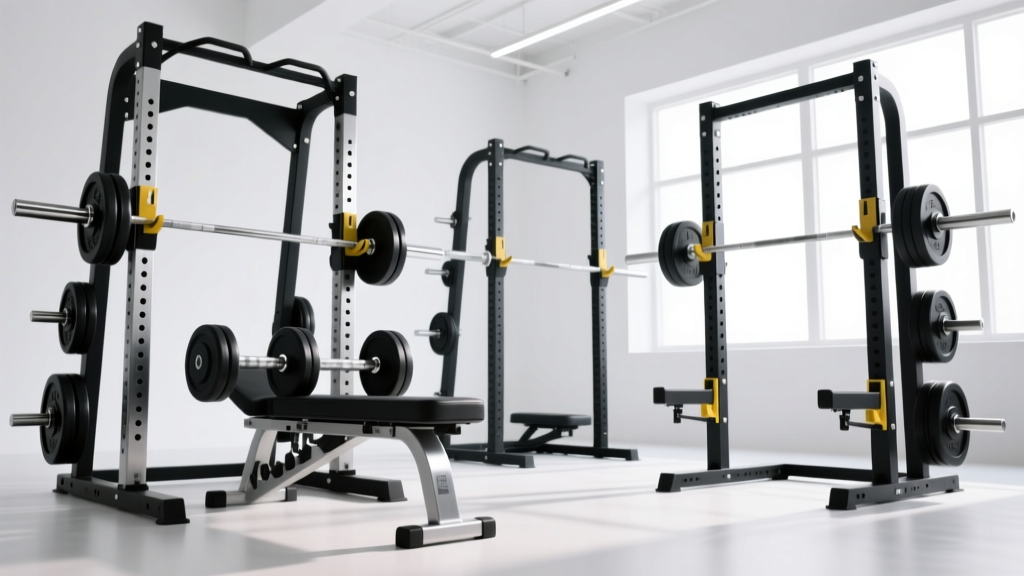
Power racks, characterized by four main uprights and a fully enclosed cage, are the undisputed champions of heavy dumbbell training. In 2026, the standard interior width for premium power racks (like the Rogue RML-390F or Titan T-3) remains 24 inches, with depths ranging from 24 to 30 inches.
Why Power Racks Excel for Dumbbells
- Long Spotter Arms: Full cages utilize 24-inch or longer spotter straps/arms that span the entire interior width, guaranteeing they will catch a dropped dumbbell regardless of your grip width.
- Bench Alignment: The 24-inch interior width perfectly accommodates standard 12-inch to 14-inch wide flat benches, leaving 5 to 6 inches of clearance on either side for your elbows to drop without scraping the uprights.
- Kickback Clearance: The 30-inch depth of modern cages allows you to sit the bench far enough back to safely kick heavy dumbbells into position without hitting the front uprights.
The Drawback: Footprint and cost. A 3x3 footprint power rack with 11-gauge steel and Westside hole spacing will cost between $800 and $1,400 in 2026, and it demands a dedicated 48x60 inch floor space.
Squat Racks (Half Racks): Balancing Footprint and Function
Squat racks (or half racks) typically feature two main front uprights and a rear stabilization crossmember. They are favored by lifters with low ceilings or limited square footage. Models like the Rep Fitness PR-1100 or Bells of Steel Residential Half Rack dominate this space.
For the close-grip dumbbell bench press, half racks present a specific edge case: upright placement. Many budget half racks place the uprights 42 to 48 inches apart on the exterior. If you place a bench inside, the spotter arms must reach inward. A standard 17-inch spotter arm on a 44-inch wide rack leaves a 10-inch gap in the center. Because the close-grip dumbbell bench press keeps the weights close to your chest, a missed rep will fall directly through that 10-inch gap, rendering the safeties useless.
How to Fix the Half Rack Gap
If you own a half rack and want to perform this movement safely, you must invest in extended 24-inch spotter arms or use a rack with adjustable uprights that can be slid inward to a 24-inch interior width before benching. Always verify the pin-and-pipe safety compatibility before purchasing a half rack for dumbbell work.
Squat Stands: The Minimalist Trap for Dumbbell Pressing
Squat stands are essentially two independent metal posts. They are incredibly affordable (often $200–$350) and easy to fold away. However, they are fundamentally hostile to heavy dumbbell pressing.
- No Rear Stability: When you aggressively kick 80-pound dumbbells back to start your set, the backward momentum can easily tip unanchored squat stands forward.
- Safety Strap Limitations: While you can drape a nylon safety strap between the stands, the strap will sag in the middle. A dropped dumbbell during a close-grip press will push the strap down, potentially allowing the weight to strike your ribs before the strap catches.
- Width Issues: Stands are usually set at 49 inches apart to allow for barbell racking. This is far too wide to provide meaningful dumbbell spotting without specialized, expensive cross-members.
Expert Warning: Never perform heavy, failure-set dumbbell pressing inside standard squat stands without a dedicated human spotter. The geometry simply does not support independent weight failure.
2026 Comparison Matrix: Rack Dimensions vs. Dumbbell Utility
| Rack Type | Standard Interior Width | Spotter Arm Efficacy for DBs | Avg. 2026 Price Range | Footprint |
|---|---|---|---|---|
| Power Rack (Cage) | 24 inches | Excellent (Full coverage) | $800 - $1,500 | 48" x 60" |
| Half Rack | 24" to 44" (Varies) | Moderate (Requires long arms) | $450 - $900 | 48" x 48" |
| Squat Stand | 49 inches (Exterior) | Poor (High failure risk) | $200 - $400 | 48" x 36" |
The Spotter Arm Edge Case: Avoiding Sternum Strikes
Even if you own a premium power rack, improper spotter arm placement will ruin the close-grip dumbbell bench press. Because your hands are close together, your elbows tuck tightly to your lats. If you set your spotter arms at the same height as your barbell bench press, they will intercept your elbows before the dumbbells reach the bottom of the ROM, effectively cutting your range of motion in half.
The 'Two-Inch Drop' Setup Method
To safely execute this movement to failure, use the following setup protocol:
- Position the Bench: Center the bench inside the rack so your eyes are directly under the barbell J-cups.
- Determine Bottom ROM: Lie back with empty dumbbells, tuck your elbows, and lower the weights until they lightly touch your outer chest. Note where your elbows are in space.
- Set the Safeties: Adjust the spotter arms so they sit exactly two inches below the lowest point of your dumbbell trajectory.
- The Angle Trick: If your rack allows for angled spotter arms (like the Titan T-3 flip-down safeties), angle them slightly downward toward the center of the bench. This creates a 'V' cradle that naturally guides a slipping dumbbell away from your torso and into the safety pin.
Final Decision Framework: Which Rack Should You Buy?
Choosing the right equipment comes down to your primary training modality and spatial constraints.
Buy a Power Rack If:
You regularly perform heavy dumbbell presses, require pull-up bar integration, and have a dedicated 20+ square foot area. The 24-inch interior width is non-negotiable for safe close-grip dumbbell bench pressing without a human spotter.
Buy a Half Rack If:
You have an 8-foot ceiling or need to store the bench inside the rack footprint. Ensure you purchase a model with adjustable uprights or extended 24-inch spotter arms to close the center gap for dumbbell safety.
Buy Squat Stands If:
You are strictly a barbell squatter and deadlifter on a tight budget. If you insist on dumbbell pressing, you must limit the weight to what you can safely drop to the floor, or always train with a spotter.
Ultimately, the close-grip dumbbell bench press is an invaluable tool for arm and chest development, but it demands respect for spatial geometry. By selecting a rack with the correct interior dimensions and utilizing extended safety mechanisms, you can push your triceps to absolute failure in 2026 with total peace of mind.
More gear to consider
All reviews
Loadable Dumbbell Care for One-Arm Dumbbell Overhead Extensions

Budget Breakdown: Loadable Bench Flyes Dumbbells vs. Fixed Sets

2026 Trends: 10 Pound Dumbbell vs Cast Iron & Comp Kettlebells

Breakdown: Equip Bands Essentials — Resistance Band Specifications, Real-World Testing, and Functional Integration

Loadable Dumbbell Care: Surviving the Leg Press with Dumbbells