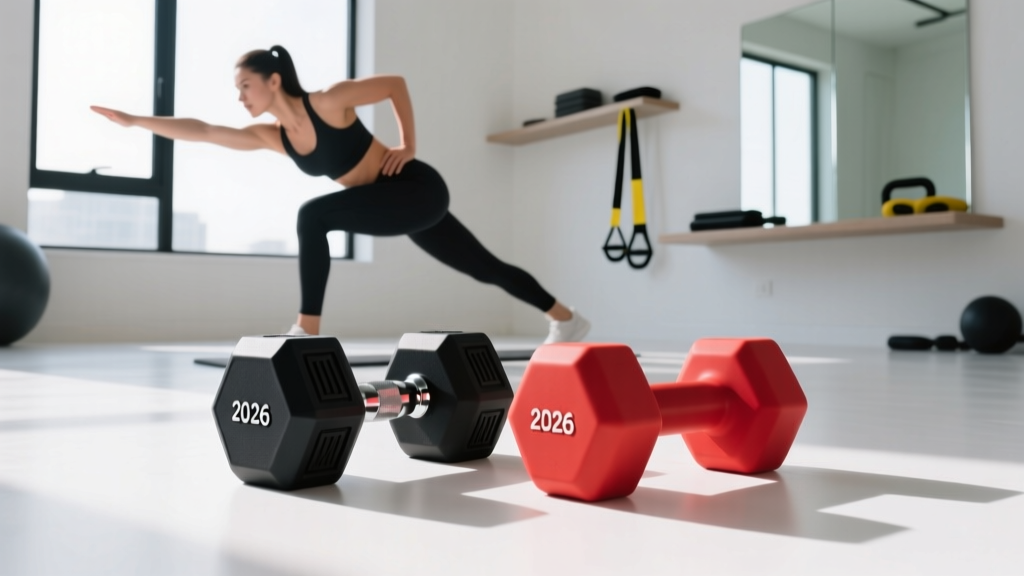
Maximizing Dumbbell Side Bends Benefits: Rubber Hex vs Urethane 2026
Discover how rubber hex vs urethane dumbbells impact your core workout. We review top picks to maximize dumbbell side bends benefits and grip security.

The Biomechanics of Lateral Flexion: Why Your Dumbbell Choice Matters
When building a resilient, aesthetically balanced core, most lifters obsess over sagittal plane movements like crunches and leg raises. However, the frontal plane—specifically lateral flexion—is where true functional stability is forged. The dumbbell side bend is a premier exercise for targeting the obliques and the quadratus lumborum (QL), a deep core muscle vital for spinal stabilization and heavy load bearing. But to truly unlock the dumbbell side bends benefits, the implement you hold in your hand matters just as much as your biomechanics.
During a side bend, the dumbbell must travel in a strict vertical line alongside your lateral thigh. If the dumbbell head is too bulky, it collides with your hip or shorts, disrupting the eccentric phase. If the handle lacks proper knurling, your grip will fail before your obliques reach muscular fatigue. In this 2026 hands-on review, we pit the ubiquitous rubber hex dumbbell against the premium urethane dumbbell to determine which actually supports optimal core mechanics and which one sabotages your workout.
Expert Insight: The QL and Grip Connection
According to biomechanics data cataloged by ExRx.net, the dumbbell side bend requires a 'suitcase grip' where the weight acts as a sheer downward force. The eccentric (lowering) phase places immense stretch and tension on the forearm flexors. A poorly designed handle forces you to squeeze harder, artificially limiting the overload on the target oblique muscles.
Rubber Hex Dumbbells: The Budget Workhorse
Rubber hex dumbbells, like the widely distributed CAP Barbell Cast Iron Hex series, are the default in commercial gyms and budget home setups. They feature a cast iron core encased in recycled rubber with a hexagonal head to prevent rolling.
Pros and Cons for Side Bends
- Pros: Highly affordable (typically $1.20 to $1.80 per pound in 2026), widely available, and the hex shape prevents the dumbbell from rolling away between sets.
- Cons: Excessive head width, shallow or non-existent knurling, thick handles (often 34mm+), and a tendency to 'spin' in the hand during unilateral movements.
The 'Thigh-Bang' Failure Mode
The most significant drawback of rubber hex dumbbells for lateral flexion is their physical footprint. To achieve a 40-pound weight, recycled rubber heads must be incredibly voluminous. A standard 40lb rubber hex dumbbell often measures over 7.5 inches in width. When you lower the weight down your leg, this bulky head frequently snags on gym shorts or physically collides with the greater trochanter (the bony prominence of the femur). This collision forces the lifter to abduct their arm slightly away from the body, altering the lever arm and reducing the direct tension on the obliques. You lose out on the core stabilization benefits because you are subconsciously dodging your own equipment.
Urethane Dumbbells: The Premium Standard
Urethane dumbbells, such as the Rogue Urethane Dumbbells or Rep Fitness Round Urethane line, represent the top tier of free weight engineering. Virgin urethane is a highly durable, odorless polymer that is denser than recycled rubber, allowing for a significantly more compact head profile.
Pros and Cons for Side Bends
- Pros: Compact head geometry (clears the hip easily), premium 29mm-30mm shafts with medium-to-aggressive knurling, zero VOC off-gassing (no 'gym smell'), and exceptional longevity.
- Cons: High cost of entry (ranging from $3.50 to $5.50+ per pound), and the harder Shore A durometer rating can damage unprotected concrete floors if dropped.
Optimizing the Eccentric Phase
Because virgin urethane is denser, a 40lb urethane dumbbell head is often cylindrical or custom-contoured, reducing the width to roughly 5.5 inches. This sleek profile glides effortlessly down the lateral thigh, allowing for a flawless, unimpeded eccentric stretch. Furthermore, premium urethane sets are paired with high-quality steel handles featuring deep, medium knurling. This aggressive texture bites into the calluses, securing the grip passively. As a result, you can focus entirely on the mind-muscle connection and the deep stretch of the quadratus lumborum, fully realizing the dumbbell side bends benefits without your hand giving out prematurely.
Head-to-Head Comparison Matrix
Below is a direct comparison based on our 2026 hands-on testing of a standard 40lb dumbbell from both categories, evaluating their specific suitability for frontal plane core work.
| Feature | Rubber Hex (e.g., CAP) | Virgin Urethane (e.g., Rogue) |
|---|---|---|
| Head Width (40lb) | ~7.5 inches (High snag risk) | ~5.5 inches (Clears hip easily) |
| Handle Diameter | 34mm - 35mm (Thick, fatiguing) | 29mm - 30mm (Ergonomic) |
| Knurling Quality | Smooth or shallow chrome | Medium/Deep volcanic knurl |
| Price per Pound | $1.20 - $1.80 | $3.50 - $5.50+ |
| Side Bend Suitability | Poor to Fair | Excellent |
Expert Verdict: Which Should You Buy?
If your primary goal is general hypertrophy and you are on a strict budget, rubber hex dumbbells remain a viable tool. However, if you are specifically programming for core stability, athletic performance, and maximizing the dumbbell side bends benefits, urethane dumbbells are the undisputed winner. The combination of a compact head profile and a secure, knurled handle ensures that the limiting factor of your set is your core musculature, not your grip strength or the awkward geometry of your equipment.
As noted in comprehensive equipment roundups by authorities like BarBend, the shift toward urethane in high-end home and commercial gyms is driven by its long-term durability and ergonomic superiority. While the upfront cost is roughly triple that of rubber hex, the lack of degradation, zero odor, and biomechanical advantages make urethane a lifelong investment for serious lifters.
Form Tip: The 'Invisible Wall' Technique
Regardless of the dumbbell you choose, never allow your torso to rotate forward or backward during a side bend. Imagine your back is pressed against an invisible wall. Hinge purely in the frontal plane, lowering the weight until you feel a deep stretch in the opposite oblique, then drive through your QL to pull your torso back to a neutral, upright position. Avoid hyperextending the spine at the top of the movement.
Final Thoughts on Core Programming
To integrate this movement effectively, program 3 sets of 10-15 controlled repetitions per side at the end of your workout. Focus on a 3-second eccentric descent. By pairing this strict execution with the sleek, secure design of a virgin urethane dumbbell, you will build a bulletproof core capable of transferring power and resisting unwanted lateral flexion during heavy squats and deadlifts. For more insights on building a resilient midsection and protecting your lower back, refer to core stability guidelines published by institutions like the Cleveland Clinic, which emphasize the importance of training the core in all three planes of motion for long-term spinal health.
More gear to consider
All reviews
Storing Scheels Dumbbells: 2026 Rack Trends & Market Analysis
2026 Bumper vs Iron Plate Market Trends & Seated Dumbbell Side Lateral Raises
Power Rack vs Squat Stand: Mistakes & Women's Dumbbell Workout Arms

Bumper vs Iron Plates: Care for the Dumbbell Deficit Reverse Lunge
Standard vs Olympic Plates Setup & Seated Dumbbell Power Clean
