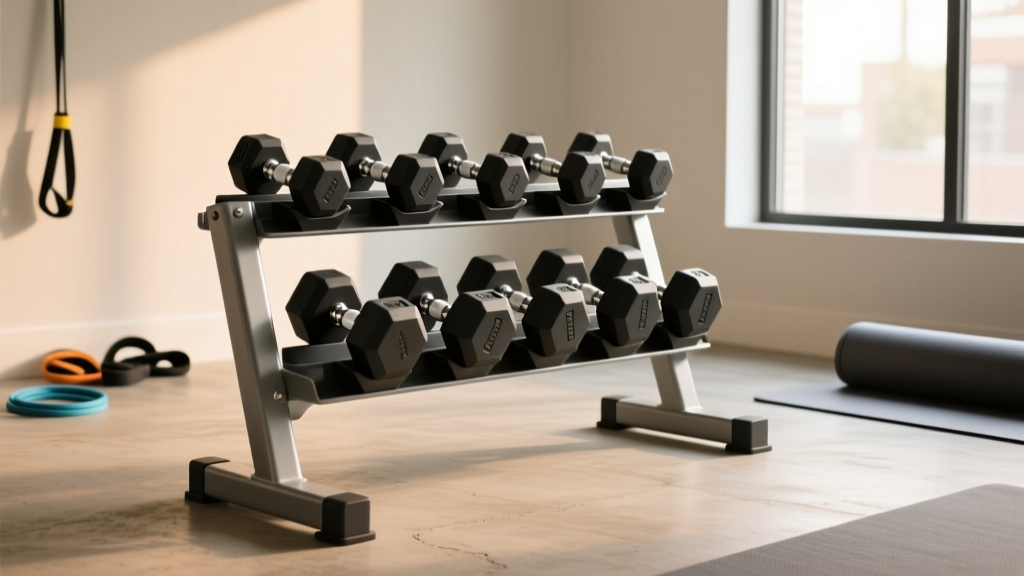
Are Dumbbell Flys Good? Budget Dumbbell Racks & Storage Analysis
Discover if dumbbell flys are worth it and explore our budget breakdown of the best dumbbell racks and storage solutions for your home gym.

The Biomechanics of the Fly & The Storage Problem
If you have ever found yourself asking, are dumbbell flys good for chest development, the short answer from a biomechanical standpoint is an emphatic yes. Recent research published on PubMed highlights that training muscles at long muscle lengths (the deep stretch at the bottom of a fly) induces superior stretch-mediated hypertrophy compared to shortened ranges of motion. The dumbbell fly remains one of the most effective tools for isolating the pectoralis major without the tricep fatigue associated with heavy pressing.
However, executing flys properly requires a precise weight ladder. Because the movement relies on leverage and places immense shear stress on the shoulder joint at the bottom of the arc, you cannot simply jump from 25-pound dumbbells to 40-pound dumbbells. You need micro-progressions: 20s, 25s, 30s, 35s, and 40s.
Owning five to ten pairs of dumbbells creates an immediate logistical problem. Leaving them scattered across your garage floor destroys the flooring, degrades the dumbbell coatings, and creates a severe tripping hazard. This brings us to the true bottleneck of building a free-weight sanctuary: budgeting for the right dumbbell rack and storage solution.
Expert Insight: The 'Drop Zone' Danger
When finishing a grueling set of flys, your grip is fatigued. The National Strength and Conditioning Association (NSCA) emphasizes controlled re-racking to prevent equipment damage and injury. Cheap, lightweight racks often shift or tip when a 40-pound dumbbell is dropped onto the top tier, turning a storage solution into a projectile hazard.
Material Matters: How Your Dumbbells Dictate Your Rack
Before breaking down the budget tiers, you must match your rack style to your dumbbell material. The storage market in 2026 is largely divided by two tray types: flat shelves and contoured saddles.
- Hex Rubber Dumbbells: These require flat-shelf racks. The hexagonal shape prevents rolling, but the rubber edges are prone to chipping if slammed onto metal saddle racks. Flat shelves distribute the weight across the entire side of the dumbbell head.
- Round Urethane Dumbbells: Urethane is denser, more durable, and resistant to UV degradation, but it will roll off a flat shelf. You must budget for saddle-style racks (UHMW plastic or steel contours) that cradle the round heads securely.
Budget Breakdown: 3 Dumbbell Rack Tiers Analyzed
Tier 1: The A-Frame & Vertical Solutions (Under $150)
For tight spaces and smaller collections (4 to 6 pairs, up to 50 lbs), the A-Frame is the default budget choice. The Titan Fitness A-Frame Dumbbell Rack retails for approximately $149.99. It features a 22" x 22" footprint, taking up just 3.4 square feet of floor space.
The Value Proposition: You are paying for verticality. However, the 14-gauge steel construction means it lacks the mass to absorb kinetic energy. Failure Mode: If you place your heaviest dumbbells on the top tier while the bottom tier is empty, the center of gravity shifts dangerously high, creating a tipping hazard during dynamic re-racking.
Tier 2: The 3-Tier Horizontal Standard ($250 - $450)
This is the sweet spot for 90% of home gym owners. The horizontal 3-tier rack holds 10 pairs of dumbbells (up to 100 lbs each) and keeps the center of gravity low.
Let us compare the two market leaders:
- Rep Fitness 3-Tier Dumbbell Rack (~$299): Built from 12-gauge steel with a 2x3" upright profile. It utilizes a flat-shelf design, making it ideal for hex rubber dumbbells. It offers a 48" x 28" footprint.
- Rogue 3-Tier Dumbbell Rack (~$395): As noted in the Rogue Fitness equipment specifications, this unit is constructed from heavy-duty 11-gauge steel with 3x3" uprights. It includes laser-cut UHMW plastic saddle trays, specifically designed to protect premium round urethane dumbbells from scratching and scuffing.
The Value Proposition: The Rogue rack costs roughly 32% more upfront, but the 11-gauge steel and UHMW saddles eliminate the need for aftermarket tray liners, offering superior long-term ROI for those investing in expensive urethane iron.
Tier 3: Wall-Mounted & Modular Saddle Systems ($400 - $600+)
If your floor space is entirely consumed by a power rack and lifting platform, wall-mounted storage is the ultimate space hack. Systems like the Fringe Sport Wall-Mounted Dumbbell Hangers or custom DIY lag-bolt solutions cost between $150 and $300 for the hardware, but require significant installation labor.
The Catch: You must mount these directly into 16-inch on-center wooden studs or solid masonry. Drywall anchors will fail catastrophically under the 400+ lb dynamic load of a full dumbbell set. Furthermore, retrieving heavy dumbbells from wall hangers requires awkward lateral lifting, which can strain the lower back if not executed with proper hip-hinge mechanics.
Value Analysis Matrix: Cost & Footprint Efficiency
To determine true value, we must look beyond the sticker price and calculate the Cost Per Pound of Storage Capacity and the Footprint Efficiency (pounds of iron stored per square foot of floor space).
| Rack Model | Est. Price (2026) | Max Capacity | Footprint | Efficiency (lbs/sq ft) |
|---|---|---|---|---|
| Titan A-Frame | $149 | 500 lbs | 3.4 sq ft | 147 lbs/sq ft |
| Rep 3-Tier (Flat) | $299 | 800 lbs | 9.3 sq ft | 86 lbs/sq ft |
| Rogue 3-Tier (Saddle) | $395 | 1,000 lbs | 9.3 sq ft | 107 lbs/sq ft |
| Wall-Mount (2-Tier) | $220 | 600 lbs | 0.0 sq ft | Infinite (Wall) |
The Synthesis: While the A-Frame wins on raw spatial efficiency, it fails on total capacity. The Rogue 3-Tier justifies its premium price tag by offering a massive 1,000 lb capacity, future-proofing your gym if you eventually add heavy 75lb and 100lb pairs for pressing movements.
Edge Cases & Assembly Failure Modes
When evaluating budget equipment, the hidden costs often lie in assembly and long-term wear. Here are the most common failure modes we see in home gym storage setups:
1. The 'Sway' Effect on Budget Racks
Many sub-$200 horizontal racks omit a rear cross-brace to save on manufacturing and shipping costs. Without this diagonal or horizontal stabilizer, the rack will sway laterally every time you drop a heavy dumbbell onto the top tier. Over time, this swaying loosens the carriage bolts, requiring monthly maintenance with a socket wrench. Solution: If buying a budget rack without a rear brace, zip-tie or bolt the rear legs to a wall stud or adjacent squat rack.
2. Tray Degradation in Unclimate-Controlled Garages
If your gym is in a garage that experiences freezing winters and humid summers, avoid racks with cheap, hard-plastic injection-molded trays. These become brittle in the cold and crack under the impact of a 50-pound dumbbell. Always look for racks featuring UHMW (Ultra-High-Molecular-Weight) polyethylene liners or bare, powder-coated steel saddles.
3. The Hex-Head Wedge
If you use rubber hex dumbbells on a rack designed for round heads (or vice versa), the mismatched geometry causes the dumbbells to wedge tightly into the trays. Over time, the friction tears the rubber coating off the dumbbell heads, leaving ugly black streaks on your equipment and exposing the raw iron core to rust.
Final Verdict: Maximizing Your Home Gym ROI
So, are dumbbell flys good? They are an irreplaceable tool for chest hypertrophy, provided you have the correct weight increments to safely navigate the strength curve. But buying the dumbbells is only half the battle.
If you are on a strict budget under $150 and only own lighter weights (under 40 lbs), the Titan A-Frame provides adequate, space-saving storage. However, if you are building a comprehensive free-weight arsenal that includes heavy pairs for presses and precise pairs for flys, the Rep Fitness 3-Tier offers the best balance of structural integrity, footprint, and price. For those who refuse to compromise on equipment longevity and own premium urethane dumbbells, the Rogue 3-Tier Saddle Rack remains the undisputed gold standard, turning a messy pile of iron into a commercial-grade display.
More gear to consider
All reviews
EZ Curl Bar vs Straight Bar: Arm Strength for the Dumbbell Get Up

Cast Iron vs Competition Kettlebells: Beyond the Lying Dumbbell Press

Olympic vs Standard Plates: Beyond the Dumbbell Back Workout Routine

Budget Dumbbell Racks for the Ultimate Arm Workout Using Dumbbells

Neoprene Dumbbell Setup: The Best Tricep Dumbbell Exercise
