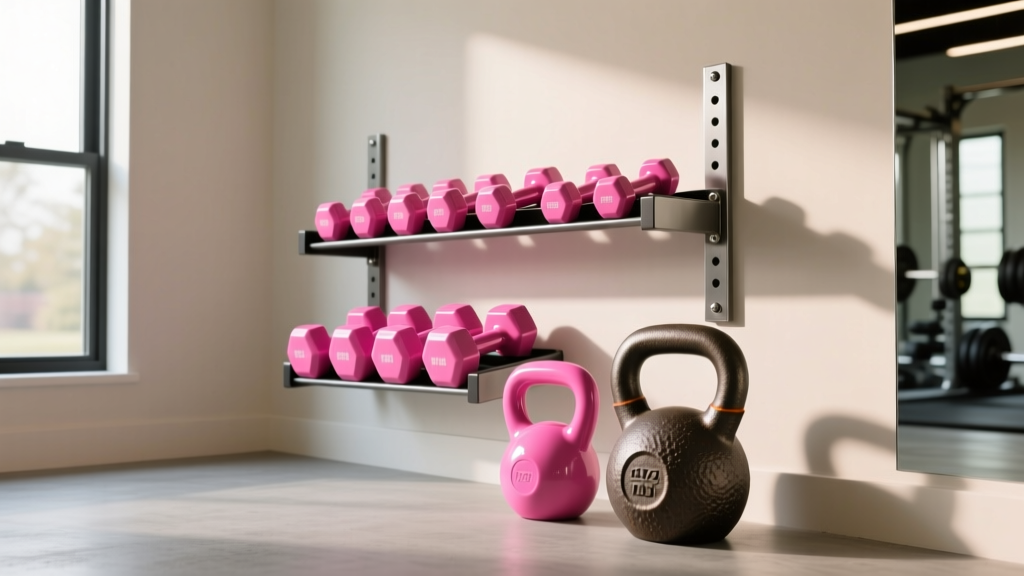
Space-Saving Layouts: Kettlebells & Pink Dumbbell Set With Rack
Optimize your home gym layout with our spatial guide to cast iron vs. competition kettlebells and integrating a pink dumbbell set with rack.

The Spatial Dilemma: Cast Iron vs. Competition Kettlebells
Designing a highly functional home gym in 2026 requires more than just buying the right equipment; it demands a rigorous approach to spatial geometry and layout optimization. When outfitting a compact garage gym or basement fitness space (typically ranging from 150 to 300 square feet), the physical footprint of your free weights dictates your movement flow, safety clearances, and storage efficiency. Nowhere is this more apparent than in the kettlebell buying guide debate: cast iron vs. competition kettlebells.
While many buyers focus solely on handle texture or price, the dimensional variance between cast iron and competition bells fundamentally alters how you design your storage racks and floor zones. According to the dimensional standards outlined by StrongFirst, the physical architecture of the bell dictates its spatial behavior during complex movements like snatches or tactical lunges, as well as how it nests on a storage shelf.
The Cast Iron Footprint
Cast iron kettlebells, such as those offered by Rogue Fitness, are manufactured using a traditional sand-cast or gravity-cast process. Their primary spatial characteristic is variable scaling. As the weight increases, the bell diameter, handle thickness, and overall height grow proportionally. An 8kg cast iron bell might measure 210mm in height, while a 24kg bell can exceed 280mm. This creates a tapered footprint that complicates uniform rack storage and requires adjustable shelving or staggered floor layouts to prevent wasted cubic volume.
The Competition Standard
Conversely, competition kettlebells (detailed extensively in the Kettlebell Kings Size Guide) adhere to strict, uniform dimensional standards regardless of weight. Whether you are holding an 8kg or a 32kg steel competition bell, the dimensions remain locked at approximately 280mm x 280mm x 280mm, with a standardized 33mm or 35mm handle diameter. From a layout design perspective, this uniformity is a dream for space optimization, allowing for perfectly symmetrical rack configurations and predictable floor clearances for juggling or partner-passing drills.
Footprint Analysis & Rack Compatibility Matrix
To effectively plan your gym layout, you must map the storage requirements of your chosen kettlebell style. The following matrix breaks down the spatial implications for a standard 5-bell set (8kg, 12kg, 16kg, 20kg, 24kg).
| Feature | Cast Iron Kettlebell Set | Competition Kettlebell Set | Space & Layout Impact |
|---|---|---|---|
| Bell Dimensions | Variable (grows with weight) | Uniform (280mm cube) | Competition allows uniform shelf depth; Cast Iron requires staggered racks. |
| Handle Horn Width | Narrower, scales with weight | Wider, standardized for two-handed clearance | Competition bells require 10-12 inches of lateral clearance per bell on vertical racks. |
| Shelf Depth Required | 10" to 14" (tapered) | 12" (uniform) | Cast iron wastes vertical space on deep shelves; competition maximizes cubic efficiency. |
| Floor Drop Zone | Irregular bounce/roll patterns | Predictable flat-bottom stability | Competition bells require smaller safety perimeters in tight multi-use zones. |
Designing the Accessory Zone: Vertical Storage Solutions
A truly optimized home gym layout separates heavy, dynamic ballistic movements from controlled, isolation-based hypertrophy work. While kettlebells dominate the floor space for swings, cleans, and goblet squats, the accessory zone requires a completely different spatial strategy focused on verticality and visual zoning.
When mapping out the isolation and rehab corner of a compact 200-square-foot garage gym, vertical storage is paramount. Rather than letting 5lb to 15lb neoprene or urethane weights clutter the floor and create trip hazards during dynamic movements, incorporating a pink dumbbell set with rack serves a dual purpose. First, it maximizes vertical cubic volume by utilizing a tiered A-frame or wall-mounted shelving unit, keeping the floor entirely clear. Second, in the psychology of gym design, the vibrant color acts as a deliberate visual anchor, clearly demarcating the "light accessory and mobility zone" from the industrial, heavy-iron "ballistic zone." This color-coded spatial organization ensures that lighter implements are always returned to their designated footprint, maintaining the flow and safety of the primary workout area.
Layout Pro-Tip: Visual ZoningIn compact spaces, visual clutter creates physical clutter. Using a highly visible pink dumbbell set with rack for your warm-up, rotator-cuff, and cool-down zone trains your brain to associate that specific corner with mobility and isolation, keeping heavy traffic confined to the center drop zone.
The 3-Zone Compact Gym Floorplan
To synthesize the spatial differences between cast iron, competition bells, and tiered dumbbell racks, implement this 3-zone floorplan designed for a standard 10x20 foot garage gym bay.
Zone 1: The Ballistic Drop Zone (Center)
- Dimensions: 6ft x 8ft clear floor space.
- Equipment: Competition kettlebells (uniform flat bottoms prevent erratic rolling if dropped).
- Layout Rule: Maintain a 3-foot swing radius clearance from all walls and power rack uprights. Do not place storage racks in this zone; use a corner-mounted gravity rack to keep the floor entirely flush.
Zone 2: The Heavy Strength & Rack Zone (Perimeter)
- Dimensions: 4ft x 8ft footprint against the primary load-bearing wall.
- Equipment: Power rack, barbell, and cast iron kettlebells.
- Layout Rule: Cast iron bells are ideal here for heavy goblet squats and front rack lunges where the bell is held, not swung. Store them on a heavy-duty, staggered shelf attached directly to the power rack uprights to eliminate the need for a freestanding KB rack, saving 4 square feet of floor space.
Zone 3: The Isolation & Mobility Anchor (Corner)
- Dimensions: 3ft x 4ft footprint.
- Equipment: Yoga mats, resistance bands, and your tiered pink dumbbell set with rack.
- Layout Rule: Position this zone near a window or secondary lighting source. The A-frame rack should face inward toward the center of the room to allow for easy grab-and-go access without requiring the user to step into the heavy drop zone.
Flooring & Clearance Metrics
Space optimization is incomplete without addressing the Z-axis (flooring thickness) and its impact on equipment clearance. Standard 3/4-inch horse stall mats are the industry standard, but they add significant weight and alter the effective height of your pull-up bars and rack shelves.
"When calculating shelf heights for kettlebell storage, always measure from the top of your rubber flooring mat, not the concrete subfloor. Failing to account for 3/4-inch matting can result in bottom-shelf competition bells scraping the rubber, causing premature wear on the steel and making them difficult to slide out of the rack."
— Home Gym Engineering Best Practices, 2025
Step-by-Step Clearance Verification
- Measure the Matting: Confirm the exact thickness of your rubber tiles or rolled mats (typically 0.75" to 0.80").
- Calculate Bell Height: Add the mat thickness to the height of your largest cast iron kettlebell (e.g., 280mm bell + 20mm mat = 300mm total clearance needed).
- Set Shelf Spacing: For uniform competition bells, set all rack shelves at exactly 13 inches apart. For cast iron, utilize a pegboard-style storage wall rather than horizontal shelves, allowing the variable heights to hang freely without wasting vertical airspace.
- Verify the Horn Gap: Ensure lateral spacing on horizontal shelves is at least 11 inches center-to-center to accommodate the wider horns of competition bells and prevent knuckle-scraping during retrieval.
Final Thoughts on Spatial Efficiency
Choosing between cast iron and competition kettlebells is ultimately a decision about how you interact with your space. If your layout relies on modular, uniform storage and predictable floor mechanics, competition steel is the superior choice for spatial harmony. If you prefer a rugged, traditional aesthetic and utilize pegboard or staggered storage solutions, cast iron remains a viable, cost-effective option. By pairing your heavy kettlebell selection with intelligent vertical storage solutions—like a color-coded pink dumbbell set with rack for the accessory zone—you transform a cramped garage into a highly engineered, multi-zone performance facility.
More gear to consider
All reviews
Are Iron Grip Dumbbells in KG or LBS? Adjustable Set Troubleshooting

Cast Iron vs Competition Kettlebells vs Lat Exercises Using Dumbbells
Best Adjustable Dumbbells for a Fast Dumbbell Workout (2026)

Dumbbell Curtsy Lunges: Form Fixes & Olympic vs Standard Plate Guide
Bumper vs Iron Plate Care & How to Build Triceps Using Dumbbells
