Space-Saving Deltoid Dumbbell Setups: Rubber Hex vs Urethane
Optimize your home gym layout with our guide to rubber hex vs urethane dumbbells. Discover space-saving storage and deltoid dumbbell clearance tips.

The Spatial Dilemma: Designing a Compact Free Weight Zone
When designing a high-performance home gym in 2026, spatial optimization is the ultimate bottleneck. Whether you are converting a 10x10 spare bedroom or a tight two-car garage, every square inch of floor space must be justified. The choice between rubber hex and urethane dumbbells extends far beyond mere aesthetics or budget—it directly dictates your storage infrastructure, floor plan, and movement clearance. This spatial relationship becomes critically important when programming a high-volume deltoid dumbbell routine. Shoulder isolation and compound movements demand significant lateral and vertical wingspan, meaning your equipment layout must accommodate both the physical footprint of the gear and the biomechanical envelope of the athlete.
In this comprehensive layout guide, we break down the material science, dimensional footprints, and storage requirements of rubber hex versus premium urethane dumbbells. By understanding how these tools interact with your environment, you can engineer a space-optimized free weight zone that maximizes functionality without compromising on heavy-duty performance.
Material Science & Footprint: Rubber Hex vs. Urethane
To optimize a layout, you must first understand the physical geometry and material properties of the equipment. Rubber hex dumbbells, such as the widely available CAP Barbell Cast Iron Hex (Model #SDH), feature a six-sided head encased in recycled rubber vulcanized with sulfur. This hexagonal geometry is a dream for flat-shelf storage; the flat edges allow the dumbbells to sit flush against one another, enabling high-density stacking on standard steel shelving units.
Conversely, premium urethane dumbbells—like the Rogue Urethane Dumbbells or Rep Fitness Urethane line—utilize a specialized polyurethane elastomer. Urethane is vastly superior in terms of durability, odor elimination, and floor protection. However, urethane heads are frequently manufactured in 12-sided or perfectly round profiles to reduce the risk of chipping on sharp hex corners. While round or 12-sided profiles are ergonomically pleasing, they are a nightmare for flat shelving. They require specialized tiered, angled racks to prevent rolling and ensure safe retrieval, which inherently increases the floor footprint of your storage solution.
| Feature | Rubber Hex (e.g., CAP Barbell) | Premium Urethane (e.g., Rogue/Rep) |
|---|---|---|
| Average Cost (per lb) | $1.50 - $2.20 | $4.50 - $6.50 |
| Head Geometry | 6-Sided Hexagon | Round or 12-Sided |
| Optimal Storage Type | Flat Horizontal Shelves | Angled Tiered A-Frame / 3-Tier Rack |
| Floor Footprint (5-50lb Set) | ~12 sq. ft. (Wall shelves possible) | ~18 sq. ft. (Floor rack required) |
| Off-Gassing / Odor | High (Requires ventilation) | Zero (Apartment friendly) |
Optimizing Layouts for Deltoid Dumbbell Movements
When executing a strict deltoid dumbbell movement, spatial awareness is just as critical as the weight itself. The shoulder joint operates across three planes of motion, and the exercises required to fully develop the anterior, lateral, and posterior deltoids demand expansive clearance. If your storage racks are positioned poorly, you risk striking the equipment mid-rep or altering your biomechanics to avoid obstacles.
Clearance Specs for Deltoid Training
- Standing Lateral Raises: Requires a minimum of 96 inches of lateral clearance. The average male wingspan is 72 inches; adding two 12-inch dumbbell heads means you need an 8-foot wide empty zone.
- Seated Arnold Press: Requires 48 inches of lateral clearance and 84 inches of vertical clearance to prevent ceiling strikes at full lockout.
- Bent-Over Reverse Flys: Requires a 60-inch posterior clearance zone to ensure the dumbbell heads do not clip your storage rack during the eccentric phase.
To accommodate these spatial demands in a compact room, you must push your storage infrastructure to the perimeter. According to guidelines highlighted by Garage Gym Reviews, utilizing vertical wall space is the most effective way to reclaim floor area for complex movements. By mounting flat shelving on the walls, you create a centralized 'dead space' in the room specifically reserved for wide-stance deltoid and lateral movements.
Storage Solutions: Wall-Mounted vs. Floor Racks
Your choice of dumbbell material will directly dictate your storage hardware, which in turn defines your room's layout.
The Rubber Hex Advantage: Wall-Mounted Flat Shelves
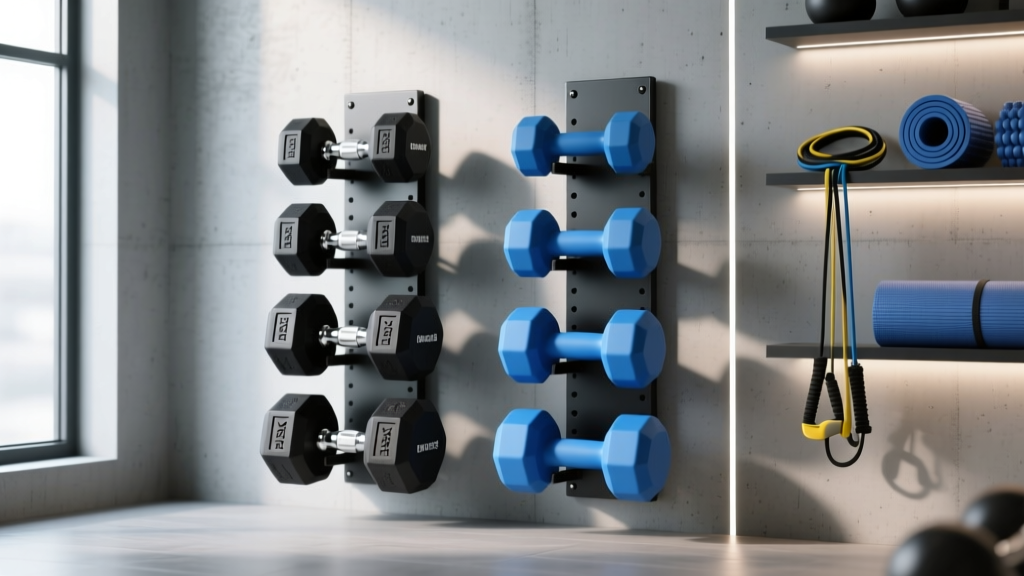
Because rubber hex dumbbells feature flat edges, they can be safely stored on heavy-duty, wall-mounted flat shelves. Products like the Rogue Wall Mount Dumbbell Shelves or generic heavy-duty steel brackets bolted directly into 16-inch on-center wooden wall studs can hold immense weight. A full set of 5 to 50-pound rubber hex dumbbells weighs approximately 660 pounds. Distributing this across three 48-inch wide wall shelves (220 lbs per shelf) completely eliminates the floor footprint of the rack. This layout strategy is unparalleled for apartment gyms or narrow garages where every inch of depth matters.
'By moving 660 pounds of rubber hex iron onto the wall, you instantly reclaim a 48x24 inch floor rectangle. In a 10x10 room, that represents nearly 8% of your total usable floor space returned to your training area.'
The Urethane Reality: Floor-Standing Tiered Racks
Urethane dumbbells, particularly round or 12-sided variants, cannot be safely stacked on flat wall shelves without custom 3D-printed saddles or specialized retaining lips. They require floor-standing 3-tier horizontal racks or A-frame vertical racks. A standard 3-tier rack, such as the Titan Fitness 3-Tier Dumbbell Rack, measures 48 inches wide by 24 inches deep. While this consumes 8 square feet of floor space, the angled shelves position the dumbbell handles at an ergonomic 30-degree tilt, making weight changes seamless during high-intensity drop sets. If you opt for urethane, you must place the rack in a corner or against a flat wall, ensuring the 96-inch lateral clearance zone for lateral raises is maintained in the center of the room.
Real-World Failure Modes in Compact Gyms
When optimizing layouts, athletes often overlook environmental failure modes that degrade equipment over time. Understanding these edge cases is vital for long-term gym planning.
- Rubber Dry Rot and Off-Gassing: Rubber hex dumbbells are notorious for off-gassing volatile organic compounds (VOCs) and sulfur odors. In a poorly ventilated, compact spare bedroom, this odor can become overwhelming. Furthermore, in non-climate-controlled garages where humidity fluctuates above 60%, the rubber coating can eventually dry rot, flake, and leave black residue on your floors and hands.
- Urethane Handle Loosening: While urethane heads are virtually indestructible, the friction-welded or bolted handles can loosen if repeatedly dropped on bare concrete. If your compact layout does not leave room for thick horse stall mats (typically 4x6 feet and 3/4-inch thick), dropping urethane dumbbells will eventually compromise the handle integrity and damage your subfloor.
- Wall Stud Shear Force: A critical failure mode in wall-mounted flat shelf layouts is mounting into drywall anchors rather than structural studs. The dynamic load of racking a 50-pound dumbbell creates a shear force that will rip drywall anchors out instantly. Always use lag bolts driven at least 2.5 inches into wooden studs or use toggle bolts rated for 300+ lbs in masonry walls.
Final Verdict: Which Belongs in Your Layout?
The decision between rubber hex and urethane dumbbells ultimately hinges on your spatial constraints, ventilation, and budget. If you are designing a hyper-compact apartment gym or a narrow garage where reclaiming floor space for expansive deltoid dumbbell routines is paramount, rubber hex dumbbells on wall-mounted flat shelves offer an unbeatable spatial advantage. You sacrifice some aesthetic appeal and must manage the initial off-gassing, but the zero-floor-footprint storage is transformative.
However, if you have a dedicated 20x20 garage gym, prioritize indoor air quality, and possess the budget for premium gear, urethane dumbbells housed on a floor-standing 3-tier rack are the undisputed champions of durability and ergonomics. By mapping your biomechanical clearance zones first, and selecting your storage hardware second, you can build a free weight layout that supports heavy, uncompromised training for decades to come.
More gear to consider
All reviews
Rubber Hex vs Urethane: Is the Round Dumbbell Set Obsolete?

Cast Iron vs Competition Kettlebell Care & Dumbbells at Academy Sports

Collar vs Clamp: Securing Bars for the One Dumbbell Tricep Extension

Overhead Shoulder Press Dumbbells vs Barbells: Collar Safety Guide

Squat Stand vs Power Rack: Dumbbell Deadlift to Upright Row Setup
