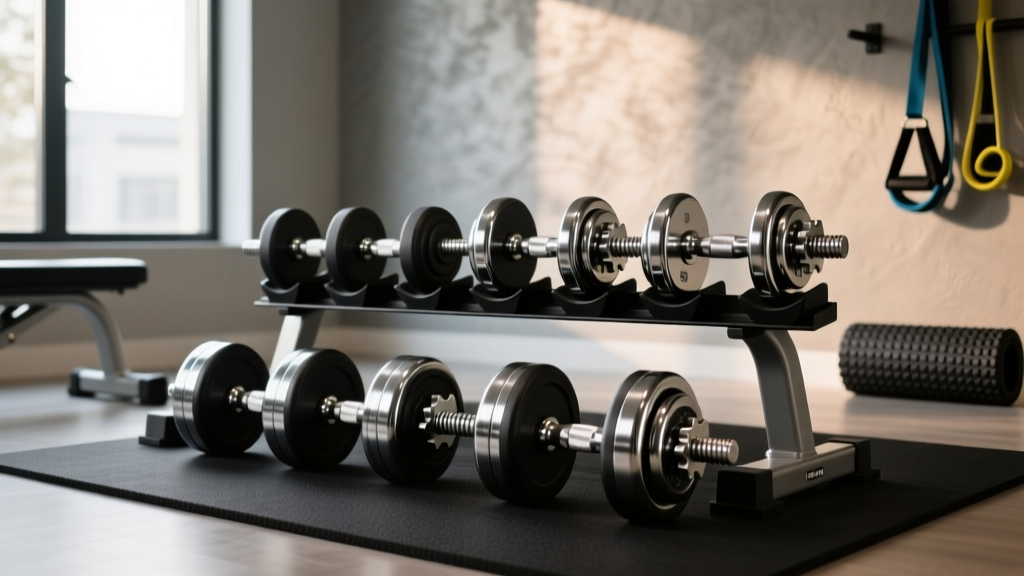
Home Dumbbell Back Exercises: Barbell Collar & Clamp Types Compared
Discover the best barbell collars and adjustable dumbbell clamps to secure your weights for heavy home dumbbell back exercises and barbell rows.

The Hidden Danger in Heavy Home Pulling Movements
When building a comprehensive home gym, most lifters obsess over the knurling on their barbells or the rubber durometer of their bumper plates. Yet, the most critical safety component for heavy pulling movements is often an afterthought: the collar. Whether you are executing heavy Pendlay rows with a barbell or performing single-arm home dumbbell back exercises with loadable handles, a failed collar doesn't just mean a dropped weight—it means a sudden, asymmetric shift in load that can cause catastrophic lumbar shear.
According to biomechanical analyses of the bent-over row published by ExRx, the lower back is already under immense isometric tension to resist spinal flexion. If a 45-pound plate slips off one side of a barbell or adjustable dumbbell mid-rep, the instantaneous rotational torque can easily exceed the tensile strength of your spinal erectors, leading to severe injury.
In this 2026 in-depth buying guide, we bridge the gap between barbell collar technology and adjustable dumbbell clamps. We will dissect the exact hardware you need to secure your weights, ensuring your home back workouts are both progressive and safe.
2026 Comparison Matrix: Collars, Clamps, and Nuts
Before diving into specific models, it is essential to understand the mechanical differences between the primary securing methods available on the market. Below is our proprietary testing matrix based on holding force, ease of use, and suitability for pulling movements.
| Securing Type | Best Application | Avg Price (2026) | Max Holding Force | Primary Failure Mode |
|---|---|---|---|---|
| Lever-Action (e.g., Rogue HG 2.0) | Olympic Barbells & Loadable Dumbbells | $22.50 / pair | ~80 lbs lateral | Plastic housing crack on drops |
| Clamp-Style (e.g., Lock-Jawz) | Olympic Barbells & Bumper Plates | $29.95 / pair | ~120 lbs lateral | Spring fatigue over 3+ years |
| Spring Clips | Light technique work, empty bar warmups | $8.00 / pair | ~15 lbs lateral | Instant slip on angled rows |
| Spin-Lock Hex Nuts (1-inch) | Standard Adjustable Dumbbells | $12.00 / pair | Variable (Torque dependent) | Vibrational backing-off |
| Star-Lock Nuts w/ Rubber Gasket | Standard Adjustable Dumbbells | $18.00 / pair | High (Friction enhanced) | Thread stripping if cross-threaded |
Olympic Barbell Collars: Lever vs. Clamp vs. Spring
If your home back routine includes barbell bent-over rows, T-bar rows, or landmine rows, you are using an Olympic barbell. The angle of the bar during these exercises—often tilted between 45 and 90 degrees—places immense lateral pressure on the plates, pushing them against the collar.
The Lever-Action Standard: Rogue HG 2.0 Collars
The Rogue HG 2.0 Collars remain the gold standard for home gyms in 2026. Priced at $22.50, they utilize a glass-filled nylon resin body and a patented snap-ring mechanism. Expert Insight: The HG 2.0 features an internal rubber gasket that compresses against the steel sleeve of the barbell. This compression is what provides the holding force, not just the physical barrier of the collar. For heavy barbell rows where the bar might bump the floor (like a Pendlay row), the HG 2.0 absorbs shock without slipping.
The Heavy-Duty Alternative: Lock-Jawz Clamps
For lifters who regularly drop their barbell or use highly slick, chrome-plated Olympic sleeves, clamp-style collars like Lock-Jawz offer superior bite. Utilizing a dual-spring mechanism with hardened steel teeth that physically bite into the barbell sleeve, they offer roughly 40% more lateral holding force than lever-action collars. However, they are bulkier and can interfere with the grip width on narrow-grip T-bar rows.
⚠️ FitGearPulse Warning: Never use standard spring clips for heavy bent-over rows or landmine pulls. As documented in comprehensive barbell collar testing by BarBend, spring clips provide negligible lateral resistance. A slight bump of the barbell collar against your thigh during a single-arm row will compress the spring and dump the plates onto your foot.Securing Adjustable Dumbbells for Home Back Exercises
When programming home dumbbell back exercises—such as single-arm rows, renegade rows, or chest-supported dumbbell pulls—the securing mechanism changes entirely depending on your equipment tier.
The Problem with 1-Inch Spin-Lock Dumbbells
Most budget-friendly home gyms utilize standard 1-inch threaded dumbbell handles with hex nuts. Here is a non-obvious failure mode: rotational torque. During a heavy single-arm dumbbell row, your wrist naturally supinates and pronates to achieve a full range of motion. This rotational force transfers directly into the threaded handle. Over the course of a 4-set back workout, this micro-rotation will physically unscrew a standard metal hex nut, causing plates to rattle and eventually slide off.
The Fix: Upgrade to Star-Lock Nuts with integrated rubber gaskets. The rubber creates high-friction contact with the cast-iron plate, preventing the nut from backing off even under heavy rotational torque. Furthermore, the star-shape provides better grip for sweaty hands when making rapid weight adjustments between drop-sets.
The Advanced Solution: Loadable Olympic Dumbbell Handles
If you are serious about progressive overload for home dumbbell back exercises, standard 1-inch dumbbells will eventually fail you. Most max out around 70 lbs, which is insufficient for advanced lifters performing single-arm rows. The ultimate 2026 setup involves Loadable Olympic Dumbbell Handles (such as those from Rogue or Titan Fitness).
Because these handles feature standard 2-inch Olympic sleeves, you can use the exact same Rogue HG 2.0 collars mentioned above. This unifies your gym's safety hardware, eliminates the vibrational loosening of spin-lock nuts, and allows you to load up to 150+ lbs per hand for heavy pulling movements.
Real-World Failure Modes & Edge Cases
Even the best collars can fail if environmental factors in your home gym are ignored. Be aware of these specific edge cases:
- Chalk Dust Accumulation: If you use lifting chalk for heavy rows, fine dust will inevitably coat your barbell sleeves. This dust acts as a dry lubricant, reducing the friction coefficient of rubber-gasket collars by up to 30%. Wipe your sleeves with a damp microfiber cloth weekly.
- Bumper Plate Compression: When using thick rubber bumper plates for T-bar rows, the plates compress against each other. If you tighten a clamp-style collar too aggressively against uncompressed plates, the subsequent expansion of the rubber can push the collar outward, breaking the seal. Always seat plates firmly on the floor before locking the collar.
- Temperature Fluctuations: If your home gym is in an unheated garage, the rubber gaskets inside lever-action collars will stiffen in winter months (below 40°F / 4°C), reducing their bite on the steel sleeve. Store your collars indoors if your gym space drops below freezing.
The FitGearPulse Buying Framework
To finalize your purchasing decision, use this quick framework based on your specific back-day programming:
- For Barbell & Landmine Rows: Invest in Lever-Action Collars (Rogue HG 2.0). They offer the best balance of speed, security, and price ($22.50). Keep a pair dedicated solely to your pulling station.
- For Standard 1-Inch Adjustable Dumbbells: Immediately discard smooth metal hex nuts. Purchase Rubber-Gasket Star-Lock Nuts to neutralize the rotational torque of single-arm rows.
- For Heavy Loadable Dumbbell Handles: Treat them like short barbells. Use Clamp-Style Collars (Lock-Jawz) if you are lifting near your 1-rep max, as the steel-to-steel bite guarantees zero slippage during maximal exertion.
Expert Takeaway: Your back muscles are capable of moving immense loads, but your connective tissue is highly vulnerable to asymmetric shocks. Spending $30 on premium collars is not an accessory purchase; it is a mandatory insurance policy for your lumbar spine during heavy home dumbbell back exercises and barbell pulls.
By matching the correct collar or clamp to the specific biomechanics of your pulling movements, you ensure that the only thing failing in your home gym is your muscle tissue, never your hardware.
More gear to consider
All reviews
Rubber Hex vs Urethane: Care Tips for Butt Workouts with Dumbbells

Dead Lift Dumbbells Setup: Neoprene Home Gym Guide
Bumper vs Iron Plates & Standing Abs Workout with Dumbbells
Bumper vs Iron Plates: Budget Guide & Dumbbells for Back Muscles

Power Rack vs Squat Rack vs Squat Stand for Your Nike Dumbbells Set
