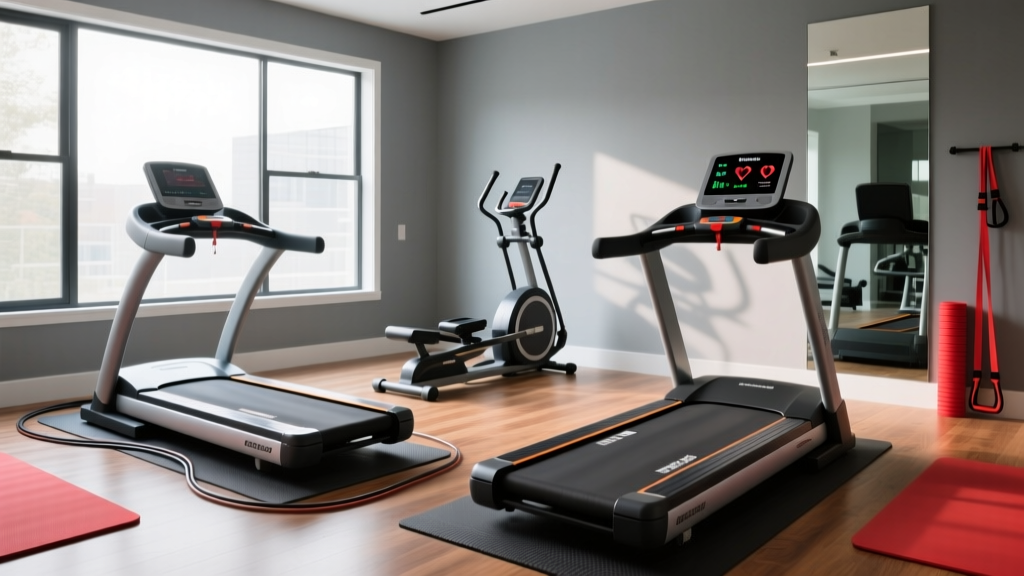
Curved vs Motorized Treadmill Setup: Elliptical vs Treadmill Calories
Master your home gym layout with our curved vs motorized treadmill setup guide, covering clearances, wiring, and the elliptical vs treadmill calories debate.

The Blueprint: Curved Manual vs. Motorized Treadmill Installation
Setting up a high-end cardio zone in 2026 requires more than just unboxing a machine and plugging it into the nearest wall outlet. The choice between a curved manual treadmill (like the $3,299 AssaultRunner Elite) and a motorized powerhouse (like the $2,799 NordicTrack 2450) fundamentally alters your room's spatial, electrical, and environmental requirements. As a senior equipment technician, I have overseen hundreds of home gym installations. This comprehensive walkthrough will guide you through the exact clearances, wiring protocols, and subfloor preparations required for both machine types, while addressing how metabolic output dictates your gym's environmental layout.
Phase 1: Spatial Clearances and Structural Load
Curved and motorized treadmills occupy space differently. Motorized models require massive longitudinal clearance for the deck and the motor hood, while curved models trade length for height and concentrated weight distribution.
The Curved Treadmill Footprint
Because they lack a front motor housing, curved treadmills are surprisingly compact in length. The TrueForm Runner ($3,495) measures 63 inches long and 31 inches wide. However, the rear curve requires specific overhead clearance. More importantly, curved treadmills are incredibly dense. The AssaultRunner Elite weighs in at a staggering 320 lbs. Unlike motorized models that distribute weight across a long frame, a curved treadmill concentrates this mass—and the dynamic impact force of a sprinting user—into a 4-square-foot area. Installation Rule: If installing on a second-floor wooden subfloor, ensure your floor joists are spaced 16 inches on-center (OC) and consider adding cross-bridging to prevent micro-fractures over time.
The Motorized Treadmill Footprint
Motorized treadmills demand length. The Sole F80 ($1,199) boasts an 82-inch footprint, and the NordicTrack 2450 spans 81 inches. Critical Clearance Warning: When a motorized treadmill reaches its maximum 15% incline, the rear deck elevates by nearly 12 inches. For a 6-foot-tall user, you need a minimum ceiling height of 8 feet 6 inches to prevent head strikes during high-incline walking. Curved treadmills do not incline, meaning standard 8-foot ceilings are perfectly adequate.
⚠️ Setup Warning: Incline HeadroomNever place a motorized treadmill with a 12%+ incline capability directly beneath a ceiling fan or low-hanging pendant light. The dynamic vertical movement of the user plus the deck elevation creates a severe strike hazard.
Phase 2: Electrical Wiring and Circuit Isolation
This is where the installation paths diverge drastically.
- Curved Manual Treadmills: Zero electrical setup required. Models like the Technogym Skillrun ($12,000+) use magnetic resistance and belt-friction systems, generating their own power for the console via internal dynamos. You can place them in the center of a room, facing a window, without worrying about cord routing.
- Motorized Treadmills: Require strict adherence to electrical codes. Under heavy load (e.g., a 220 lb user running at 8 mph on a 10% incline), a motorized treadmill can draw 15 to 20 amps continuously.
According to the National Electrical Code (NFPA 70), high-draw fitness equipment should be installed on a dedicated 15-amp or 20-amp circuit. Sharing a circuit with a space heater, air conditioner, or even a high-draw refrigerator will cause the breaker to trip mid-stride. Furthermore, avoid GFCI (Ground Fault Circuit Interrupter) outlets for motorized treadmills; the static electricity generated by the belt friction can cause nuisance tripping, abruptly stopping the belt and creating a fall hazard.
Phase 3: Metabolic Zoning and the Elliptical vs Treadmill Calories Reality
When mapping out your home gym's HVAC and ventilation zones, the ongoing elliptical vs treadmill calories debate actually plays a surprising role in equipment placement. Cardio machines generate vastly different amounts of human thermogenesis (body heat) and require distinct environmental support.
Biomechanical studies published in the National Center for Biotechnology Information (NCBI) demonstrate that running on a curved non-motorized treadmill requires up to 30% more energy expenditure and oxygen consumption compared to a standard motorized treadmill at the same speed. When we zoom out to the broader cardio landscape, the elliptical vs treadmill calories debate heavily favors the treadmill—specifically the curved manual variant, which forces intense posterior chain engagement and spikes core temperature far beyond what an elliptical cross-trainer demands.
"Because curved treadmills demand significantly more caloric output and generate higher core body temperatures, they must be positioned directly under a high-CFM ceiling fan or an HVAC return vent. Ellipticals, which burn fewer calories per minute and involve less vertical oscillation, can be safely relegated to lower-airflow corners of the gym."
Data from Harvard Health Publishing confirms that a 185-pound individual burns approximately 378 calories in 30 minutes on an elliptical, compared to 444 calories running at 5.2 mph on a treadmill. With curved manual treadmills increasing that metabolic demand by an additional 20-30%, your HVAC planning must account for localized heat islands. Install a dedicated smart thermostat sensor in the cardio zone to prevent the rest of your home from overcooling just to keep the treadmill user comfortable.
Phase 4: Subfloor Protection and Vibration Dampening
Do not place either machine directly on luxury vinyl plank (LVP) or engineered hardwood. The vibration from a motorized treadmill will cause micro-gaps in floating floors, while the horizontal sheer force of a curved treadmill sled-push will scratch and dent the finish.
| Machine Type | Primary Force Vector | Recommended Matting | Estimated Cost |
|---|---|---|---|
| Motorized (e.g., Sole F80) | Vertical Impact & Motor Vibration | 3/8" Recycled Rubber Mat | $60 - $90 |
| Curved Manual (e.g., TrueForm) | Horizontal Sheer & Concentrated Mass | 1/2" High-Durometer Vulcanized Rubber | $120 - $180 |
For curved treadmills, purchase a mat that extends at least 12 inches beyond the front and rear of the track. When users perform sled-push starts on an AssaultRunner, their feet often strike the ground slightly behind the machine before catching the belt. A standard 4x6 foot mat is insufficient; opt for a custom-cut 4x8 foot vulcanized rubber stall mat to protect your subfloor from aggressive traction forces.
Final Installation Checklist
Before running your first mile, verify the following installation metrics:
- Clearance Check: Minimum 24 inches of lateral space on both sides for emergency dismounts. Minimum 36 inches of clearance behind motorized treadmills to prevent wall-scuffing when the deck inclines.
- Leveling: Use a 48-inch digital level across the treadmill deck. Adjust the rear leveling feet until the bubble is perfectly centered. An unlevel curved treadmill will cause the belt to drift laterally during high-speed sprints.
- Console Calibration: For motorized models, run the automated belt-tension calibration sequence (usually found in the hidden engineering menu) before allowing users on the deck.
- Emergency Stop Tether: Mount the magnetic safety key lanyard to the handrail at hip height to ensure it doesn't drag on the belt during use.
By treating your cardio equipment installation as a structural and environmental project rather than a simple furniture delivery, you ensure the longevity of both your home and your high-end fitness gear. Whether you are pushing the limits on a curved manual sled or logging steady-state miles on a motorized deck, proper setup is the foundation of every great workout.
More gear to consider
All reviews
Horizon Treadmill Reviews T101: Small-Space Folding Test

Elliptical vs Treadmill Longevity: plae slat treadmill Upkeep Tips

Elliptical vs Treadmill: 12-3-30 Routine & How Many Days a Week?
Elliptical vs Treadmill: Echelon Stride 6s 10 Treadmill 2026 Data

Elliptical vs Treadmill for Home Cardio: Dog Treadmill Harness Safety
