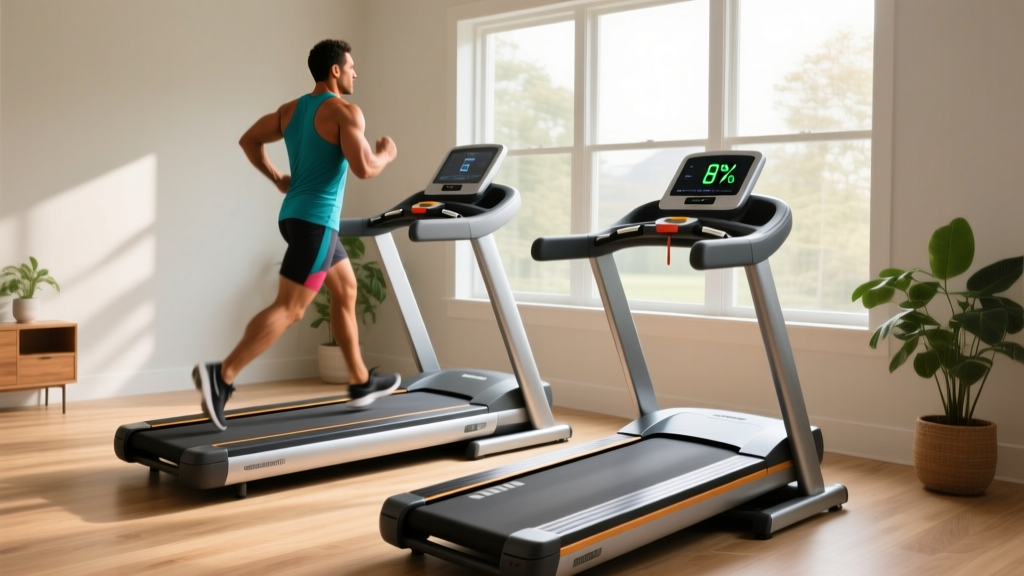
Pad vs Treadmill: Running on a Treadmill to Lose Weight How Long?
Compare walking pads and treadmills for weight loss. Discover common mistakes, hardware limits, and exactly how long you should train for results.

The Home Cardio Dilemma: Walking Pads vs. Traditional Treadmills
The home fitness landscape in 2026 has been entirely reshaped by the explosion of ultra-compact walking pads. But when your primary goal is fat loss, the hardware you choose dictates your physiological ceiling. Many buyers assume a $299 under-desk walking pad can replace a $600 traditional treadmill. This assumption leads to stalled progress, hardware burnout, and deep frustration. Before you commit to a daily grind, we need to address the most common search query in the cardio space: when running on a treadmill to lose weight how long do you actually need to exercise, and can a walking pad realistically support that protocol?
This guide cuts through the marketing fluff. We will break down the exact caloric math, compare the mechanical limitations of walking pads versus full-sized treadmills, and troubleshoot the critical form and hardware mistakes that are secretly sabotaging your weight loss journey.
The Core Question: Running on a Treadmill to Lose Weight How Long?
There is no universal 'magic number' for weight loss, but there is hard physiological math. To lose one pound of fat, you must create a caloric deficit of approximately 3,500 calories. According to the Centers for Disease Control and Prevention (CDC), adults aiming for significant weight loss should target 300 minutes of moderate-intensity aerobic activity or 150 minutes of vigorous-intensity activity per week.
When users ask about running on a treadmill to lose weight how long per session, the answer depends on your speed and incline. Data from Harvard Health Publishing indicates that a 155-pound person running at a moderate 5 mph (12 min/mile) burns roughly 288 calories in 30 minutes. If you increase that to a vigorous 6 mph (10 min/mile), that burn jumps to 360 calories per half-hour.
The Expert Formula for Duration
To achieve a 500-calorie daily deficit purely through cardio (without dietary restriction), a 155-lb individual must run at 6 mph for roughly 42 to 45 minutes daily. If you are walking at 3.5 mph on a flat surface, that duration stretches to 90+ minutes. This time-to-efficiency ratio is the single biggest differentiator between walking pads and standard treadmills.
Hardware Reality Check: Walking Pad vs. Standard Treadmill
To understand why your weight loss might be stalling, we must look at the mechanical specifications of the machines. Below is a direct comparison between a top-rated 2026 walking pad and a budget-friendly traditional treadmill.
| Specification | UREVO Strol 2E (Walking Pad) | Horizon Fitness T101 (Treadmill) |
|---|---|---|
| Price Range | $280 - $320 | $599 - $649 |
| Motor Type | 2.5 Peak HP | 3.0 Continuous HP (CHP) |
| Max Speed | 6.0 mph (with handrail up) | 10.0 mph |
| Incline | 0% (Fixed Flat) | 0% - 15% Motorized |
| Belt Dimensions | 40' L x 16' W | 55' L x 20' W |
| Weight Capacity | 240 lbs | 300 lbs |
| Ideal Use Case | NEAT accumulation, light walking | Vigorous running, interval training |
The lack of incline and the restricted belt length on the walking pad physically prevent the high-intensity, long-stride running required to maximize caloric burn in shorter time windows.
4 Common Mistakes Sabotaging Your Weight Loss
Whether you own a compact pad or a folding treadmill, poor biomechanics and flawed programming will halt your progress. Here are the most frequent errors we see in home cardio setups.
1. The 'Handrail Lean' on Walking Pads
Gripping the handrails and leaning backward while walking or jogging on a treadmill transfers up to 30% of your body weight off the belt and onto the machine's frame. This drastically reduces your metabolic equivalent of task (MET) output. The Fix: If you must hold on at 5+ mph, the speed is too high for your current fitness level. Drop the speed to 3.5 mph, pump your arms, and engage your core.
2. Ignoring the Incline Deficit
Walking pads are locked at a 0% grade. Walking on a flat surface burns significantly fewer calories than walking on an incline. The Fix: If your budget or space restricts you to a flat walking pad, invest in a 10-pound weighted vest (such as the CAP Barbell Adjustable Vest, approx. $45). Adding 5-10% of your body weight via a vest mimics the metabolic demand of a 5-8% treadmill incline without requiring a longer belt or larger motor.
3. Stride Chopping on Short Belts
A 40-inch walking pad belt forces users with a natural stride to 'chop' their steps when speeds exceed 3.5 mph. This alters your gait, reduces glute activation, and can lead to anterior knee pain. The Fix: Restrict walking pad use to Zone 2 steady-state walking (2.0 - 3.5 mph) and save your running intervals for outdoor routes or a full-sized treadmill.
4. Overestimating Console Calorie Counts
Treadmill and walking pad consoles notoriously overestimate caloric expenditure by 15% to 25% because they use generic algorithms based on a 170-lb male. The Fix: Use a chest-strap heart rate monitor (like the Polar H10) paired with a smartwatch to track active calories based on your specific VO2 max and heart rate zones.
Troubleshooting Hardware & Form Failures
Beyond human error, the machines themselves require maintenance to support a rigorous weight loss protocol. Ignoring these mechanical realities leads to mid-workout failures.
Belt Slippage and Tensioning
On budget walking pads, the belt will often slip or stutter during heel strike after 40+ hours of use. This happens as the belt stretches and the tension drops. Troubleshooting: Locate the two hex-key bolts on the rear roller caps. Using the included Allen wrench, turn both bolts exactly one-quarter (1/4) turn clockwise. Test the machine at 3 mph. Do not overtighten, as this will cause the motor to overwork and trip the thermal fuse.
Motor Thermal Cutoff Trips
Walking pads advertise '2.5 Peak HP', but their continuous output is often closer to 1.0 HP. If a 200-lb user jogs at 5 mph on a walking pad for 45 minutes, the motor generates excessive heat. Most budget boards feature a thermal cutoff switch that will abruptly kill the power at 104°F (40°C) to prevent a fire. Troubleshooting: If your pad shuts off mid-run, it is not broken; it is overheating. Unplug it, let it cool for 30 minutes, and restrict continuous jogging sessions to 20-minute blocks.
Pro-Tip for 2026 Buyers: Always look for Continuous Horsepower (CHP), not Peak HP. A 2.5 CHP motor on a Horizon or Sole treadmill can sustain a 180-lb runner at 7 mph for hours without thermal throttling, whereas a 2.5 Peak HP walking pad will struggle to maintain speed under heavy, sustained loads.
The Expert Verdict: Structuring Your Weekly Protocol
If your ultimate goal is weight loss, time efficiency is paramount. Mayo Clinic experts consistently emphasize that sustainable weight loss requires a combination of dietary management and consistent, progressive cardiovascular overload.
If you only have space for a Walking Pad: You must compensate for the lack of speed and incline with duration and frequency. Aim for three 45-minute sessions daily (morning, lunch break, evening) to accumulate your 10,000+ steps and achieve the necessary caloric burn without overheating the motor.
If you have a Traditional Treadmill: Leverage the incline and speed. Perform 30-minute sessions, 4 days a week, utilizing the '12-3-30' method (12% incline, 3 mph, for 30 minutes) or high-intensity interval training (HIIT) to trigger excess post-exercise oxygen consumption (EPOC), keeping your metabolism elevated long after the machine is turned off.
Ultimately, the machine is only a tool. Understanding the biomechanical limits of your hardware and the exact mathematical requirements of your body is the only way to guarantee your time spent running or walking translates into lasting results.
More gear to consider
All reviews
TT8 Treadmill vs Compact Portable Cardio: Maintenance Guide

True 540 Treadmill vs Air Bike: Assault Comparison

Walking Pad Mistakes & NordicTrack Promo Code 1750 Treadmill Tips
Elliptical vs Treadmill: Maintenance & Treadmill Calorie Loss

True 8000 Treadmill Belt Maintenance & 2026 Market Trends