Hammer Curls vs Dumbbell Curls: Barbell Collar & Clamp Guide
Master hammer curls vs dumbbell curls safely. Compare barbell collar and clamp types, clamping forces, and failure modes for loadable dumbbell handles.

The Arm Day Dilemma: Hammer Curls vs Dumbbell Curls
When building a comprehensive arm routine, the debate between hammer curls vs dumbbell curls is a staple in the fitness community. Standard supinated dumbbell curls primarily isolate the biceps brachii, emphasizing the peak contraction. In contrast, hammer curls—performed with a neutral grip—shift the mechanical load to the brachioradialis and the brachialis, adding crucial thickness to the forearm and upper arm. According to a surface electromyography (EMG) analysis published in the National Institutes of Health, altering wrist positioning fundamentally changes muscle activation patterns, making both variations essential for complete arm development.
However, as lifters progress to advanced loads, many transition from fixed-weight dumbbells to loadable dumbbell handles (such as 20-inch Olympic sleeves) to save space and accommodate micro-loading. This is where an often-overlooked piece of equipment becomes the most critical factor in your training safety: the barbell collar. When comparing the biomechanics of hammer curls vs dumbbell curls, the rotational torque and lateral stress applied to your collars differ drastically. Choosing the wrong clamp type can lead to plate slippage, catastrophic shifts in the center of gravity, and severe wrist injuries.
Biomechanics and Collar Stress: Why Grip Matters
To understand why collar selection is vital, we must examine the physical forces exerted on loadable handles during these two movements. As detailed by the biomechanics database ExRx.net, the brachioradialis acts as a powerful forearm flexor, particularly when the forearm is in a neutral or pronated position. During heavy hammer curls, the neutral grip aligns the loadable handle parallel to the forearm. If you are using uneven plate configurations (e.g., a 25lb plate paired with a 10lb plate on each side to achieve a specific weight), the asymmetrical width creates a lateral lever arm that constantly pulls outward against the collar.
Conversely, standard dumbbell curls require active supination. As you twist your wrist outward at the top of the movement, you apply a distinct rotational torque to the handle. If the collar relies solely on friction rather than a mechanical lock, this twisting force can cause the collar to micro-slip along the steel sleeve. Over the course of a high-volume hypertrophy block, these micro-slips compound, eventually leading to a complete failure of the collar's grip.
Barbell Collar and Clamp Types Compared
Not all collars are engineered equally. In 2026, the market is segmented into distinct categories based on clamping mechanism, material composition, and lateral force resistance. Below is a breakdown of the primary collar types used for free weight training.
1. Traditional Spring Collars
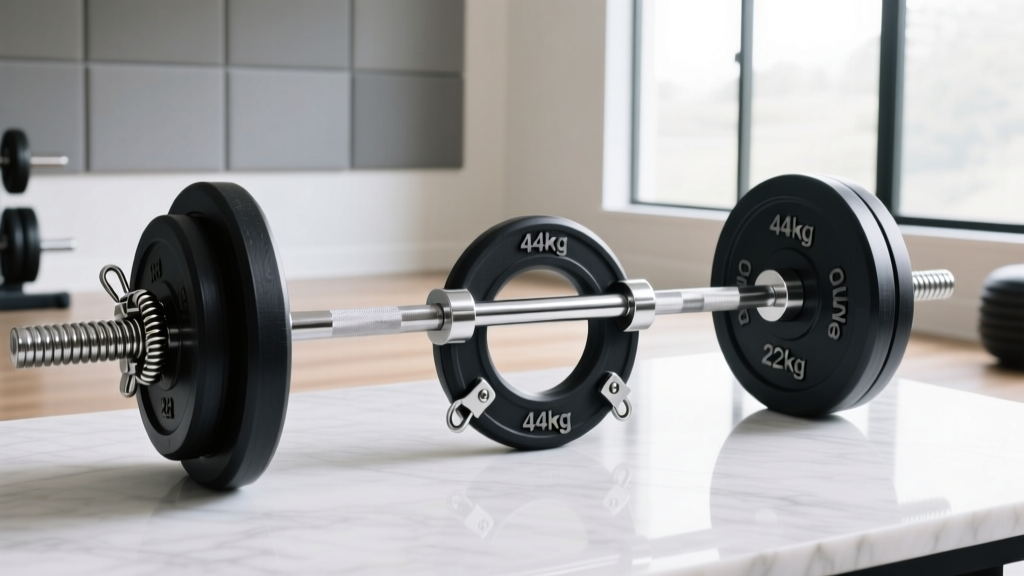
Constructed from zinc-plated steel wire (typically 1.5mm to 2mm thick), spring collars rely on the tension of the metal coils to grip the sleeve. While they are inexpensive and ubiquitous in commercial gyms, their lateral clamping force rarely exceeds 15 lbs. They are entirely inadequate for heavy hammer curls, as the outward lateral pull of the plates will easily overcome the spring tension, causing the collar to pop off the sleeve.
2. Clamp Collars (Lock-Jaw & Urethane)
Clamp collars utilize a glass-filled nylon or polyurethane body with an internal TPU (thermoplastic polyurethane) rubber pad. A plastic cam lever is pulled down to compress the pad against the steel sleeve. Models like the Rogue AX Collars or the Lock-Jaw Pro generate between 100 and 150 lbs of clamping force. These are excellent for standard dumbbell curls and drop sets, as they offer a balance of high security and rapid release times. However, under extreme rotational torque, the TPU pad can slightly deform, allowing for minor sleeve rotation.
3. Lever / Pro-Loc Collars
The gold standard for heavy, torque-intensive lifting. Pro-Loc style collars (such as the Eleiko Pro Lock or Titan Pro Loc) feature a rigid polyurethane body paired with a stainless steel cam lever and a high-durometer rubber friction pad. These generate upwards of 250 lbs of clamping force. Because the lever mechanism physically locks into place and the rubber compound is engineered to resist shearing forces, they completely neutralize the rotational torque generated during heavy supinated dumbbell curls and the lateral pull of heavy hammer curls.
4. Spinlock / Threaded Collars
Found primarily on standard 1-inch dumbbell handles, spinlock collars thread directly onto the sleeve. While they offer infinite security against lateral slippage, they are incredibly slow to remove. If your training involves mechanical drop sets or rest-pause techniques where you need to strip weight quickly between hammer curls and standard curls, spinlocks will ruin your training flow and time-under-tension metrics.
2026 Collar Comparison Matrix
| Collar Type | Top 2026 Model Example | Clamping Force | Avg Price Range | Best Application |
|---|---|---|---|---|
| Spring | Generic Zinc Spring | 10-15 lbs | $5 - $10 / pair | Warm-ups, Rehab, Light Isolation |
| Clamp (Urethane) | Rogue AX Collars | 100-130 lbs | $25 - $30 / pair | Olympic Lifts, Moderate Drop Sets |
| Clamp (Lock-Jaw) | Lock-Jaw Pro | 120-150 lbs | $30 - $35 / pair | Standard Dumbbell Curls, Hypertrophy |
| Lever (Pro-Loc) | Eleiko Pro Lock | 250+ lbs | $85 - $95 / pair | Heavy Hammer Curls, Max Effort Torque |
| Spinlock | Traditional Threaded | Infinite (Threaded) | $15 - $25 / pair | Fixed Weight Loading, Home Gyms |
Real-World Failure Modes: The 'Sleeve Slide' Danger
Understanding failure modes is what separates novice lifters from seasoned strength athletes. The most common catastrophic failure during bicep training is the 'Sleeve Slide'. Imagine you are performing a heavy set of 60 lb hammer curls. Your wrist is in a neutral position, placing significant stress on the radioulnar joints. If a substandard clamp collar fails to hold the plates flush against the inner collar of the sleeve, the plates can shift laterally outward by even just 0.25 inches.
This minor shift drastically alters the center of mass of the dumbbell. Because your grip is fixed, the sudden imbalance forces your wrist into acute, uncontrolled ulnar or radial deviation. This specific mechanism of injury is a primary culprit behind TFCC (Triangular Fibrocartilage Complex) tears in the wrist—a debilitating injury that often requires months of physical therapy or surgical intervention to correct. When executing hammer curls vs dumbbell curls at high intensities, the structural integrity of your collar is literally the only thing protecting your wrist joints from asymmetric loading.
⚠️ Critical Safety Warning: Knurling Coverage
Never place a clamp or lever collar directly over the knurled portion of a loadable dumbbell handle. The aggressive metal ridges prevent the TPU or rubber padding from making flush, continuous contact with the steel. This can reduce your effective clamping force by up to 60%, regardless of how tight the lever is pulled. Always ensure the plates are pushed completely flush, and leave at least 1/8th of an inch of smooth, unknurled sleeve exposed between the knurling and the inner edge of the collar.
The 2026 Buying Framework: Which Collar Should You Choose?
Your purchasing decision should be dictated by your specific training methodology and the types of curls you prioritize.
- The Hypertrophy & Drop-Set Specialist: If your programming heavily features standard dumbbell curls with frequent drop sets, prioritize speed and solid friction. The Lock-Jaw Pro ($30) or Rogue AX Collars ($28) are ideal. They provide ample clamping force to handle supination torque while allowing you to strip 10lb plates in under three seconds.
- The Heavy Strength & Hammer Curl Focus: If you train in the 4-6 rep range and prioritize heavy hammer curls to build the brachioradialis, rotational and lateral torque are your biggest enemies. Invest in a lever-based system like the Eleiko Pro Lock ($89) or Rogue Pro Loc ($45). The mechanical lock and high-durometer rubber will not slip, even when subjected to the intense outward leverage of a neutral-grip max effort curl.
- The Budget Home Gym Owner: If you are strictly using standard 1-inch threaded handles for light isolation work, stick to traditional Spinlock Collars ($15). Just be prepared for the time penalty when changing weights.
Final Thoughts on Arm Training Security
The debate over hammer curls vs dumbbell curls will always center on muscle activation, forearm thickness, and bicep peaking. But as you load up those 20-inch dumbbell handles with heavy iron, remember that the exercise is only as safe as the hardware holding it together. By matching your collar's clamping force and torque resistance to the specific biomechanical demands of your grip, you ensure that the only thing failing during your set is the muscle fiber, not your equipment.
More gear to consider
All reviews
What Do Dumbbell Squats Work vs Kettlebells? Cast Iron Value Guide

Best Adjustable Dumbbells for Dumbbell High Pulls (2026 Review)

Olympic vs Standard Plates: Setup for Dumbbell Uppercuts
How to Gain Muscle Using Dumbbells vs. Olympic Barbells: Weight & Knurling Guide

Standard vs Olympic Plates & The Thomas Inch Dumbbell Diameter