
Cast Iron vs Competition Kettlebells & Dumbbell Rear Lat Raise Swaps
Optimize your home gym layout. We compare cast iron vs competition kettlebells for tight spaces and offer dumbbell rear lat raise alternatives.

The Spatial Dilemma: Dimensional Analysis
When engineering a high-performance home gym in a constrained footprint—such as a single-car garage, a spare bedroom, or a basement alcove—every square inch of floor and wall space must be justified. The debate between cast iron and competition kettlebells is usually framed around grip feel or sport-specific training. However, from a space optimization and layout design perspective, the decision hinges entirely on dimensional consistency, storage geometry, and active clearance.
Competition kettlebells are manufactured to strict International Union of Kettlebell Lifting (IUKF) standards. Regardless of whether the bell weighs 8kg or 32kg, the physical dimensions remain locked: 280mm in height, 210mm in width, and a 33mm handle diameter. This uniformity is a dream for custom storage design. You can build a flush-mounted, multi-tier wall rack with exact 8.5-inch shelf depths, knowing no bell will overhang or shift the center of gravity.
Standard Competition Specs (IUKF):- Height: 280mm (11.02 inches)
- Width: 210mm (8.26 inches)
- Handle Diameter: 33mm
- Window Size: 140mm x 100mm
Cast iron kettlebells, conversely, scale in volume as weight increases. A 16kg cast iron bell might measure 230mm wide, while a 32kg behemoth can span 280mm or more. This variance forces you to over-engineer your storage solutions. A shelf deep enough to safely hold a 32kg cast iron bell (requiring at least 12 inches of depth) will waste valuable spatial volume when storing lighter 12kg or 16kg bells, leaving dead air that could have been utilized for plate storage or resistance band anchoring.
Storage Layouts: Designing Your Kettlebell Zone
To visualize the spatial impact, consider a standard three-bell starter set (16kg, 20kg, 24kg). Below is a footprint matrix comparing the storage requirements for both styles when placed side-by-side on a single tier.
| Metric | Competition Set (16-24kg) | Cast Iron Set (16-24kg) |
|---|---|---|
| Total Linear Width | 25.5 inches (exact) | 26.5 - 29 inches (varies by brand) |
| Required Shelf Depth | 9.5 inches (flush fit) | 11 - 13 inches (to prevent overhang) |
| Total Shelf Area | 242 sq inches | 318+ sq inches |
| Wall Mount Feasibility | High (predictable load center) | Low (requires deep, heavy-duty brackets) |
As demonstrated, competition bells save roughly 25% of shelf real estate. For micro-gyms under 80 square feet, this allows you to mount your kettlebells directly above your pull-up bar or rig, utilizing vertical dead space that cast iron bells would render unsafe due to their deeper center of mass.
Exercise Versatility: The Dumbbell Rear Lat Raise Problem
Space optimization is not just about where equipment lives when idle; it is about maximizing the exercise vectors available within your active footprint. When designing a compact gym, isolation movements often get sacrificed due to equipment bulk. Take the dumbbell rear lat raise, for instance.
Executing the dumbbell rear lat raise properly requires an adjustable bench set to a specific incline, alongside a rack of dumbbells spanning 15 to 45 pounds to accommodate progressive overload and warm-up sets. In a space-optimized layout, dedicating 15 square feet to a dumbbell rack and bench footprint for a single isolation vector is highly inefficient.
Biomechanical Swaps for Compact Gyms
Instead of hoarding dumbbells for rear deltoid and latissimus dorsi isolation, a well-chosen pair of kettlebells can replicate the stimulus while occupying less than one square foot of storage space. According to BarBend's comprehensive breakdown of kettlebell biomechanics, the offset center of mass in a kettlebell forces greater stabilizer recruitment than a balanced dumbbell.
- The Single-Arm Kettlebell High Pull: By hinging at the hips and pulling a 20kg or 24kg cast iron bell toward the lower face, you target the rear delts and upper lats with a similar contraction profile to the dumbbell rear lat raise, but with the added benefit of explosive hip extension.
- The Gorilla Row: Using two kettlebells placed tightly together on the floor, you can perform alternating rows. The wider horn spacing on cast iron bells (compared to the uniform 210mm competition bells) actually provides a slight advantage here, allowing for better knuckle clearance at the bottom of the movement.
- Kettlebell Pullovers: Lying on the floor (eliminating the need for a bulky adjustable bench), a single heavy kettlebell held by the horns provides immense lat tension through a deep stretch, mimicking the isolation of a dumbbell pullover without the spatial overhead.
Active Footprint: Swing Radius and Ceiling Clearance
Layout design must also account for the 'active envelope'—the space required while the equipment is in motion. Kettlebell swings, snatches, and cleans require significant vertical and horizontal clearance.
Because competition kettlebells are uniformly 280mm tall, your ceiling clearance requirement is static. If your basement gym has a low ceiling (e.g., 7 feet), you can confidently calculate that a 6-foot-tall athlete snatching a competition bell will have exactly 12 inches of clearance, regardless of whether they are warming up with a 12kg or maxing out with a 24kg.
Cast iron bells disrupt this predictability. A 32kg cast iron bell can be nearly 3 inches taller than a 16kg bell. If you design your gym layout with low-hanging overhead storage or exposed ductwork based on the height of your lighter bells, transitioning to a heavy cast iron bell mid-workout could result in a catastrophic collision with your ceiling infrastructure. For rooms with ceilings under 8 feet, competition bells are the only safe choice for overhead ballistic movements.
Cost vs. Space: The 2026 Financial Breakdown
While space is the primary constraint, budget dictates reality. As of 2026, the pricing landscape for premium iron remains segmented.
The Golden Rule of Iron: You are paying for either dimensional precision or raw mass. Competition bells command a premium for the machining required to maintain uniform volume, while cast iron is priced closer to raw material costs.
Brands like Rogue Fitness offer premium cast iron bells with durable E-coat finishes that resist rust in humid garage environments, typically pricing out between $1.75 and $2.50 per pound. Competition bells from manufacturers like Kettlebell Kings or Onnit generally range from $3.50 to $5.00 per pound due to the steel-iron alloy blends and precise calibration required.
If your spatial layout allows for deep, heavy-duty floor racks and you do not plan on performing high-repetition overhead snatches, cast iron is the superior financial investment. You can purchase a full spectrum of cast iron bells (12kg to 32kg) for the same price as a matched pair of competition 24kg bells. However, if your gym is a 60-square-foot apartment corner where wall-mounted, flush-fit storage is mandatory, the premium for competition bells is effectively a 'space tax' that pays immediate dividends in livable square footage.
Final Verdict for Space-Constrained Lifters
Choosing between cast iron and competition kettlebells is ultimately an exercise in spatial geometry. If your layout features low ceilings, requires custom flush-mounted wall shelving, or demands predictable storage dimensions, competition kettlebells are the undisputed champions of space optimization. Their uniform 210mm width and 280mm height allow for architectural precision in your gym design.
Conversely, if you have the floor space for a heavy-duty, deep-shelved A-frame rack and prioritize budget over spatial elegance, cast iron bells offer superior grip variability and cost-efficiency. By strategically utilizing kettlebell movements to replace bulky isolation setups—solving the dumbbell rear lat raise dilemma with single-arm high pulls and gorilla rows—you can build a brutally effective, space-optimized training environment that refuses to compromise on muscular development.
More gear to consider
All reviews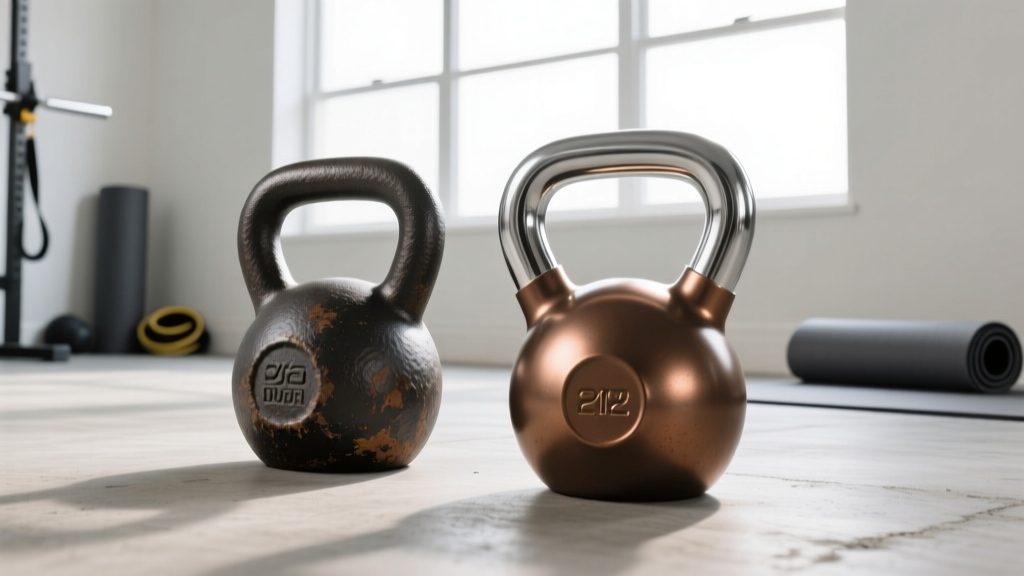
Cast Iron vs Competition Kettlebells: Dumbbell Pullover Alternatives

Bumper vs Iron Plates: Care & Incline Dumbbell Press Technique

How to Do Kettlebell Swings With a Dumbbell: Home Guide

Power Rack vs Squat Stand for a Dumbbell Only Glute Workout

Power Rack vs Squat Stand: Bench Dumbbell Workout Routine Setups
