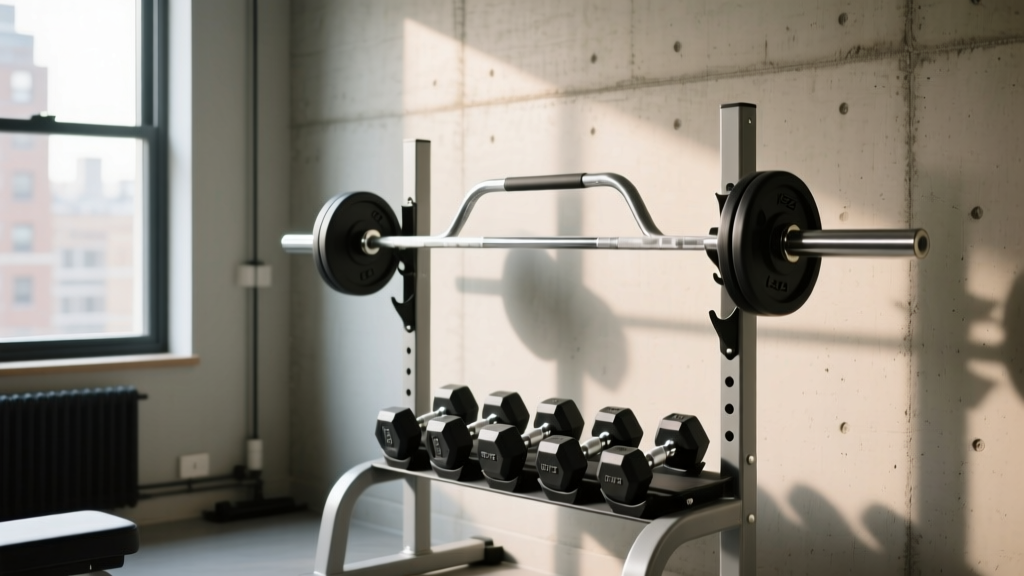
EZ Curl Bar vs Straight Bar: Budget & Dumbbells High Pull Value
Compare the EZ curl bar vs straight bar for your home gym budget. We analyze costs, versatility, and dumbbells high pull alternatives for maximum value.

The 2026 Home Gym Dilemma: Specialization vs. Versatility
As we navigate the 2026 fitness equipment market, steel tariffs and fluctuating shipping costs have fundamentally shifted the baseline prices of Olympic barbells and specialty bars. For home gym owners operating under strict budget and spatial constraints, every dollar must yield maximum return on investment. One of the most common crossroads lifters face is choosing between an EZ curl bar and a straight barbell (often a 5-foot or 6-foot Olympic bar) for their secondary lifting tool. While both serve distinct purposes, analyzing their true value requires looking beyond the initial price tag. We must evaluate exercise versatility, joint biomechanics, material durability, and how your choice impacts the rest of your programming—specifically when you need to rely on alternatives like the dumbbells high pull to compensate for missing barbell movements.
Head-to-Head: EZ Curl Bar vs Straight Bar Specs and Pricing
To understand the budget breakdown, we must compare apples to apples. Below is a snapshot of the current market pricing and specifications for mid-tier to premium bars, contrasting the specialized EZ bar against the versatile straight bar.
| Feature | Rogue Fitness Curl Bar | CAP Barbell EZ Curl Bar | Rogue Ohio Bar (Straight) | Yes4All 5ft Straight Bar |
|---|---|---|---|---|
| Price (2026) | $245.00 | $75.00 | $205.00 | $65.00 |
| Weight | 35 lbs | 18 lbs (Non-Olympic sleeves) | 44 lbs (20kg) | 44 lbs |
| Tensile Strength | 190,000 PSI | ~50,000 PSI (Estimated) | 190,000 PSI | ~60,000 PSI |
| Sleeve Construction | Bronze Bushings | Welded / Solid Rod | Bronze Bushings | Basic Bushings |
| Shaft Diameter | 28mm | 25mm - 28mm (Variable) | 28.5mm | 28mm |
| Primary Use | Isolation / Arms | Isolation / Arms | Compound / Full Body | Compound / Full Body |
The immediate takeaway is the massive price disparity between premium and budget options. However, the hidden cost lies in the tensile strength and sleeve construction. A $75 CAP Barbell EZ bar is perfectly adequate for strict bicep curls where the load rarely exceeds 100 pounds. But if you attempt to use a budget straight bar for heavy compound movements, the lower PSI steel will eventually develop a permanent bend, rendering the bar useless and forcing a replacement.
The Versatility Gap: Barbell Rows and the Dumbbells High Pull
The straight bar is the undisputed king of versatility. It allows for deadlifts, bench presses, bent-over rows, and explosive Olympic variations like the barbell high pull. The EZ curl bar, with its angled grips and shorter shaft, is a specialist tool designed almost exclusively for arm isolation and upright rows.
When outfitting a small-footprint gym, you might be forced to choose between a 5-foot straight bar and an EZ curl bar as your secondary lifting tool. If you choose the EZ bar for joint-friendly curls, you sacrifice the ability to perform barbell high pulls—a staple for trap and posterior chain power. This is where the dumbbells high pull becomes a critical, budget-friendly alternative. By pairing an EZ bar with a set of adjustable dumbbells, you can execute the dumbbells high pull with a neutral grip. According to biomechanics data from ExRx Kinesiology, a neutral grip during explosive pulls significantly reduces the risk of shoulder impingement and wrist strain compared to the pronated grip required by a straight barbell. Therefore, investing in an EZ bar alongside adjustable dumbbells can actually provide a safer, more joint-friendly ecosystem for both isolation and explosive compound movements.
Expert Insight: 'The dumbbells high pull allows for unilateral force production and a natural bar path that a fixed straight bar simply cannot accommodate, making it a superior choice for lifters with a history of rotator cuff or AC joint irritation.' — Adapted from ACE Fitness Exercise Database guidelines on joint mechanics.
Biomechanical Realities: Wrist Supination and Valgus Angles
Why do lifters gravitate toward the EZ bar despite its lack of versatility? The answer lies in the carrying angle. A standard straight bar forces your wrists into full supination (palms facing up) during curls. This places immense valgus stress on the medial epicondyle and the wrist extensors. The EZ curl bar features bends typically set at 15 to 30 degrees, allowing for a semi-supinated grip. This slight shift in hand position recruits the brachialis and brachioradialis more heavily while relieving acute tension on the radioulnar joint. For lifters over 30 or those with a history of tendonitis, the EZ bar is not a luxury; it is a medical necessity for pain-free training.
Knurling Patterns and Grip Fatigue
When analyzing value, grip quality is often overlooked until your hands are shredded. Premium straight bars like the Ohio Bar feature a medium-depth volcanic knurling that provides traction without tearing calluses. They also include dual knurl marks for IPF and IWF standards, aiding in consistent hand placement for rows and deadlifts.
Conversely, EZ bars feature segmented knurling. The angled sections are aggressively knurled to prevent the bar from sliding during heavy tricep extensions, while the smooth center allows for comfortable placement on the collarbone during front raises. Budget bars, however, often use a shallow, machined knurl that feels like smooth chrome after a few months of use, forcing you to rely heavily on chalk or lifting straps, which adds to your long-term accessory budget.
Budget Scenarios: 3 Paths to Arm and Back Development
Let us break down three distinct home gym setups for 2026, analyzing the total cost of ownership and the programming compromises of each.
Scenario A: The Space-Saver (EZ Bar + Adjustable Dumbbells)
- Equipment: CAP Barbell EZ Curl Bar ($75) + Nuobell 80lb Adjustable Dumbbells ($399)
- Total Cost: $474
- Pros: Excellent for arm isolation; allows for the dumbbells high pull to target traps and posterior chain safely; takes up minimal floor space.
- Cons: Cannot perform heavy barbell rows or traditional deadlifts.
Scenario B: The Compound Purist (5ft Straight Bar + Bumper Plates)
- Equipment: Titan Fitness 5ft Olympic Bar ($130) + 160lbs of Crumb Bumpers ($220)
- Total Cost: $350
- Pros: Ultimate versatility for rows, high pulls, floor presses, and deadlifts.
- Cons: Heavy straight bar curls will likely cause wrist strain over time; requires purchasing separate dumbbells later if joint pain develops.
Scenario C: The Hybrid Compromise (Multi-Grip Swiss Bar)
- Equipment: REP Fitness AB-5100 Swiss Bar ($199)
- Total Cost: $199
- Pros: Offers neutral grips for pressing and rows, reducing shoulder strain while allowing for heavy pulling movements.
- Cons: Bulky to store; poor for traditional bicep curls compared to a dedicated EZ bar.
Durability and Failure Modes: Where Budget Bars Break
When evaluating the budget breakdown, you must account for failure modes. The most common point of failure on budget EZ curl bars is the sleeve attachment. High-end bars use a retaining ring and bronze bushings to allow the sleeve to spin independently of the shaft. Budget bars often feature a solid steel rod with a hollow pipe welded over the end to simulate a sleeve. When you drop an EZ bar after a heavy set of skull crushers, the shockwave travels directly into the weld. Over time, these welds fracture, leading to a wobbly sleeve that makes controlled eccentrics impossible.
Straight bars face a different failure mode: oxidation. Budget bars are typically coated in decorative chrome. Unlike hard chrome used on premium bars, decorative chrome is incredibly thin and prone to flaking. Once the steel beneath is exposed to the humidity of a garage gym, rust sets in within weeks. According to equipment maintenance guidelines discussed by the National Strength and Conditioning Association (NSCA), proper barbell maintenance requires regular brushing and light oiling, but no amount of oil can save a flaking chrome budget bar. If you are buying a straight bar on a strict budget, opt for black oxide or bare steel with a clear coat, and commit to a weekly maintenance routine.
Final Verdict: Maximizing Your Free Weight Investment
The choice between an EZ curl bar and a straight bar ultimately hinges on your primary training goals and your existing equipment roster. If you already own a standard 7-foot Olympic barbell for your heavy squats and deadlifts, adding a $75 to $245 EZ curl bar is the most logical, joint-friendly investment for arm specialization. However, if you are building a minimalist gym and can only afford one secondary bar, the 5-foot straight bar offers unmatched versatility.
Just remember that choosing the straight bar means committing to the pronated grip for your pulling movements, while choosing the EZ bar means you must pivot your explosive programming. By embracing the dumbbells high pull, you can successfully bridge the versatility gap, ensuring your traps, rhomboids, and hip-hinge mechanics continue to progress without sacrificing the health of your wrists and elbows. In 2026, smart budgeting is not just about finding the cheapest steel; it is about engineering a biomechanically sound ecosystem that keeps you lifting pain-free for decades.
More gear to consider
All reviews
Best Adjustable Dumbbells for Wide Dumbbell Curls: 2026 Setup Guide

Best Loadable Dumbbells for the Dumbbell Flye: 2026

EZ Bar vs Straight Bar: Space Layouts & Dumbbell Exercises for Wings
EZ Curl Bar vs Straight Bar: 2026 Trends & 45-Min Dumbbell Workouts

Bumper vs Iron Plate Storage: Space For One Arm Dumbbell Roll