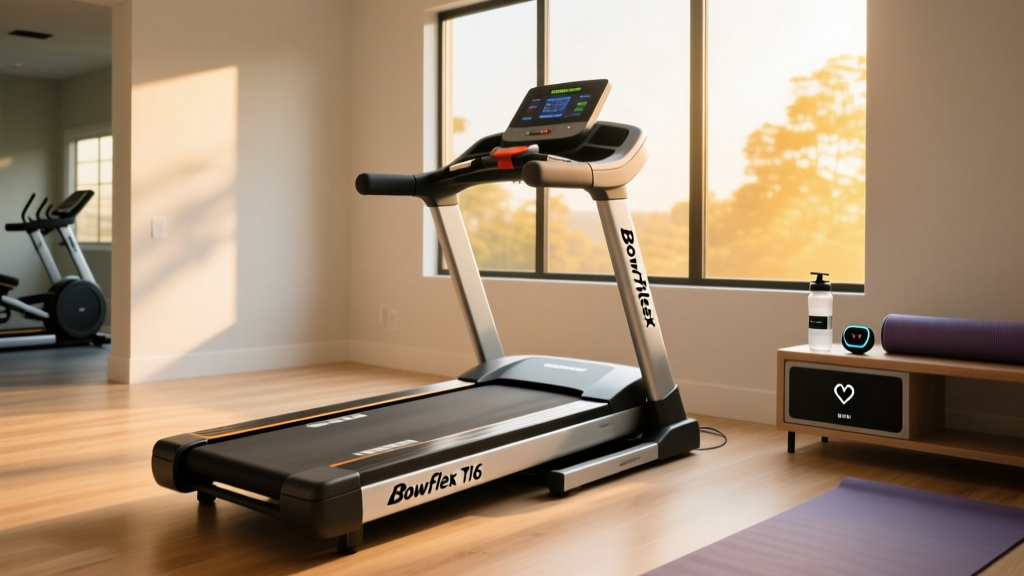
Bowflex T16 Treadmill Review: Feature Comparison Mistakes
Avoid buyer's remorse with our Bowflex T16 treadmill review. Learn common feature comparison mistakes and how to troubleshoot cardio machine mismatches.

The Benchmark Problem: Why Feature Comparison Fails
When consumers begin researching premium home cardio equipment, the search inevitably leads to a comprehensive Bowflex T16 treadmill review. As of 2026, the Bowflex T16 (often interchangeable with the Series 16 nomenclature) remains a dominant benchmark in the $2,500 to $3,000 price tier. However, using a flagship machine as a baseline often exposes a critical flaw in how buyers compare treadmill features. Shoppers frequently fall victim to marketing deception, comparing raw numbers without understanding biomechanical impact or long-term hardware sustainability.
This guide dissects the most common mistakes buyers make when comparing treadmill specifications against the Bowflex T16, and provides actionable troubleshooting steps to fix feature mismatches if you have already purchased the wrong machine.
⚠️ The Spec-Sheet Trap: Never compare 'Peak HP' to 'Continuous Horsepower (CHP)'. A budget treadmill advertising a '4.5 HP Motor' will routinely stall under the 4.0 CHP continuous output of the Bowflex T16 when a 200+ lb runner exceeds 7.0 mph.Motor Metrics: Continuous Duty vs. Peak Deception
The most frequent error in treadmill buying guides is the conflation of peak horsepower with continuous duty horsepower. The Bowflex T16 utilizes a 4.0 CHP motor, meaning it can sustain 4.0 horsepower indefinitely without overheating. Budget competitors often use smaller motors with aggressive gear ratios to temporarily spike to 4.5 Peak HP, but these motors will thermally throttle or trip the internal breaker during a sustained 45-minute tempo run.
Troubleshooting Motor Thermals and Belt Lag
If you purchased a competitor model based on inflated 'Peak HP' numbers and are experiencing belt hesitation (the belt momentarily slows down when your foot strikes the deck), follow these diagnostic steps:
- Check the Amp Draw: Use a multimeter or a smart plug with energy monitoring. If your treadmill pulls over 15 amps consistently at a moderate 5.0 mph walking pace, the motor is overworking due to deck friction.
- Perform the Lift Test: With the machine off, lift the belt in the center of the deck. You should see about 2 to 3 inches of clearance. If it is flush against the deck, friction is choking the motor.
- Apply Silicone Lubricant: Use 100% silicone treadmill lube (never petroleum-based). Apply 1 oz under the belt, run the machine at 2.0 mph for 3 minutes to distribute it, and re-test the amp draw.
The Incline and Decline Matrix: Eccentric Loading Realities
Another major comparison mistake is ignoring the decline feature. According to the Centers for Disease Control and Prevention (CDC), incorporating varied intensity and muscle engagement is vital for comprehensive adult fitness. The Bowflex T16 offers a -5% decline to 20% incline range. Many buyers compare it to the Sole F80 (0% to 15%) and assume the Sole is 'close enough' because it hits high inclines. This ignores the biomechanical necessity of eccentric muscle loading provided by decline walking.
| Feature Metric | Bowflex T16 (Series 16) | NordicTrack 1750 | Sole F80 |
|---|---|---|---|
| Motor (Continuous) | 4.0 CHP | 3.5 CHP | 3.5 CHP |
| Incline / Decline | -5% to 20% | -3% to 15% | 0% to 15% |
| Running Surface | 20' x 60' | 22' x 60' | 22' x 60' |
| Ecosystem OS | JRNY (Adaptive AI) | iFIT (Trainer-led) | Sole+ (Basic Metrics) |
Workaround: Simulating Decline on Flat Treadmills
If you mistakenly bought a treadmill lacking a decline feature but require eccentric quad and tibialis anterior conditioning, you can simulate the effect. Wear a weighted vest (10-15% of your body weight) and perform slow, controlled step-downs off the side rails onto a low aerobic step placed adjacent to the treadmill deck. This safely replicates the eccentric braking forces of a -5% decline without voiding your machine's warranty.
Smart Ecosystems: Screen Size vs. Processing Overhead
In 2026, the smart fitness market is heavily focused on screen real estate. Buyers often look at a Bowflex T16 treadmill review, note the 16-inch HD touchscreen, and immediately compare it unfavorably to the Peloton Tread+ (23.8 inches) or the NordicTrack 1750 (14-inch tilting screen). This is a fundamental misunderstanding of software architecture.
Comparing raw screen inches ignores the operating system's processing overhead. The Bowflex T16 utilizes the JRNY platform, which relies heavily on cloud-based AI adaptation rather than local rendering of 4K topographical maps. Consequently, the T16 requires less local GPU power, resulting in fewer system crashes during long endurance sessions.
Expert Insight: When evaluating smart treadmills, check the RAM and processor specs, not just the diagonal screen measurement. A 16-inch screen with 4GB of RAM will vastly outperform a 24-inch screen bottlenecked by 2GB of RAM when streaming live telemetry and video simultaneously.
Troubleshooting Smart Screen Wi-Fi Handshake Failures
A universal complaint across all smart treadmills, including the Bowflex T16, is Wi-Fi connectivity dropping mid-workout. This is rarely a hardware defect; it is a network architecture mismatch.
- The WPA3 Conflict: Many 2026 mesh routers default to WPA3 security. Treadmill IoT chips often only support WPA2. Log into your router and enable 'WPA2/WPA3 Transitional Mode' for the 2.4GHz band.
- The 6GHz Band Issue: Smart treadmills cannot see 6GHz (Wi-Fi 6E/7) networks. Ensure your router's 2.4GHz SSID is explicitly visible and not hidden behind a unified smart-connect name.
- DNS Routing: If the JRNY or iFIT app fails to load video but registers your speed, change the treadmill's static IP settings to use Google DNS (8.8.8.8) or Cloudflare (1.1.1.1) to bypass ISP-level content blocking.
Deck Cushioning: Marketing Gimmicks vs. Force Attenuation
The Consumer Reports treadmill buying guide consistently highlights that deck cushioning is the most misunderstood feature in the industry. Brands throw around terms like 'Variable Cushioning' or 'Orthopedic Belts.' The Bowflex T16 uses 'Comfort Tech' cushioning, which utilizes specialized elastomers under the front strike zone while keeping the rear push-off zone firm.
The mistake buyers make is assuming 'softer is better.' An overly soft deck (like a marshmallow) causes energy leakage, forcing your Achilles tendon to work 15% harder to stabilize your ankle upon impact. When comparing treadmills, look for zonal cushioning systems rather than uniform shock absorption.
Fixing a 'Dead' or Overly Firm Deck
If your current treadmill feels like running on concrete, the elastomers may be compressed, or the belt is over-tensioned.
- Loosen the Rear Roller: Using a 6mm or 8mm Allen wrench (depending on the brand), turn both rear roller adjustment bolts counter-clockwise by exactly one-quarter (1/4) turn. Over-tightening the belt stretches the running surface, eliminating the micro-flex of the deck boards.
- Inspect the Bumpers: On machines older than 3 years, the rubber deck supports compress and lose their durometer rating. You can order replacement 80A durometer polyurethane bumpers online for under $30 and swap them out in 20 minutes.
Final Verdict: Aligning Features with Biomechanics
Ultimately, a Bowflex T16 treadmill review reveals a machine engineered for serious, high-mileage runners who require continuous motor output and eccentric decline training. The most common mistake buyers make is sacrificing these foundational hardware metrics in favor of a larger touch screen or a marginally wider belt. By understanding the difference between peak and continuous horsepower, recognizing the necessity of decline gradients, and properly troubleshooting software and belt-tension issues, you can ensure your cardio investment delivers biomechanical value for the next decade.
More gear to consider
All reviews
Aquatic Treadmill Feature Comparison: Buying Mistakes to Avoid

Optimizing Space for ProForm Performance 600 Treadmill Belt Care

Do You Burn More Calories on StairMaster or Treadmill? 2026 Guide

Signature Fitness Treadmill Review: Top Folding Picks for Small Spaces
Air vs Assault Bike: Space-Saving Elliptical or Treadmill Fat Loss
