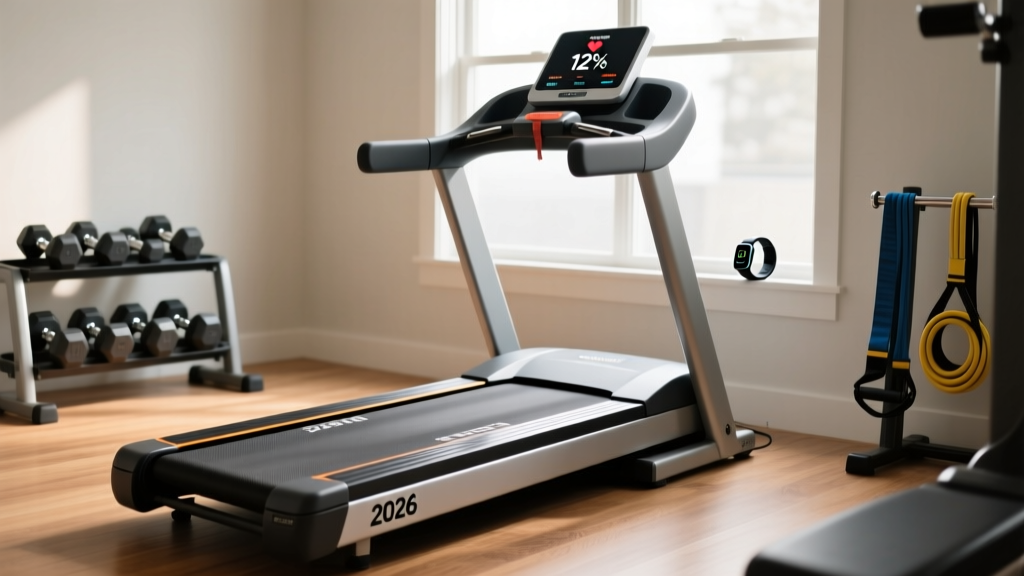
Star Trac Treadmill Models & Cardio Noise: Beginner Comparison Guide
Learn how to compare cardio machine noise levels. This beginner guide analyzes Star Trac treadmill models against ellipticals and bikes for quiet home use.

As high-density living and work-from-home setups continue to dominate in 2026, the acoustic footprint of your home gym is just as critical as its square footage. If you share walls, floors, or a roof with neighbors or family members, understanding cardio machine noise levels is mandatory. This beginner-friendly, step-by-step guide will teach you how to measure, compare, and mitigate equipment noise, using premium Star Trac treadmill models as our primary benchmark for commercial-grade acoustic performance.
Step 1: Decode the Decibel (dB) Scale for Home Gyms
Before comparing machines, you must understand how sound is measured. The Environmental Protection Agency (EPA) outlines that prolonged exposure to noise above 70 decibels (dB) can cause hearing fatigue, while sudden impact noises easily penetrate floor joists. In fitness equipment, noise is divided into two categories:
- Airborne Noise: The sound traveling through the air (e.g., the whir of a treadmill motor or the whoosh of an air bike fan). Measured in standard dB.
- Structure-Borne (Impact) Noise: Vibrations transferred directly into the floor (e.g., foot strikes on a treadmill deck). This is the primary culprit for neighbor complaints in multi-story apartments.
Step 2: Analyze Star Trac Treadmill Models as Benchmarks
Star Trac, now a flagship brand under Core Health & Fitness, engineers equipment primarily for commercial gyms. Using their light-commercial and commercial lines as a baseline helps us understand how heavy-duty engineering affects acoustics.
The Star Trac S-TRx (Light Commercial)
Priced between $4,800 and $5,500 in 2026, the S-TRx features a 4.0 HP AC (Alternating Current) motor. Unlike the DC (Direct Current) motors found in sub-$1,500 residential treadmills—which emit a high-pitched whine that increases with speed—the AC motor produces a lower-frequency, consistent hum. At 3.0 mph, the S-TRx generates roughly 68 dB of airborne noise. At 8.0 mph, it peaks around 78 dB.
The Star Trac Instinct Treadmill (Full Commercial)
Retailing upwards of $7,500, the Instinct series utilizes a heavy-gauge steel frame and advanced Trac-Action shock absorption deck. The massive frame weight (over 350 lbs) naturally dampens micro-vibrations. However, because it is designed for club environments where ambient noise is already high, its impact noise transfer is substantial. Without proper isolation pads, a 180-lb runner on the Instinct will generate low-frequency thuds that easily penetrate standard 3/4-inch plywood subfloors.
"Commercial treadmill motors are built for thermal endurance and continuous duty cycles, not necessarily for whisper-quiet residential operation. The acoustic trade-off is a lower-pitch motor hum but higher overall mass transferring impact vibrations."
Step 3: Cross-Compare Cardio Modalities (Noise Matrix)
To contextualize how Star Trac treadmill models compare to other cardio equipment, review the matrix below. This data reflects a 175-lb user exercising at a moderate-to-vigorous intensity in a standard 150 sq. ft. room with hard flooring.
| Machine Type | Airborne Noise (dB) | Impact/Structure Noise | Apartment Friendly? |
|---|---|---|---|
| Star Trac S-TRx Treadmill | 68 - 78 dB | High (Footstrike) | No (Requires Isolation) |
| Magnetic Elliptical | 45 - 55 dB | Very Low | Yes |
| Air Bike (e.g., Assault) | 75 - 85 dB (Wind) | Low | No (Airborne issue) |
| Water Rower | 55 - 65 dB (Slosh) | Low | Yes |
| Spin Bike (Magnetic) | 40 - 50 dB | None | Yes |
Step 4: Your Step-by-Step Home Noise Audit
Do not rely on manufacturer claims of "whisper-quiet" operation. Conduct your own acoustic audit using the American Council on Exercise (ACE) recommended methodology for home equipment placement.
- Download a Calibrated dB Meter: Use a reputable app like NIOSH Sound Level Meter (iOS) or Decibel X (Android/iOS). Place your phone on a tripod at ear level, exactly 3 feet from the machine console.
- Establish the Baseline: Record the ambient room noise with the machine off (typically 35-45 dB).
- Test Motor Idle: Turn the treadmill on to 1.0 mph with no one on it. This isolates the motor and belt friction noise. Star Trac AC motors should read around 60-64 dB here.
- Test Under Load (Walk): Walk at 3.0 mph. Note the dB spike. This introduces rhythmic impact noise.
- Test Under Load (Run): Run at 6.0 mph. If the meter spikes above 80 dB, or if you feel vibrations in your bare feet while standing in the next room, the structure-borne noise is failing your environment's acoustic threshold.
Step 5: Engineer Your Vibration Isolation Setup
If your audit reveals that your Star Trac treadmill (or any heavy cardio machine) is transferring too much impact noise, you must decouple the machine from the floor. A standard $30 PVC foam mat from a big-box store will compress to less than 1mm under a 350-lb treadmill and fail to stop low-frequency thuds.
The 2026 Gold Standard for Treadmill Isolation:
- Base Layer: A 3/8-inch thick vulcanized rubber mat (Shore A hardness of 60). This absorbs high-frequency belt vibrations.
- Decoupling Pads: Place four Sorbothane or high-density neoprene anti-vibration pads (rated for 150 lbs each) under the treadmill feet. This creates an air-gap effect that stops low-frequency footstrike waves from entering the subfloor.
- Clearance: Ensure the treadmill belt does not rub against the mat during heavy incline use, as this creates a secondary friction noise of 70+ dB.
Frequently Asked Questions
Are Star Trac treadmills too loud for an apartment?
The airborne noise of Star Trac treadmill models is manageable, but the impact noise of a runner on a commercial deck will disturb downstairs neighbors without proper Sorbothane isolation pads and a thick rubber mat.
Which cardio machine is the absolute quietest?
Magnetic resistance spin bikes and front-drive magnetic ellipticals are the quietest, often producing less than 50 dB of airborne noise and zero structural impact noise.
Does treadmill maintenance affect noise levels?
Yes. A dry treadmill belt can increase motor strain and friction noise by 5 to 8 dB. Lubricating your belt with 100% silicone lubricant every 150 miles is essential for maintaining the factory acoustic baseline.
More gear to consider
All reviews
NordicTrack Flex Select T6 5s Treadmill Noise: Troubleshooting & Fixes

Treadmill Walking Calorie Burn: Motor Size Troubleshooting

NordicTrack T5.7 Treadmill Review: 2026 Small Space Layout & Test

Treadmill Track Sticking? Motor Size & Installation Setup Guide
Rowing Guide: Why It Beats the Typical Burn Fat on Treadmill Workout