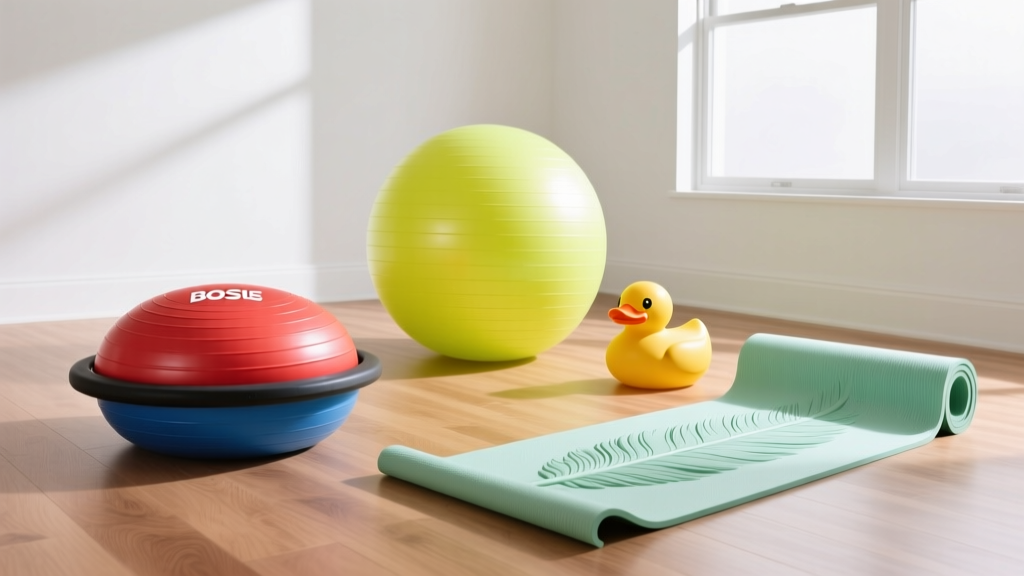
BOSU vs Stability Ball: Is It Worth More Than a Duck Yoga Mat?
We break down the ROI of a BOSU trainer vs. a stability ball, and compare these balance tools against a duck yoga mat.

The Home Gym Budget Dilemma: Dynamic Balance vs. Foundation
As we navigate the fitness equipment market in 2026, budget-conscious home gym owners are forced to make strict allocations between dynamic instability tools and static recovery gear. When outfitting a functional training space, two balance staples dominate the conversation: the classic Swiss stability ball and the premium BOSU Balance Trainer. However, a new trend has complicated the budget matrix. Many shoppers are now cross-shopping dynamic balance trainers with trending static mobility gear, such as the viral duck yoga mat—an aesthetic, alignment-focused TPE mat that has taken social media wellness spaces by storm.
But where does the actual fitness ROI lie? Is the $139 price tag of a BOSU trainer justified when a standard stability ball costs under $25? And how do these dynamic tools compare to the $45 investment in a high-density duck yoga mat for your recovery and mobility routine? In this comprehensive budget breakdown, we analyze the cost-per-use, biomechanical value, and long-term durability of these three distinct pieces of equipment.
The Stability Ball: The Budget King of Core Recruitment
The Swiss ball (or stability ball) remains the undisputed champion of budget-friendly core training. Models like the TheraBand Stability Ball or the Cap Barbell Anti-Burst Swiss Ball typically retail between $18 and $28. Despite the low entry cost, the biomechanical return is substantial.
Key Specifications and Value Metrics
- Material: Anti-burst PVC (Polyvinyl Chloride).
- Static Load Capacity: Ranges from 500 lbs (standard) to 2,000 lbs (professional grade).
- Sizing: 55cm (for users under 5'5"), 65cm (5'5" to 6'0"), and 75cm (over 6'0").
- Cost-Per-Use: Exceptionally low. At $20, using it just three times a week for a year drops the cost to roughly $0.12 per session.
The primary value of the stability ball lies in its ability to introduce multi-planar instability. According to guidelines from the American Council on Exercise (ACE), unstable surface training forces the deep stabilizers of the core—specifically the transverse abdominis and multifidus—to fire continuously to maintain posture. However, the stability ball falls short in unilateral lower-body loading; attempting heavy split squats on a Swiss ball introduces a high risk of joint shear and PVC rupture.
The BOSU Balance Trainer: Justifying the Premium Price Tag
The BOSU Pro Balance Trainer (MSRP $139) and the slightly more affordable BOSU Elite (MSRP $119) represent a significant leap in both price and versatility. The BOSU (Both Sides Up) features a rigid, high-impact plastic base paired with an 8.5-inch urethane dome.
Where the $139 Actually Goes
Unlike a standard PVC Swiss ball, the BOSU's urethane bladder is rated for up to 2,500 lbs of static load. This allows users to perform heavy, unilateral exercises like Bulgarian split squats, single-leg Romanian deadlifts, and plyometric box jumps with a significantly lower risk of catastrophic failure. Furthermore, the flat, rigid base allows the BOSU to be flipped over, transforming it into a sliding surface for mountain climbers or an unstable platform for push-ups and planks.
Expert Insight: The BOSU is not just a balance tool; it is a multi-vector proprioceptive platform. The rigid base eliminates the 'rolling' hazard of a Swiss ball, making it a mandatory investment for athletes integrating heavy free weights into their instability training.
The Wildcard: Evaluating the Duck Yoga Mat
To truly understand home gym budget allocation in 2026, we must address the trending alternative: the duck yoga mat. Priced around $45, this 6mm thick, closed-cell TPE (Thermoplastic Elastomer) mat features aesthetic waterfowl motifs and laser-etched alignment lines. While it offers zero dynamic instability for core recruitment, its value proposition lies entirely in static mobility, joint cushioning, and recovery.
When comparing a duck yoga mat to a stability ball, you are comparing two entirely different physiological adaptations. The duck yoga mat provides essential friction and 6mm of shock absorption for ground-based mobility flows, yoga, and post-workout stretching. A stability ball cannot replace this grounded surface. However, if your primary goal is caloric expenditure, core hypertrophy, and athletic power transfer, the duck yoga mat is a supplementary luxury, whereas the stability ball is a foundational necessity.
Head-to-Head Value Matrix
To visualize the budget breakdown, we have mapped the three items across critical performance and financial metrics.
| Equipment | Avg. MSRP | Primary Biomechanical Benefit | Material & Durability | Space Footprint |
|---|---|---|---|---|
| Swiss Stability Ball | $18 - $28 | Multi-planar core stabilization | Anti-burst PVC (Degrades in UV) | High (Requires wall corner) |
| BOSU Pro Trainer | $139 - $149 | Unilateral load & plyometrics | Urethane & ABS Plastic (5-8 yrs) | Medium (Stackable) |
| Duck Yoga Mat (TPE) | $40 - $55 | Static mobility & joint cushioning | Closed-Cell TPE (Tears on pivot) | Low (Rolls to 5" cylinder) |
Biomechanics and Muscle Activation (EMG)
When deciding between the $20 stability ball and the $139 BOSU, electromyography (EMG) studies provide a clear answer based on your training goals. Research highlighted by the National Strength and Conditioning Association (NSCA) indicates that while both tools increase rectus abdominis activation compared to stable floor exercises, the type of activation differs.
Activation Profiles
- Stability Ball: Maximizes activation during flexion movements (e.g., Swiss ball crunches, pikes). The rolling nature of the ball requires constant micro-adjustments, heavily taxing the obliques and deep spinal erectors.
- BOSU Trainer: Maximizes activation during isometric holds and loaded lower-body movements. The rigid base allows for higher force production, meaning you can overload the core with dumbbells or kettlebells safely.
If your budget only allows for one, and your goal is pure core isolation, the stability ball wins on ROI. If your goal is athletic performance, ankle proprioception, and loaded lower-body work, the BOSU is non-negotiable. Rehabilitation protocols often cite Cleveland Clinic recommendations for low-impact proprioception, where the BOSU's predictable dome height makes it safer for aging populations recovering from lower-limb injuries.
Real-World Durability and Failure Modes
A true value analysis must account for equipment failure. Cheap gear that breaks in six months is ultimately more expensive than premium gear that lasts a decade.
1. The Pet Claw Hazard (PVC vs. Urethane)
Standard stability balls are highly susceptible to micro-punctures from dog or cat claws. A tiny scratch on a pressurized PVC ball can lead to a slow leak or a catastrophic burst mid-exercise. The BOSU's thicker urethane bladder is significantly more resistant to surface abrasions, though it is not entirely claw-proof. The duck yoga mat, made of TPE, will easily scratch and tear if subjected to high-friction pivot movements or pet traffic.
2. UV and Temperature Degradation
PVC stability balls oxidize and become brittle when exposed to direct sunlight or extreme temperature fluctuations in a garage gym. The ABS plastic base of the BOSU and its urethane dome handle temperature variances much better, maintaining their structural integrity in both cold and hot environments.
3. Valve and Bladder Leaks
The most common failure point for both the stability ball and the BOSU is the air valve. Over time, the rubber gaskets inside the valves dry out and shrink, causing slow leaks. The BOSU Pro mitigates this with a higher-grade, replaceable valve plug, whereas budget Swiss balls often require you to constantly re-inflate them or discard them entirely.
Final Verdict: Where to Allocate Your 2026 Fitness Budget
Your purchasing decision should be dictated by your primary training modality, not just the sticker price.
The Budget Framework
- Buy the Stability Ball ($25) IF: You are strictly focused on core hypertrophy, Pilates-style floor work, and budget is your primary constraint. It offers the highest cost-per-use ratio in the fitness industry.
- Buy the BOSU Pro ($139) IF: You are an athlete or lifter who needs to integrate heavy dumbbells into your balance training, require a safe surface for plyometrics, or need a durable tool for ankle/knee rehabilitation.
- Buy the Duck Yoga Mat ($45) IF: Your routine consists of 80% static stretching, yoga, and ground-based mobility work. It is a comfort and alignment tool, not a dynamic core trainer.
Ultimately, the stability ball and the duck yoga mat are complementary budget items that cover dynamic core work and static recovery, respectively. The BOSU trainer is a premium upgrade for those who have exhausted the limitations of the Swiss ball and require a safer, more versatile platform for loaded athletic training. Assess your movement patterns, protect your joints, and invest where your biomechanics demand it most.
More gear to consider
All reviews
What Size Yoga Mat Do I Need? Exercise Ball Sizing & Trends

Home Gym Common Mistakes: What 12,000+ Home Gym Owners Wish They Knew Before Buying

Manduka PRO 6mm Yoga Mat vs Resistance Bands: Levels & Types Guide
Resistance Band Set Buying Guide & Hatha Yoga Mat Setup
Jump Rope Types: Speed, Weighted, Beaded & Your Yellow Yoga Mat
