
Loop vs Tube Band Maintenance and FSA Yoga Mat Care
Discover expert loop band vs tube band maintenance tips. Learn how to extend band longevity and use your FSA yoga mat as a debris-free inspection zone.

Resistance bands are among the most versatile and cost-effective tools in any home gym, but their elastomer construction makes them highly susceptible to environmental degradation, micro-tears, and catastrophic failure. When comparing the two dominant market styles—continuous loop bands and handled tube bands—the maintenance protocols differ significantly based on their structural anatomy. Furthermore, protecting your out-of-pocket fitness investments requires a pristine inspection environment. This is where your FSA yoga mat transitions from a simple stretching accessory into a critical piece of maintenance equipment.
While the IRS Publication 502 outlines that fitness equipment generally does not qualify for Flexible Spending Account (FSA) reimbursement, a high-density, closed-cell yoga mat can be purchased with pre-tax FSA funds if accompanied by a Letter of Medical Necessity (LMN) for conditions like chronic lower back pain or physical therapy. Because your FSA funds likely covered the mat, preserving your cash-purchased loop and tube bands is financially vital. More importantly, that closed-cell mat provides the ultimate sterile, non-abrasive surface for inspecting your bands for microscopic wear before every workout.
The Anatomy of Elastomer Wear: Loop vs. Tube Bands
To understand longevity, we must first look at the material science governing modern resistance bands. Premium loop bands (such as the Rogue Fitness Monster Bands or WODFitters pull-up assist bands) are typically constructed from 100% natural Malaysian latex, layered and vulcanized into a continuous sleeve. Tube bands (like Bodylastics or TheraBand CLX) often utilize synthetic Thermoplastic Elastomers (TPE) or extruded latex tubing, sometimes reinforced with an inner nylon safety cord.
| Feature | Natural Latex Loop Bands | Synthetic/Latex Tube Bands |
|---|---|---|
| Primary Failure Mode | Edge fraying, rolling, UV dry-rot | Carabiner tearing, inner cord snapping |
| Average Lifespan | 1 to 3 years (with strict care) | 6 to 18 months (heavy use) |
| Sweat/Oil Resistance | Low (oils break down latex polymers) | Moderate (TPE resists oils better) |
| Inspection Requirement | Visual edge check for micro-nicks | Tactile check of hardware and inner cord |
Loop Band Maintenance: Preventing Edge Fraying and Roll-Back
Continuous loop bands face a unique mechanical stress: the "roll-back" effect. When a flat loop band is stretched under tension (especially during lower-body movements like lateral band walks), the edges naturally want to curl inward. This curling creates concentrated stress points along the band's margins, leading to microscopic fraying that eventually propagates into a full-thickness tear.
The Debris Factor: Why Your FSA Yoga Mat is Your Best Tool
The leading cause of premature loop band failure is not overstretching; it is micro-abrasion from environmental debris. Sand, pet hair, dried sweat crystals, and microscopic grit act like sandpaper against stretched latex. When you lay your bands out on a garage floor or carpet to inspect them, you are embedding these particulates into the elastomer.
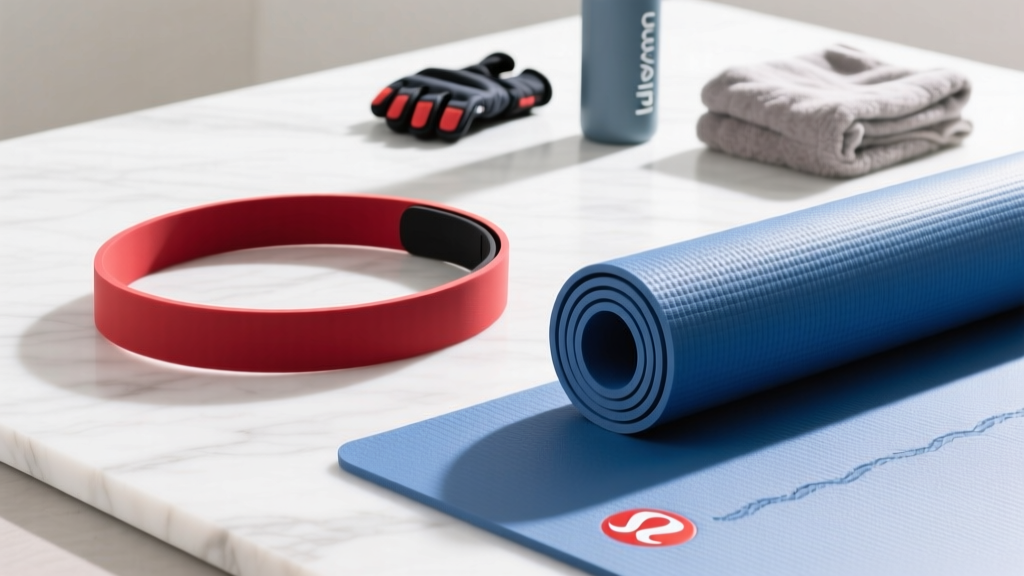
Expert Insight: Always perform your pre-workout band inspection on a clean, closed-cell surface. Your FSA-eligible yoga mat (such as a Manduka PRO or Liforme) features a non-porous, closed-cell surface that repels grit and sweat. By laying your loop bands flat on your mat, you can visually trace the entire perimeter for edge nicks without introducing new abrasive contaminants.
To maintain loop bands, wipe them down with a damp microfiber cloth and a mild, non-oil-based soap (like diluted Dawn dish soap) immediately after use. Never use alcohol-based wipes or bleach, as these strip the natural moisture from the latex, accelerating dry-rot and causing the band to turn brittle and chalky.
Tube Band Longevity: Hardware and Inner-Cord Inspection
Tube bands introduce mechanical hardware into the equation—specifically, metal carabiners, plastic handles, and nylon straps. The junction where the metal carabiner clips into the plastic or nylon strap of the tube is the highest-risk failure point in any home gym setup.
⚠️ The Snap-Back Danger Zone
According to safety guidelines highlighted by the American Council on Exercise (ACE), tube bands without internal safety cords pose a severe laceration and ocular injury risk if the outer tubing snaps. Always verify that your tube bands feature an inner woven nylon or Kevlar cord (rated for at least 150 lbs of tensile strength per tube). Even if the outer rubber degrades and snaps, the inner cord will hold the tension, preventing a dangerous snap-back to your face or torso.
Hardware Maintenance Protocol
- Carabiner Gate Check: Ensure the spring-loaded gate on the carabiner closes flush every time. A gate that sticks open can easily slice through the nylon strap of the tube band under heavy load.
- Strap Fraying Inspection: Run your fingers along the nylon strap connecting the tube to the handle. If you feel frayed threads or notice the plastic crimping is bending, retire the attachment immediately.
- Internal Cord Tactile Test: Pinch the tube and slide your fingers along its length. You should feel the distinct, braided ridge of the inner safety cord. If the cord feels loose, disconnected, or entirely absent inside the tubing, the band is compromised.
Chemical Degradation: Sweat, Oils, and Cleaning Protocols
Human sweat is highly acidic and contains urea, salts, and sebum (skin oils). Natural latex is incredibly porous at a microscopic level. When sebum penetrates the latex matrix, it breaks down the sulfur cross-links created during the vulcanization process. This results in the band losing its elastic memory, becoming permanently stretched out, or turning into a sticky, degraded mess.
To combat this, adopt a strict post-workout cleaning regimen:
- Step 1: Mix a solution of 1 part mild baby shampoo to 10 parts distilled water in a spray bottle.
- Step 2: Lightly mist the bands (do not soak them) and wipe them down with a lint-free microfiber towel.
- Step 3: Allow the bands to air-dry completely in a shaded, well-ventilated area before storage. Never use a hairdryer or place them near a HVAC vent, as rapid heat fluctuations cause micro-fissures in the rubber.
Storage Matrix: Preserving Tensile Strength
How you store your bands between workouts dictates their ultimate lifespan. UV radiation from sunlight and ozone from household electronics (like treadmills or air purifiers) are the silent killers of elastomers. TheraBand's clinical guidelines emphasize keeping elastomers away from direct sunlight and extreme temperature fluctuations to maintain their durometer rating.
| Storage Method | Longevity Impact | Best For |
|---|---|---|
| Hanging on Wall Hooks | Poor. Creates permanent stress points and stretches the band unevenly. | Short-term drying only. |
| Plastic Bins in Garage | Moderate. Protects from UV, but garages experience extreme temperature swings that degrade latex. | Tube bands with handles. |
| Mesh Bags in Climate-Controlled Room | Excellent. Allows airflow, prevents moisture buildup, and maintains stable room temperature. | All loop and tube bands. |
| Talcum Powder Coating | Superior. Prevents latex layers from fusing together during long-term storage. | Natural latex loop bands. |
The 3-Point Safety Check: When to Retire Your Bands
No amount of maintenance can make a resistance band last forever. Elastomers have a finite fatigue life. Before every heavy compound movement (like banded squats or assisted pull-ups), perform this 3-point safety check on your FSA yoga mat:
- The Stretch Test: Anchor the band and stretch it to 2.5x its resting length. Look closely at the edges. If you see any white stress marks, micro-cracks, or "chalky" discoloration, the latex polymers are breaking down.
- The Tactile Glide: Run a damp cotton ball along the entire surface of the band. If the cotton snags on a micro-tear that is invisible to the naked eye, the band will fail under load.
- The Odor Check: If your natural latex bands emit a sour, rancid, or overly chemical odor (beyond the normal initial rubber smell), the material is actively degrading and breaking down at a chemical level.
By understanding the distinct mechanical vulnerabilities of loop versus tube bands, and by leveraging the clean, sterile environment of your FSA yoga mat for rigorous inspections, you can maximize the lifespan of your gear, protect your financial investment, and most importantly, train safely without the risk of catastrophic snap-backs.
More gear to consider
All reviews
Beyond the Yoga Mat Discount: Foam Roller Density & Size Compared

Beige Yoga Mat Guide: Thickness, Material & Grip Compared
Loop Band vs Tube Band Comparison & Lululemon Yoga Mat Care

Resistance Band Set Guide: Match Levels to Camouflage Yoga Mat

Best Yoga Mat for Bed Use: 2026 Thickness & Grip Test
