
Beyond the Yoga Mat: 2026 Market Trends for Loop vs Tube Bands
Discover 2026 market trends moving beyond the yoga mat. We compare loop vs tube bands with pricing, material science, and biomechanical data.

The Shift Beyond the Yoga Mat: 2026 Resistance Band Market Overview
For the past decade, the home fitness accessories market was heavily anchored by a single, ubiquitous product: the standard PVC yoga mat. However, as we navigate the 2026 fitness landscape, consumer spending and manufacturer R&D have shifted dramatically. The real growth vector is now found in the peripheral resistance market. Moving beyond the yoga mat, consumers are demanding specialized, biomechanically optimized resistance tools. At the center of this $4.2 billion elastic resistance market is a highly debated comparison: loop bands versus tube bands.
While casual consumers often use the terms interchangeably, industry analysts, physical therapists, and elite strength coaches recognize them as fundamentally different tools with distinct material properties, failure modes, and market trajectories. This trend report dissects the material science, market share dynamics, and practical applications of loop versus tube bands in 2026.
Material Science: TPE vs. Natural Latex
To understand the market divide, we must first look at the polymers driving production. The resistance band market is currently bifurcated by material:
- Thermoplastic Elastomer (TPE): Dominates the flat, continuous 'mini' loop band segment. TPE is cheap to injection-mold, latex-free, and highly resistant to UV degradation. However, its elongation-at-break limit is relatively low (typically 300% to 400%).
- 100% Malaysian Natural Latex: The gold standard for heavy-duty tubular bands, thick pull-up assist loops, and premium tube bands. Natural latex offers superior elastic memory and can safely elongate up to 600% to 700% before structural failure.
According to biomechanical analyses published by the National Institutes of Health (NIH), the variable resistance profile of natural latex closely mimics the human muscle strength curve, providing peak tension at the point of maximum muscle contraction. This makes premium latex bands highly effective for hypertrophy, a key selling point in the 2026 market.
Biomechanical & Market Comparison Matrix
| Feature | Flat TPE Loop Bands (Mini Bands) | Heavy Latex Loop Bands (Pull-Up) | Extruded Tube Bands (w/ Handles) |
|---|---|---|---|
| Primary Material | Injection-molded TPE | Layered Natural Latex | Hollow Latex or TPE w/ Nylon Core |
| Max Elongation | 300% - 400% | 600% - 700% | 300% (Limited by inner cord) |
| 2026 Wholesale Cost | $0.35 - $0.50 / unit | $8.00 - $12.00 / unit | $2.50 - $4.00 / set |
| Average Retail Price | $10.00 - $15.00 (Set of 5) | $25.00 - $45.00 (Single) | $30.00 - $60.00 (Full Kit) |
| Primary Failure Mode | Micro-tears from jewelry/nails | Oxidation & dry rot | Carabiner detachment / cord fray |
Loop Bands: The Glute-Hypertrophy Monopoly
Loop bands—specifically the flat, continuous TPE 'mini' bands—have maintained a stranglehold on the lower-body accessory market. Their seamless design allows them to be placed directly above the knees during hip thrusts, squats, and lateral band walks without the discomfort of rolling or pinching associated with older fabric or tubular alternatives.
The Rolling Problem and the 2026 Fabric Shift
A major consumer pain point over the last few years was the 'roll-up' effect, where TPE bands would slide up the thigh during high-rep sets. In response, the 2026 market has seen a massive surge in latex-core fabric loop bands. Brands like Peach Bands and Gymreapers have captured significant market share by wrapping a thick latex inner loop in a grippy, woven cotton-polyester blend. While these retail at a premium ($20-$30 for a set of three), their failure rate is virtually zero compared to bare TPE, and they solve the migration issue entirely.
'If you are programming high-volume lateral band walks or glute bridges, the continuous loop distributes force evenly across a wider surface area. This reduces localized shear stress on the skin and provides a more stable resistance vector than a clipped tube band.' — Insights adapted from the American Council on Exercise (ACE) exercise library guidelines.
Tube Bands: The Anti-Snap Revolution & Rehab Resurgence
While loop bands dominate social media-driven lower-body workouts, tube bands are experiencing a massive resurgence in upper-body training, home-gym setups, and clinical rehabilitation. The defining feature of modern tube bands is the integration of safety mechanisms and modular attachments.
The Anti-Snap Inner Cord
The most significant innovation in the tube band sector is the anti-snap inner cord. Pioneered by brands like Bodylastics, modern premium tube bands feature a braided nylon core running through the hollow center of the latex tube. This cord is measured to be exactly 300% of the tube's resting length. If the latex degrades and snaps, the nylon cord catches the tension, preventing the violent 'snap-back' that historically caused severe eye and facial injuries. This safety feature has made tube bands the mandated standard for commercial senior living fitness centers and physical therapy clinics in 2026.
⚠️ Edge Case Warning: Carabiner Shear StressThe weakest link in any tube band system is not the rubber, but the metal carabiner connecting the tube to the handle. Cheap, stamped-aluminum carabiners can suffer gate failure under asymmetric loads (e.g., single-arm woodchoppers). Always look for tube band kits that utilize forged steel or anodized aircraft-aluminum carabiners with a minimum tensile rating of 400 lbs.
Use-Case Decision Framework for Retailers and Consumers
Choosing between loop and tube bands is not about finding a universally 'better' product; it is about matching the tool to the biomechanical demand. Use this framework to guide purchasing or inventory decisions:
1. The Glute & Lower-Body Hypertrophy Segment
- Winner: Fabric-Wrapped Loop Bands.
- Why: Continuous tension without pinch points. The wide surface area prevents migration during hip-dominant movements.
- Top 2026 Pick: Rogue Fitness Echo Fabric Bands (Retail: ~$25).
2. The Upper-Body & Pulling Segment
- Winner: Tube Bands with Handles & Door Anchors.
- Why: Handles allow for natural wrist supination and pronation during rows, curls, and presses. Door anchors enable high-to-low cable crossover simulations that loop bands cannot safely replicate.
- Top 2026 Pick: Bodylastics Patent-Pending Anti-Snap Set (Retail: ~$40).
3. The Powerlifting & Pull-Up Assist Segment
- Winner: Heavy-Duty Layered Latex Loop Bands (41-inch).
- Why: Extreme elongation capacity and high poundage (up to 150+ lbs of resistance). Essential for accommodating resistance on barbell squats and deadlifts.
- Top 2026 Pick: Rogue Monster Bands (Retail: $22 - $45 depending on width).
Future Forecasting: Smart Bands and Eco-Materials
Looking toward late 2026 and 2027, the resistance band market is pivoting toward two major trends. First, the integration of smart tensile sensors into tube band handles, allowing users to track exact peak force output and time-under-tension via Bluetooth. Second, a push for bio-based elastomers to replace petroleum-based TPE, driven by eco-conscious consumers demanding sustainable fitness gear. Brands that successfully merge the safety of anti-snap tube technology with sustainable materials will capture the premium tier of the market.
Frequently Asked Questions (FAQ)
Can I use a loop band for upper body workouts?
Yes, but it is suboptimal for pulling movements. Without handles, gripping a flat loop band for rows or lat pulldowns limits grip strength and alters the biomechanical path of the wrist. Tube bands with handles are vastly superior for upper-body isolation.
How long do natural latex bands last compared to TPE?
TPE bands generally outlast latex in outdoor or high-UV environments because they are immune to UV degradation. However, in a climate-controlled indoor gym, a high-quality Malaysian latex band will maintain its elastic memory and tensile strength 3 to 4 times longer than a TPE band before becoming permanently stretched out.
Are fabric loop bands worth the higher price?
Absolutely. For lower-body work, fabric loop bands eliminate the skin-pinching and thigh-rolling associated with bare TPE or latex. Their durability is also significantly higher, making the $20-$30 investment highly cost-effective over a multi-year lifespan.
More gear to consider
All reviews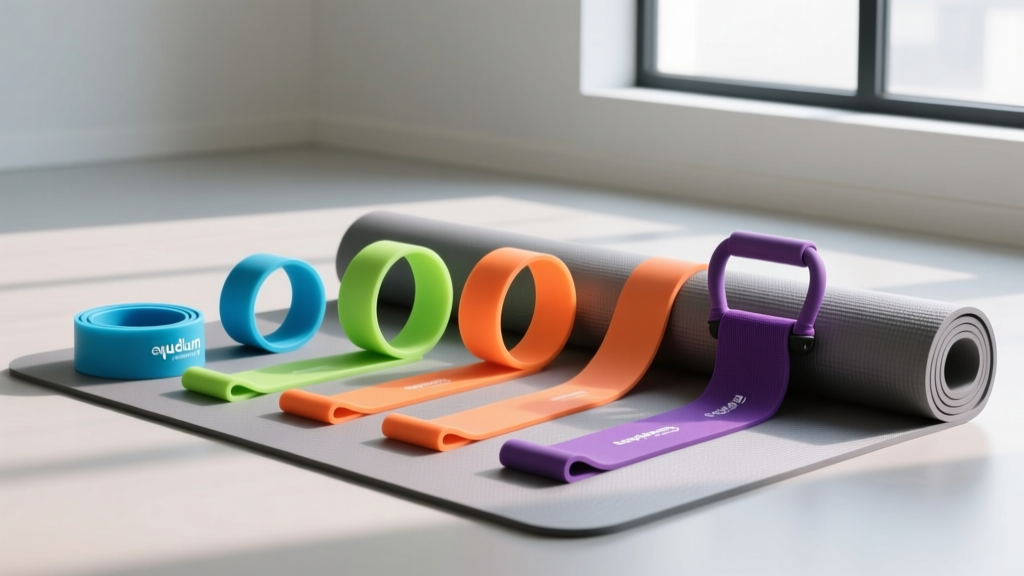
2026 Resistance Band Guide: Levels, Types & Yoga Mat Images

Pilates Accessories Budget Guide: Manduka eQua Yoga Mat Towel Value

Beyond the Bunny Yoga Mat: A Beginner's Resistance Band Guide

Subway and Yoga Mats vs Foam Rollers: Density & Size Guide
Pilates Accessories Guide: Best Yoga Mat Disinfectant for Longevity
