Assault Curved Treadmill vs Motorized: HP & Motor Guide
Compare the 0 HP Assault Curved Treadmill against 4.0 CHP motorized rivals. Our expert guide breaks down treadmill motor sizes, heat, and biomechanics.

The Great Treadmill Debate: Human Power vs. Horsepower
When shopping for a high-end home gym cardio machine in 2026, the conversation almost immediately turns to motor size. Fitness forums and buying guides obsess over Continuous Duty Horsepower (CHP), flywheel weight, and thermal protection. But what happens when you remove the motor entirely?
This guide uses a unique head-to-head product comparison to teach you everything you need to know about treadmill motor sizing and horsepower. We are pitting the pinnacle of non-motorized, human-powered engineering—the Assault Curved Treadmill (0 HP)—against two of the most formidable high-CHP motorized workhorses on the market: the Sole F85 (4.0 CHP) and the NordicTrack Commercial 1750 (3.75 CHP). By examining the extremes of treadmill design, you will learn exactly how motors work, why they fail, and whether you actually need one at all.
Decoding Treadmill Motors: Peak HP vs. CHP
Before comparing machines, we must dismantle a common marketing myth: Peak Horsepower. According to the Consumer Reports Treadmill Buying Guide, Peak HP measures the absolute maximum output a motor can achieve for a fraction of a second before it overheats or trips a breaker. It is virtually useless for evaluating a treadmill's real-world performance.
Expert Tip: Always Look for CHP
Continuous Duty Horsepower (CHP) is the metric that matters. It measures the power the motor can sustain indefinitely during a heavy workout. For walkers, 2.0 CHP is sufficient. For joggers, aim for 2.5 to 3.0 CHP. For serious runners over 200 lbs, a minimum of 3.5 CHP is mandatory to prevent the motor controller board from frying under heavy amp draw.
Furthermore, almost all residential motorized treadmills use Direct Current (DC) motors. DC motors are quieter and allow for precise speed adjustments via voltage manipulation. Commercial gym treadmills use Alternating Current (AC) motors, which are brushless and designed to run for 12+ hours a day, but they are incredibly loud and heavy for home use.
Head-to-Head Comparison Matrix
Let us look at the raw specifications of our three contenders to understand how a 0 HP machine competes with high-CHP electric models.
| Feature | Assault Curved Treadmill | Sole F85 | NordicTrack Commercial 1750 |
|---|---|---|---|
| Motor Type | Non-Motorized (Human-Powered) | 4.0 CHP DC Motor | 3.75 CHP DC Motor |
| Top Speed | Unlimited (User-Dependent) | 12 MPH | 12 MPH |
| Belt System | 1/8" Vulcanized Rubber Slats | 22" x 60" 2-Ply Woven | 22" x 60" 2-Ply Woven |
| Incline/Decline | Fixed Curve (Simulates 3-5%) | 0% to 15% Incline | -3% Decline to 15% Incline |
| Max User Weight | 350 lbs | 400 lbs | 300 lbs |
| Approx. Price (2026) | $5,499 | $2,599 | $2,799 |
Contender 1: The 0 HP Marvel (Assault Fitness)
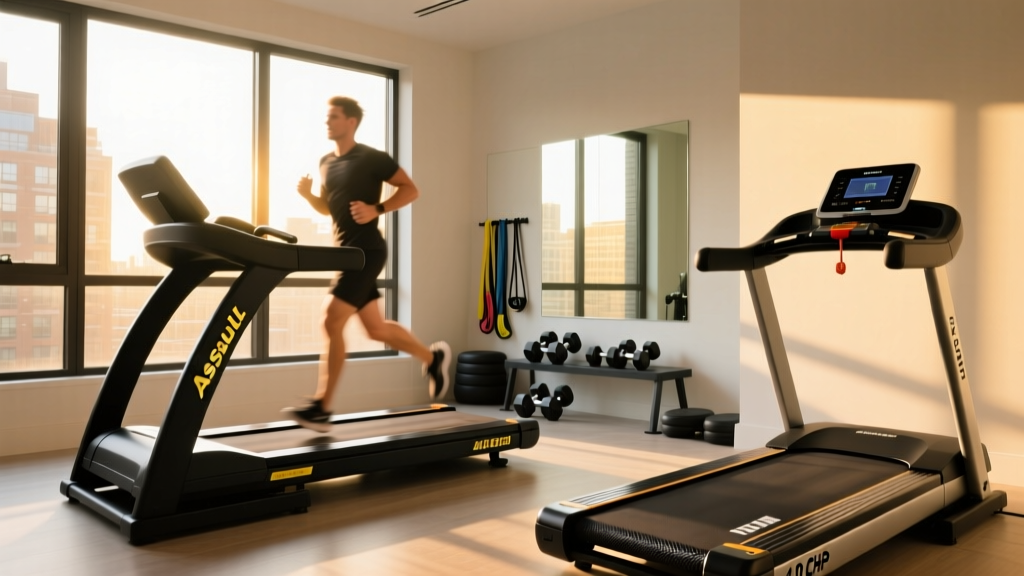
The Assault Curved Treadmill completely eliminates the motor, the drive belt, and the motor controller board (MCB). Instead, it relies on physics. The concave shape of the running surface utilizes gravity and friction. When you run on the front curve, your body weight pulls the slat belt down and backward. When you move toward the rear curve, you slow down.
Because there is no motor, there is no electrical heat buildup. The resistance is entirely biomechanical. The belt is constructed of individual vulcanized rubber slats riding on sealed cartridge bearings and polyurethane guide wheels. This design allows for instantaneous acceleration and deceleration, making it the gold standard for High-Intensity Interval Training (HIIT) and Tabata protocols where a motorized treadmill's belt speed cannot change fast enough to keep up with the user.
Contender 2 & 3: The High-CHP Workhorses
Sole F85 (4.0 CHP)
The Sole F85 is a masterclass in traditional motor sizing. Its 4.0 CHP DC motor is paired with a massive, heavy flywheel. A heavier flywheel maintains rotational momentum, which reduces the sudden amp spikes that occur every time your foot strikes the deck. This means the motor works less to maintain speed, generating less heat and extending the lifespan of the internal copper windings.
NordicTrack Commercial 1750 (3.75 CHP)
NordicTrack takes a slightly different approach. The 3.75 CHP motor is highly efficient and paired with an active internal cooling fan that forces air over the motor housing. However, the 1750's true motor complexity lies in its incline and decline motors. Moving a 300-pound user down a -3% decline requires a secondary motor to actively pull the deck down, adding significant electronic complexity and potential failure points compared to the Sole or the Assault.
The Biomechanics of Belt Friction and Motor Strain
Why does motor size matter so much? It comes down to amp draw and belt friction. When a 220-pound runner hits a motorized treadmill deck at 8 MPH, the downward force creates immense friction between the belt and the wooden deck. The motor must draw high amperage (often 12 to 18 amps) to overcome this friction. If the motor is undersized (e.g., 2.5 CHP), it will overheat, and the thermal breaker will shut the machine off mid-run.
Research published in the National Library of Medicine demonstrates that running on a non-motorized curved treadmill elicits a significantly higher physiological demand. The study found that oxygen consumption (VO2) and heart rate were markedly higher on curved treadmills compared to motorized ones at the same perceived pace, largely due to the absence of motorized belt assistance and the need for the user to overcome the mechanical friction of the slat system.
On the Assault Curved Treadmill, you are the motor. The machine does not draw electricity to move the belt; it only draws a negligible amount of power for the LCD display. Therefore, user weight does not cause electrical overheating. A 300-pound athlete will not trip a breaker on an Assault AirRunner, whereas that same athlete performing hill sprints on an undersized 2.0 CHP motorized treadmill could easily melt the motor controller board.
Failure Modes: What Actually Breaks?
Understanding how these machines fail is crucial for long-term home gym planning. The absence of a motor completely shifts the maintenance paradigm.
Motorized Treadmill Failure Points
- Motor Controller Board (MCB): The #1 point of failure. Power surges or sustained high-amp draws from heavy runners or lack of deck lubrication will fry the MCB. Replacement costs range from $150 to $300.
- Drive Belt: The rubber belt connecting the motor shaft to the front roller can stretch or snap under heavy loads.
- Deck Warping: If the user neglects to apply 100% silicone lubricant under the belt every 3-6 months, friction will literally burn through the wooden deck and seize the motor.
Non-Motorized (Assault Curved) Failure Points
- Slat Belt Bearings: The sealed cartridge bearings inside the rubber slats can degrade over thousands of miles, requiring individual slat replacement.
- Urethane Guide Wheels: The small wheels that keep the belt tracking on the curve will eventually wear down and need replacing (usually a $50-$75 maintenance kit).
- Guide Rail Lubrication: The side rails require periodic dry PTFE spray to prevent the slat edges from dragging and creating excess mechanical friction.
The Verdict: Choosing Your Drive System
When evaluating treadmill motor size and horsepower, your decision ultimately hinges on your training style, maintenance tolerance, and budget.
Choose the Assault Curved Treadmill (0 HP) if: You are an athlete focused on HIIT, sprint mechanics, and functional fitness. You want a machine that requires zero electrical maintenance, will never suffer a blown motor controller, and forces you to engage your posterior chain (glutes and hamstrings) to propel the belt. The $5,499 price tag is steep, but the total cost of ownership over a decade is remarkably low due to the absence of complex electronics.
Choose the Sole F85 (4.0 CHP) if: You are a traditional distance runner who prefers steady-state cardio, long runs over 10 miles, and the passive assistance of a motorized belt. The 4.0 CHP motor is robust enough to handle heavy users without thermal shutdown, and the heavy flywheel ensures a smooth, consistent pace.
Choose the NordicTrack 1750 (3.75 CHP) if: You want immersive, interactive training. The 3.75 CHP motor is highly capable, but the real draw is the iFIT integration, which automatically adjusts the incline and decline motors to simulate global terrains. Just be prepared for the ongoing subscription costs and the higher likelihood of electronic component maintenance down the line.
Frequently Asked Questions
Can I upgrade the motor on my existing treadmill?
No. Treadmill motors are precisely matched to the machine's frame weight, roller diameter, and MCB voltage limits. Installing a higher CHP motor on a frame designed for a 2.5 CHP motor will instantly overload the wiring harness and controller board, creating a severe fire hazard.
Does a curved treadmill burn more calories than a motorized one?
Yes. Because you must manually overcome the friction of the slat belt and the upward curve of the track, studies show that non-motorized curved treadmills can increase caloric expenditure by 10% to 30% compared to running at the exact same speed on a flat, motorized treadmill.
What size treadmill motor do I need for walking only?
If you are strictly walking (under 4.5 MPH) and weigh under 200 lbs, a 2.0 to 2.25 CHP motor is perfectly adequate. You do not need to pay a premium for 3.5+ CHP motors unless you plan to run or have multiple heavy users sharing the machine.
More gear to consider
All reviews
LifeSmart TM3000 PowerTouch Treadmill vs Air Bike: Assault Guide

Backwards Treadmill for Knees: Belt Maintenance & Lubrication

How to open a ProForm treadmill and fix home stair climber errors

Cardio Treadmill Workouts: 2026 Belt Maintenance & Lubrication Guide
Centr Runr Treadmill vs Walking Pads: 2026 Compact Desk Review