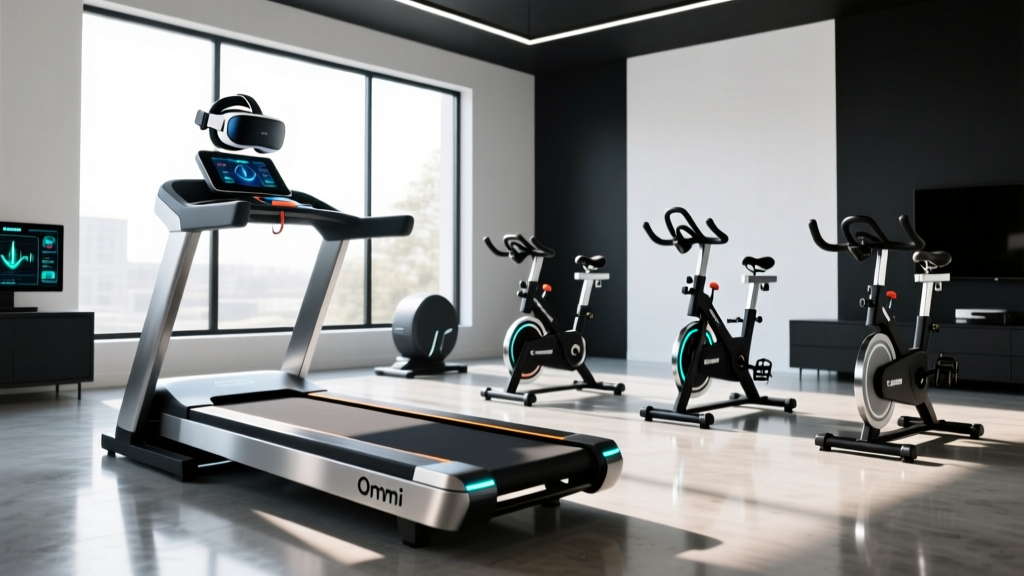
Omni VR Treadmill vs Stationary Bike Types: 2026 Market Trends
Explore 2026 market trends: Omni VR treadmill vs. stationary bike types. Compare pricing, tech, and biomechanics for upright, recumbent, and spin models.

The 2026 Cardio Landscape: Immersive Locomotion vs. Traditional Pedaling
The home fitness equipment market in 2026 is defined by a fascinating bifurcation. On one side, we have the rapid ascent of fully immersive, omnidirectional platforms—most notably the omni vr treadmill ecosystems pioneered by companies like Virtuix. On the other, we have the entrenched, biomechanically optimized stationary bike market, which continues to evolve through precision magnetic resistance and integrated telemetry. As consumers evaluate high-ticket cardio investments ranging from $1,000 to $3,000, the decision is no longer just about burning calories; it is about spatial footprint, joint preservation, and software engagement.
This trend report and market analysis dissects the current landscape, comparing the gamified, full-body engagement of the omni vr treadmill against the distinct mechanical realities and market shares of the three primary stationary bike types: upright, recumbent, and spin (indoor cycling).
Market Share & The Immersive Disruption
Historically, spin bikes have dominated the premium home cardio sector, capturing nearly 45% of the high-end market share due to the explosive growth of connected fitness platforms like Zwift and Peloton. Upright bikes hold roughly 30%, favored by traditionalists and space-constrained users, while recumbent bikes maintain a steady 25%, heavily driven by the aging demographic and physical rehabilitation sectors.
However, the introduction and consumer adoption of the omni vr treadmill (such as the Virtuix Omni One, priced around $2,595) has disrupted the premium tier. By allowing users to physically run, strafe, and walk in a 360-degree virtual environment, the omni vr treadmill forces traditional bike manufacturers to accelerate their own AR/VR integrations and gamified resistance profiles to prevent subscriber churn.
Market Insight: While the omni vr treadmill offers unparalleled neuromuscular engagement and spatial awareness, it requires a minimum 10x10 foot clear zone and a $100+ monthly game subscription. Stationary bikes remain the undisputed champions of high-intensity interval training (HIIT) in compact, multi-use living spaces.
Deep Dive: Stationary Bike Types in 2026
To understand how traditional cardio is competing with immersive VR locomotion, we must analyze the specific engineering, pricing, and failure modes of the three dominant stationary bike types.
1. Spin Bikes (Indoor Cycling)
Spin bikes mimic the aggressive, forward-leaning geometry of road bicycles. They are the preferred modality for high-cadence interval training and virtual racing.
- Top 2026 Models: Peloton Bike+ ($2,495), NordicTrack S24 ($1,799), Schwinn IC4 ($899).
- Biomechanics: Requires significant core stabilization and hip flexor mobility. The steep seat tube angle (typically 73-75 degrees) maximizes glute and hamstring recruitment during out-of-the-saddle climbs.
- Common Failure Modes: The primary enemy of the spin bike is sweat-induced chloride corrosion. In 2026, the most frequent warranty claims involve bottom bracket bearing degradation and handlebar post rust if users fail to wipe down the frame after high-sweat HIIT sessions. Belt-drive tension loss is another edge case, requiring a 14mm wrench adjustment every 1,500 miles.
2. Upright Bikes
Upright bikes feature a more relaxed geometry with a wider, plush saddle and higher handlebars. They are the quintessential 'general fitness' machines.
- Top 2026 Models: Sole B94 ($1,199), Life Fitness C7 ($2,899), Nautilus U618 ($799).
- Biomechanics: According to the American Heart Association, upright cycling provides excellent cardiovascular conditioning with lower impact than running. However, the smaller saddle and upright posture can concentrate pressure on the perineal area and lumbar spine during rides exceeding 60 minutes.
- Common Failure Modes: Pedal spindle thread stripping is a known issue on sub-$800 models when users apply excessive lateral torque during standing sprints. Additionally, the console membrane buttons on mid-tier uprights frequently fail after 3-4 years due to UV exposure and repeated friction.
3. Recumbent Bikes
Recumbent bikes feature a bucket seat with a backrest and a forward-located pedal crank. They are the gold standard for joint preservation and active recovery.
- Top 2026 Models: Schwinn 270 ($899), Life Fitness RSX ($3,299), Sole R92 ($1,299).
- Biomechanics: Recumbent cycling reduces lumbar shear force by up to 40% compared to upright cycling, making it the recommended modality for users with spinal stenosis or sciatica. The CDC's aerobic guidelines highlight recumbent cycling as an ideal sustained moderate-intensity activity for older adults or those managing hypertension.
- Common Failure Modes: The seat carriage glides on a linear aluminum rail. Dust and pet hair accumulation on this rail causes the seat adjustment mechanism to stutter and grind. Furthermore, the mesh backing on budget recumbent seats tends to sag and lose lumbar support after roughly 2,000 hours of use.
⚠️ Technical Warning: Magnetic Resistance Calibration
Across all stationary bike types in 2026, eddy-current magnetic resistance is the standard. However, a non-obvious failure mode is sensor dust accumulation. If the optical or Hall-effect sensor that reads the flywheel RPM becomes coated in micro-dust, the console will display erratic wattage and calorie outputs. We recommend using compressed air on the resistance housing every 6 months to maintain telemetry accuracy, especially if you use your bike in a garage or basement gym.
Comparison Matrix: Bikes vs. The Omni VR Treadmill
How do the traditional stationary bike types stack up against the omni vr treadmill regarding spatial requirements, financial investment, and technological integration? The table below outlines the 2026 market realities.
| Modality | Avg. Premium Price | Footprint (L x W) | Primary Use Case | Tech / VR Integration |
|---|---|---|---|---|
| Omni VR Treadmill | $2,595+ | 10 ft diameter clear zone | Gamified full-body cardio, spatial navigation | Native 360° VR (Meta Quest / SteamVR) |
| Spin Bike | $1,799 - $2,495 | 59" x 22" | HIIT, virtual racing, high-wattage output | Screen-based (Zwift, Rouvy); VR casting emerging |
| Upright Bike | $1,199 - $1,599 | 48" x 30" | Steady-state cardio, general fitness | Basic Bluetooth FTMS to 3rd party apps |
| Recumbent Bike | $899 - $3,299 | 65" x 27" (Long wheelbase) | Rehab, joint preservation, active recovery | Low; focused on media consumption & telemetry |
Consumer Buying Framework: Which Modality Wins in 2026?
Choosing between an omni vr treadmill and a traditional stationary bike requires an honest assessment of your physical limitations, spatial constraints, and psychological drivers for exercise adherence.
The Case for the Omni VR Treadmill
If you suffer from exercise boredom and require high-level cognitive engagement to maintain a cardio habit, the omni vr treadmill is unmatched. Platforms like Virtuix have proven that gamifying locomotion increases average session times by over 30%. However, you must have the dedicated square footage, the willingness to wear a VR headset while sweating, and the budget for ongoing software subscriptions. It is a lifestyle centerpiece, not a corner-filler.
The Case for Stationary Bikes (Upright, Recumbent, Spin)
For pure cardiovascular efficiency per square foot, stationary bikes remain the apex predators of the home gym.
- Choose Spin if your goal is maximizing VO2 max, participating in competitive virtual leagues, and you have the hip mobility to sustain an aggressive aero posture.
- Choose Upright if you want a traditional, low-fuss cardio experience that allows you to read, work on a laptop, or watch TV without the sensory isolation of a VR headset.
- Choose Recumbent if you are managing lower back pain, recovering from lower-extremity joint surgery, or require a machine that multiple generations in a household can use safely without complex seat-post adjustments.
The Verdict: Convergence on the Horizon
As we move through 2026, the market is not treating the omni vr treadmill and stationary bikes as mutually exclusive, but rather as distinct tools for different physiological and psychological needs. We are already seeing beta integrations where high-end spin bikes are being paired with mixed-reality (MR) headsets, attempting to bridge the gap between the pedaling efficiency of a bike and the spatial immersion of an omnidirectional treadmill. Until that convergence is perfected, understanding the exact mechanical strengths and failure modes of upright, recumbent, and spin bikes remains essential for any serious home gym investment.
More gear to consider
All reviews
Elliptical vs Treadmill vs Treadmill Bike Maintenance

Elliptical vs Treadmill: Weighing ProForm Treadmill Support Costs

Rowing Machine Buying Guide: Technique & 1750 Treadmill Comparison

Soul Treadmills vs Stair Climbers: 2026 Home Buying Guide

Flexispot WPS03 Walking Pad Treadmill: Office Space & Layout Review
