Belt Maintenance for Your NordicTrack Treadmill with Incline
Learn expert belt maintenance and lubrication tips for your NordicTrack treadmill with incline. Extend motor life and prevent deck wear with our guide.

Owning a NordicTrack treadmill with incline capabilities—such as the Commercial 1750, the Commercial 2450, or the extreme-grade X22i Incline Trainer—transforms your home gym into a dynamic climbing and running studio. However, the mechanical demands of elevating a running surface to 15% or even 40% grades introduce unique stress vectors that standard flat-deck treadmills simply do not experience. Proper belt maintenance and lubrication are not just optional upkeep tasks; they are critical interventions required to prevent catastrophic motor failure and premature deck degradation.
In this comprehensive maintenance guide, we break down the exact physics of incline friction, the specific lubricants required by NordicTrack's phenolic resin decks, and the step-by-step procedures to keep your machine running silently and efficiently for years to come.
Expert Insight: According to service data from ICON Health & Fitness Service (the parent company of NordicTrack), over 60% of premature motor control board (MCB) failures in incline treadmills are directly traced back to inadequate belt lubrication and the resulting amp-draw spikes under heavy incline loads.The Physics of Incline Friction and Deck Stress
When you operate a NordicTrack treadmill with incline features, the biomechanics of your stride and the mechanical load on the machine shift dramatically. On a flat deck, your body weight is distributed relatively evenly across the center of the running belt. When the incline lift motor raises the front of the deck to a 15% grade, your center of gravity shifts backward.
This backward shift concentrates the majority of the friction and impact force on the rear two-thirds of the treadmill deck. If the belt is dry or under-lubricated, this concentrated friction zone generates immense heat. The drive motor must work significantly harder to pull the belt over the deck against your body weight and gravity. This increased resistance causes the motor's amp draw to spike. Over time, these thermal and electrical spikes will degrade the belt's cotton backing, warp the MDF deck core, and eventually fry the motor controller.
Selecting the Correct Lubricant: The 100% Silicone Rule
NordicTrack treadmills feature decks coated with a specialized phenolic resin or factory-applied wax designed to minimize friction. Using the wrong chemical composition will strip this coating, melt the belt backing, and void your warranty.
- Approved: 100% pure silicone liquid or gel (specifically formulated for fitness equipment). NordicTrack sells their own branded silicone lubricant, but any high-grade, 100% pure non-petroleum silicone designed for treadmill decks will work.
- Strictly Prohibited: WD-40, silicone sprays containing propellants or petroleum distillates, Teflon-based sprays, and household oils. Aerosol propellants can degrade the elastomer cushioning system beneath the deck.
For most NordicTrack models, a single application requires exactly 0.5 to 1.0 ounces of liquid silicone. Over-lubricating is just as harmful as under-lubricating, as excess silicone will sling off the belt at high speeds, coating the motor housing and creating a dust-magnet that chokes the motor's cooling fan.
Step-by-Step Belt Lubrication Procedure
Perform this maintenance routine every 130 miles or every 3 to 6 months, depending on your usage frequency and the ambient humidity of your gym space.
1. Preparation and Safety
Always unplug the treadmill from the wall outlet. Remove the safety key from the console. This prevents accidental startup while your hands are near the drive roller.
2. Loosening the Belt Tension
Locate the two rear roller adjustment bolts at the very back of the treadmill frame. Using the correct size hex key (usually a 5mm or 6mm Allen wrench for NordicTrack Commercial series), turn both the left and right bolts exactly three full turns counter-clockwise. Mark the starting position of the bolts with a piece of painter's tape to ensure you can return them to the exact baseline tension later.
3. Applying the Silicone
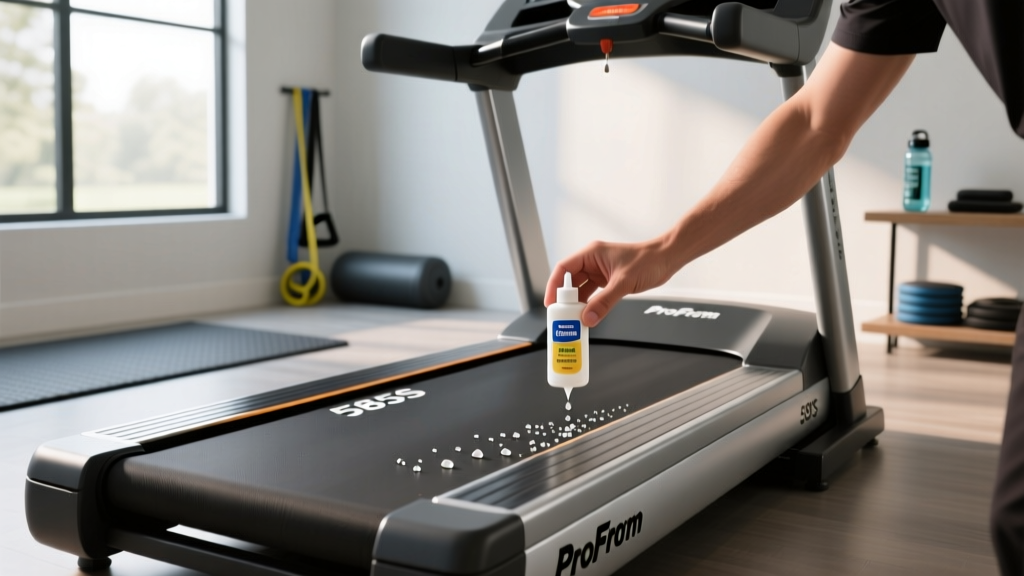
Lift the edge of the running belt on one side. Reach as close to the center of the deck as possible and apply half of your measured silicone (approx. 0.5 oz) in a zig-zag pattern from the front roller to the rear roller. Repeat this process on the opposite side of the belt with the remaining silicone.
4. Restoring Tension and Distribution
Turn both rear adjustment bolts exactly three full turns clockwise to restore the original belt tension. Plug the machine back in, insert the safety key, and turn the treadmill on. Set the speed to 1.0 mph and let it run for five minutes. Walk lightly on the belt to help distribute the silicone evenly across the entire deck surface.
Motor Amp Draw and Friction Metrics
Understanding the electrical toll of a dry belt helps illustrate why this maintenance is non-negotiable. The table below demonstrates how a dry belt impacts a standard 3.0 CHP NordicTrack drive motor under varying incline conditions.
| Deck Condition | Incline Grade | Avg Motor Amp Draw | Deck Temp Increase | Failure Risk |
|---|---|---|---|---|
| Freshly Lubricated | 0% (Flat) | 4.0 - 6.0 Amps | Ambient | Low |
| Dry / Neglected | 0% (Flat) | 8.0 - 11.0 Amps | +12°F | Moderate |
| Freshly Lubricated | 15% Incline | 9.0 - 12.0 Amps | +5°F | Low |
| Dry / Neglected | 15% Incline | 16.0 - 22.0 Amps | +35°F | Critical (MCB Burnout) |
As highlighted by equipment diagnostics experts at Fitness Repair Parts, sustained amp draws above 15 amps on a residential treadmill will trigger the internal thermal overload protector, causing the machine to abruptly shut down mid-run to prevent a fire hazard.
Belt Alignment and Tension Under Incline Torque
A common issue specific to a NordicTrack treadmill with incline mechanics is belt drift. When the heavy steel frame is raised to a 40% grade on an X-series Incline Trainer, the sheer torque applied to the chassis can cause microscopic twisting. This twisting alters the parallel alignment of the front and rear rollers, causing the belt to track slightly to the left or right.
Never adjust the belt tension while the machine is under heavy incline. Always lower the deck to a 0% flat position before making alignment adjustments to ensure the frame is in its natural, untwisted resting state.
The Quarter-Turn Adjustment Rule
If your belt drifts to the right during a steep climb, locate the right rear adjustment bolt. Turn it exactly one-quarter turn clockwise. Walk on the treadmill at 2.0 mph to observe the tracking. If it still drifts, apply another quarter turn. Never turn an adjustment bolt more than a half-turn at a time, as over-tightening will stretch the belt's polyester core and crush the deck bearings.
Diagnosing Irreversible Deck Wear
Lubrication prevents wear, but it cannot reverse it. If you have neglected your belt maintenance, you must inspect the deck for physical damage. Slide your hand under the belt and run your palm across the surface of the deck. A healthy phenolic resin deck feels smooth, almost like glass.
If you feel deep grooves, rough patches resembling sandpaper, or notice a buildup of black, gritty dust (which is actually the cotton backing of the belt disintegrating), your deck is compromised. Running a new belt over a grooved deck will destroy the new belt within weeks. According to Consumer Reports exercise equipment longevity studies, replacing a worn deck and belt simultaneously is the only way to restore the machine's factory efficiency. Expect to pay between $250 and $450 for OEM replacement deck and belt kits for Commercial series models, a cost easily avoided with a $12 bottle of silicone and 15 minutes of annual maintenance.
Frequently Asked Questions
Do brand new NordicTrack treadmills need immediate lubrication?
No. NordicTrack factory-applies a precise layer of wax or silicone to the underside of the belt and the top of the deck during manufacturing. You should not apply additional liquid silicone until you have logged at least 100 miles or 3 months of use, whichever comes first.
Can I use silicone spray from an automotive store?
Absolutely not. Automotive silicone sprays contain petroleum-based propellants and solvents that will dissolve the adhesive holding the treadmill belt's seams together and strip the deck's protective resin coating. Always use liquid silicone specifically labeled for fitness equipment.
Why does my treadmill smell like burning rubber when I use max incline?
A burning rubber odor at high inclines is the primary symptom of extreme friction caused by a dry belt or an over-tightened belt. Stop the machine immediately, allow it to cool, and perform the lubrication and tension-check procedures outlined above to prevent permanent motor damage.
More gear to consider
All reviews
LifeSmart TM2202 3-in-1 Treadmill vs Dedicated Cardio: Buyer Guide

IN10CT Treadmill: How to Use, Maintain, and Maximize Longevity

Are Treadmills Good for You? Curved vs Motorized Guide

C2255 NordicTrack Treadmill vs Walking Pads: Mistakes & Fixes
ProForm 585s Treadmill Belt Maintenance: Expert Lubrication Guide