Air Bike vs Assault Bike: Space & 12 3 30 Treadmill Workout
Compare Rogue Echo and AssaultBike ProX footprints, and learn how to adapt the 12 3 30 treadmill workout for compact home gym layouts in 2026.

The Spatial Dilemma: Viral Cardio vs. Square Footage
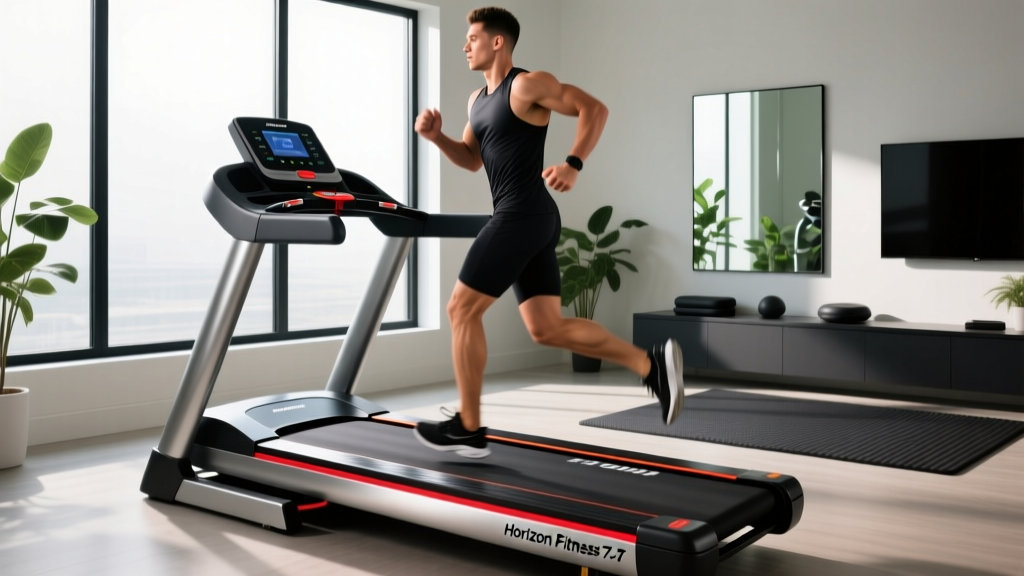
If you have spent any time on fitness forums or social media over the past few years, you have inevitably encountered the 12 3 30 treadmill workout. Popularized for its deceptively simple Low-Intensity Steady State (LISS) formula—12% incline, 3 mph speed, for 30 minutes—this routine delivers exceptional Zone 2 cardiovascular benefits without the joint impact of running. However, as urban living spaces shrink and home gym layouts become more constrained in 2026, the spatial reality of owning a treadmill is becoming a major hurdle.
A standard motorized treadmill requires a massive footprint, often dominating an entire room. For apartment dwellers or those converting small spare bedrooms into micro-gyms, the solution is pivoting to wind-resistance air bikes. But which model optimizes your floor plan best? This guide provides a deep-dive spatial comparison between the two industry titans—the Rogue Echo Bike and the AssaultBike ProX—and provides a precise, biomechanical framework for translating the 12 3 30 treadmill workout to an air bike without sacrificing the metabolic intent of the routine.
The Footprint Reality: Treadmills vs. Air Bikes
Before analyzing specific air bike models, we must quantify the spatial cost of the traditional 12 3 30 treadmill workout. To achieve a true 12% incline, you need a motorized treadmill with a robust lifting mechanism, which inherently increases the chassis size and weight.
| Equipment Model | Footprint (L x W) | Total Area | Unit Weight | Min. Ceiling Height |
|---|---|---|---|---|
| Sole F63 Treadmill | 82" x 35" | 19.8 sq ft | 212 lbs | 84" (7 ft) |
| Rogue Echo Bike (Gen 2) | 46.1" x 23.5" | 7.5 sq ft | 125 lbs | 84" (7 ft) |
| AssaultBike ProX | 50.9" x 23.3" | 8.2 sq ft | 140 lbs | 84" (7 ft) |
As the data illustrates, a treadmill consumes nearly three times the floor space of an air bike. Furthermore, treadmills require an additional 24 inches of clearance behind the deck for safety ejection zones, pushing the total required spatial allocation to nearly 35 square feet. Air bikes, conversely, can be tucked into tight corners, provided you account for handlebar sweep and lateral mounting clearance.
Air Bike vs. Assault Bike: Space & Layout Showdown
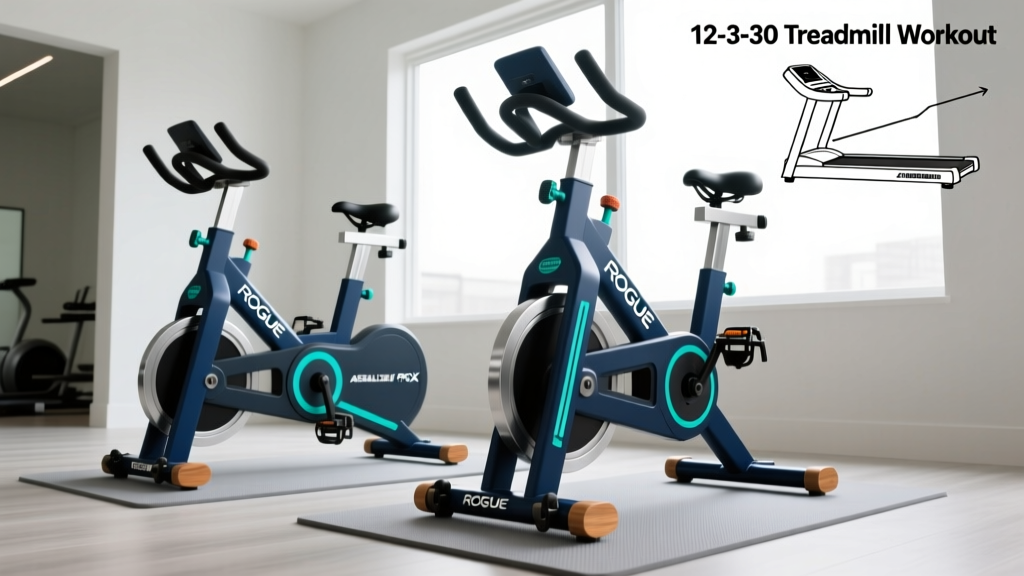
When designing a compact cardio zone, the choice between the Rogue Echo and the AssaultBike ProX comes down to drive-train mechanics, maintenance footprint, and structural geometry. Both are elite machines, but they interact with small spaces differently.
1. The Rogue Echo Bike: The Belt-Drive Advantage
The Rogue Fitness Echo Bike utilizes a quiet belt-drive system. For indoor, multi-use spaces (like a living room corner or a bedroom micro-gym), this is a massive advantage. Belt drives require zero lubrication, meaning you will never accidentally drip chain lube onto your hardwood floors or apartment carpets. The Echo's slightly shorter wheelbase (46.1 inches) makes it exceptionally easy to roll onto a standard 4x6 foot rubber stall mat, leaving room for a kettlebell or a set of dumbbells on the same mat.
2. The AssaultBike ProX: The Chain-Drive Behemoth
The AssaultBike ProX relies on a heavy-duty chain drive. While this provides a raw, mechanical feel preferred by CrossFit competitors, it demands regular cleaning and lubrication. In a tight spatial layout, this means you need to allocate storage space for degreasers and rags nearby. Additionally, the ProX is nearly 5 inches longer than the Echo. If you are placing the bike flush against a wall, the ProX's extended front stabilizer can interfere with baseboards or smart-home thermostat sensors mounted low on the wall.
Pro Layout Tip: Never push an air bike directly flush against a wall. The fan intake on the front of the chassis requires at least 12 inches of unobstructed airflow to prevent the internal monitor and bearings from overheating during long LISS sessions.
Translating the 12 3 30 Treadmill Workout to the Air Bike
The primary error athletes make when moving from a treadmill to an air bike is treating the resistance profiles as linear. On a treadmill, a 12% incline at 3 mph is a fixed, predictable workload. On an air bike, wind resistance scales exponentially with your RPM (Revolutions Per Minute). If you pedal at 70 RPM, you are no longer doing LISS cardio; you are doing high-intensity anaerobic intervals, which entirely defeats the purpose of the 12 3 30 routine.
According to the Mayo Clinic's guidelines on aerobic exercise, maintaining a steady heart rate in Zone 2 (roughly 60-70% of your maximum heart rate) is the key to building aerobic base and burning fat efficiently. Here is how to engineer the 12 3 30 treadmill workout on an air bike:
- Cap Your RPMs (The '3 MPH' Equivalent): To mimic the moderate output of walking at 3 mph, you must strictly cap your cadence between 45 and 52 RPM on the Rogue Echo, or 42 to 48 RPM on the AssaultBike ProX (which has slightly different gearing). Pushing past 55 RPM will cause the wind resistance to spike, pushing your heart rate into Zone 4.
- Engage the Upper Body (The '12% Incline' Equivalent): Walking on a 12% incline heavily recruits the glutes, hamstrings, and core stabilizers. To replicate this systemic fatigue on a seated bike, you must actively push and pull the handles rather than letting your legs do all the work. Aim for a 50/50 power distribution between your upper and lower body.
- Monitor the Wattage, Not Just Calories: Air bike monitors are notorious for inflated calorie counts. Instead, watch the wattage output. For a 150 lb individual, maintaining 110 to 140 Watts for 30 minutes will closely mirror the ~280 calorie burn and cardiovascular strain of the 12 3 30 treadmill protocol.
- Posture Check: Keep your chest up and avoid hunching over the handlebars. Because air bike handles are positioned higher than traditional spin bikes, leaning forward excessively will restrict your diaphragm, artificially elevating your heart rate and ruining the Zone 2 LISS effect.
Optimizing Your Layout: Clearance & Flooring Rules
Designing a functional micro-gym requires more than just measuring the machine's base. You must account for the human body in motion and the environmental impact of the equipment.
Critical Warning: Ceiling Height & Handle Sweep
While the static height of both the Echo and ProX is around 65 inches, this is deceptive. When a user who is 5'10" or taller stands on the pedal pegs to initiate a sprint or stretch during a workout, the handlebars can easily sweep up to 72 inches. If you are installing these bikes in a basement with low-hanging HVAC ducts or a sloped attic ceiling, you must maintain a minimum vertical clearance of 84 inches (7 feet) directly above the pedal axis to prevent catastrophic hand or head impacts.
Flooring and Vibration Dampening
Air bikes generate significant lateral torque, especially during the push-pull motion required to simulate the 12 3 30 treadmill workout's incline strain. Do not place these bikes directly on luxury vinyl plank (LVP) flooring or thin carpets. The repetitive micro-vibrations will degrade the floor's underlayment over time.
Invest in a 3/4-inch thick, 4x6 foot interlocking rubber horse stall mat. This provides a non-slip surface for the bike's leveling feet and absorbs the acoustic vibration that travels down the bike's steel frame. Cut the mat to fit your corner precisely, leaving a 1-inch gap between the rubber and the drywall to prevent scuffing during vigorous upper-body pulls.
Final Verdict: Which Bike Fits Your Space?
If your primary goal is to execute the 12 3 30 treadmill workout in a highly constrained, multi-use living space, the Rogue Echo Bike is the superior spatial choice. Its belt-drive system eliminates the mess of chain maintenance, and its shorter wheelbase allows for tighter corner integration. However, if you have a dedicated garage gym where spatial constraints are limited to a single 4x8 footprint and you prefer a rawer, more mechanical resistance curve, the AssaultBike ProX remains a formidable, space-efficient alternative to a massive motorized treadmill.
By respecting the exponential resistance curve of wind bikes and strictly capping your RPMs, you can perfectly replicate the metabolic magic of the 12 3 30 treadmill workout while reclaiming over 25 square feet of valuable floor space in your home.
More gear to consider
All reviews
Curved vs Motorized Treadmill vs WalkingPad R2 Folding Treadmill

2026 Market Trends: NordicTrack Treadmill T6.5S vs Stationary Bikes

Treadmill Guide: Cardio Machine Comparison 2026
Curved vs Motorized: Top Brands of Treadmills for Beginners

Walking Pad vs KAT Walk VR Treadmill: Beginner Review