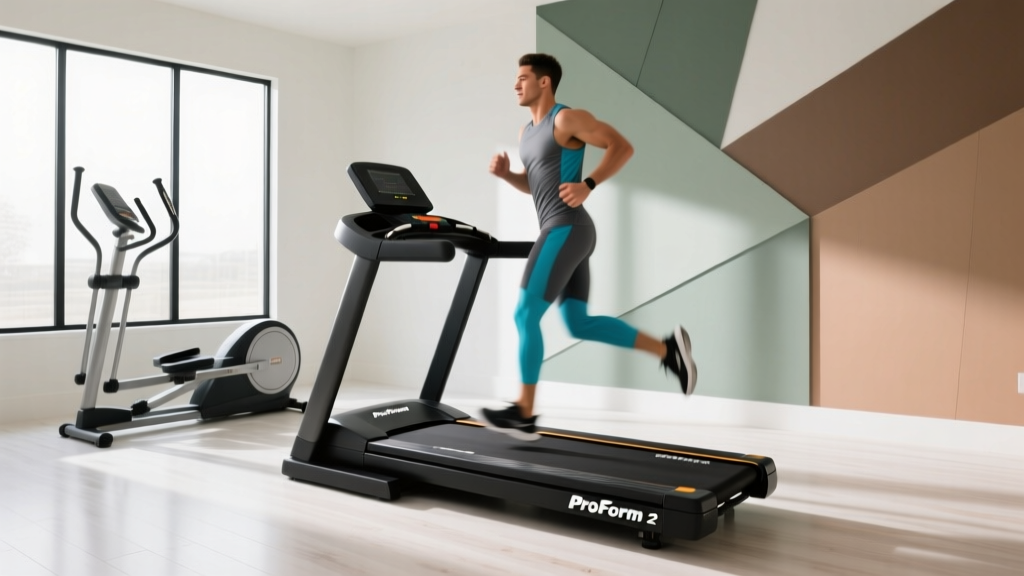
Elliptical vs Treadmill: ProForm ProShox 2 Treadmill & 2026 Market Trends
Analyze 2026 elliptical vs treadmill market trends, comparing joint impact, ROI, and how the ProForm ProShox 2 treadmill fits into modern home cardio.

The 2026 Home Cardio Market: A Shift Toward Longevity and Joint Preservation
As we navigate the 2026 home fitness equipment landscape, a distinct shift in consumer purchasing behavior has emerged. While treadmills historically dominated the home cardio market—accounting for nearly 45% of all major equipment sales in the early 2020s—elliptical cross-trainers are rapidly capturing market share among the 35-to-65 demographic. This trend is heavily driven by a cultural pivot toward 'longevity fitness,' where sustainable, low-impact cardiovascular conditioning is prioritized over high-intensity, joint-stressing workouts.
According to the Centers for Disease Control and Prevention (CDC), adults require at least 150 minutes of moderate-intensity aerobic activity weekly. However, the modality chosen to achieve this benchmark drastically affects long-term adherence and injury rates. In this comprehensive market analysis, we dissect the biomechanical, spatial, and financial differences between ellipticals and treadmills, using specific mid-tier market benchmarks to illustrate where consumer dollars are best spent in 2026.
Biomechanical Load and Ground Reaction Forces (GRF)
The most critical differentiator between a treadmill and an elliptical is the Ground Reaction Force (GRF) exerted on the skeletal system during use. GRF is the force exerted by the ground on a body in contact with it. When running on a traditional treadmill deck, the human body absorbs an impact force equivalent to 2.5 to 3.0 times its total body weight with every footstrike.
Conversely, elliptical machines utilize a continuous, closed-kinetic-chain movement pattern. Because the feet never leave the pedals, the eccentric loading phase of the gait cycle is entirely eliminated, reducing peak GRF to approximately 1.0 to 1.2 times body weight. The Mayo Clinic notes that this zero-impact glide makes ellipticals vastly superior for users with osteoarthritis, plantar fasciitis, or prior lumbar spine issues.
Impact & Muscle Activation Matrix
| Biomechanical Metric | Treadmill (Running @ 6mph) | Treadmill (Walking @ 3mph) | Elliptical (Moderate Resistance) |
|---|---|---|---|
| Peak Ground Reaction Force | 2.5x - 3.0x Body Weight | 1.2x - 1.5x Body Weight | 1.0x - 1.2x Body Weight |
| Primary Muscle Activation | Calves, Hamstrings, Core | Tibialis Anterior, Glutes | Quads, Glutes, Upper Back (if using arms) |
| Eccentric Joint Loading | High (Knees & Ankles) | Moderate | Negligible |
| Caloric Expenditure (per hour) | 600 - 850 kcal | 250 - 350 kcal | 450 - 700 kcal |
Cushioning Tech Deep Dive: The ProForm ProShox 2 Treadmill Benchmark
When analyzing the mid-tier market's demand for impact reduction, consumer search data and equipment reviews frequently highlight the proform proshox 2 treadmill series as a benchmark for budget-friendly shock absorption. ProForm’s ProShox cushioning system utilizes specialized elastomer pads positioned strategically beneath the running deck to absorb kinetic energy.
From an engineering perspective, the elastomers found in the proform proshox 2 treadmill platform reduce peak impact forces by approximately 15% to 20% compared to running on outdoor asphalt or concrete. Priced historically between $599 and $899 in the retail and secondary markets, this technology represents the entry point for consumers seeking joint protection without crossing the $2,000 threshold required for advanced adaptive cushioning systems (like NordicTrack's Reflex Cushioning or Peloton's dual-belt systems).
Expert Insight: The Limits of Elastomer CushioningWhile the proform proshox 2 treadmill effectively dampens the high-frequency shock of heel-strikes, it cannot alter the fundamental biomechanics of running. Users with severe meniscus degradation or acute sciatica will still experience inflammatory responses due to the repetitive eccentric loading inherent to treadmill running, regardless of the elastomer quality. For these specific medical demographics, an elliptical remains the only medically advisable home cardio option.
Spatial Economics and Acoustic Output Analysis
In 2026, urban living spaces and multi-purpose home gyms require strict spatial and acoustic management. Treadmills and ellipticals present vastly different challenges in these domains.
The Footprint and Clearance Reality
- Treadmills: The average motorized treadmill requires a footprint of 72 inches long by 32 inches wide. More importantly, safety guidelines mandate a minimum 24-inch clearance zone behind the deck to prevent injury in the event of a fall, effectively consuming over 22 square feet of usable floor space.
- Ellipticals: While ellipticals often have a slightly shorter base footprint (roughly 65 x 28 inches), they demand significant vertical clearance. Users must add at least 12 to 15 inches to their total height to account for the pedal apex, making them problematic for basement gyms with low drop-ceilings.
Decibel Output: The Multi-Story Home Problem
Acoustic pollution is a major driver of equipment returns in apartment complexes and multi-story homes. A motorized treadmill operating at 6.0 mph generates between 65 and 75 decibels (dB) of noise, combining the whine of the DC motor with the percussive 'thud' of footstrikes. This low-frequency vibration easily transfers through floor joists. Conversely, modern magnetic-resistance ellipticals operate at a near-silent 40 to 50 dB. The only audible output is the mechanical hum of the flywheel and the user's breathing, making ellipticals the undisputed winner for shared living environments.
Total Cost of Ownership (TCO) and Maintenance Profiles
Market analysis reveals that consumers often calculate the ROI of cardio machines based solely on the initial purchase price, ignoring the 5-year Total Cost of Ownership (TCO). Treadmills are inherently high-maintenance machines. The friction between the running belt and the deck generates immense heat and wear. If a user neglects to lubricate the silicone deck every 150 miles, the increased amp-draw will eventually fry the motor controller board—a repair that typically costs between $150 and $250 out of warranty.
Ellipticals, lacking a high-friction belt system and relying on sealed ball bearings at the pivot joints, require virtually zero preventative maintenance. The primary failure point on an elliptical after year four is the degradation of the console keypad or the wearing of the plastic track wheels, both of which are cheaper and easier to replace than a treadmill's drive motor. Consequently, the 5-year TCO of an elliptical is, on average, 30% lower than that of a comparably priced treadmill.
Expert Verdict: Matching the Machine to the 2026 Demographic
To maximize your home gym investment, align your purchase with your specific physiological needs and living constraints. The American Heart Association emphasizes that the 'best' cardiovascular machine is simply the one you will use consistently without pain. Use the following decision matrix to finalize your choice:
Buy the Treadmill If:
- You are training for a terrestrial event: If you are preparing for a 10K, half-marathon, or marathon, the SAID principle (Specific Adaptation to Imposed Demands) dictates you must run. An elliptical cannot replicate the specific tendon stiffness and calf endurance required for road running.
- You prefer high-intensity interval training (HIIT): Sprint intervals on a treadmill yield a higher peak heart rate and greater fast-twitch muscle fiber recruitment than elliptical sprints.
- You value passive walking: For users who want to catch up on emails or watch television while maintaining a low-intensity steady state (LISS) at 2.0 mph, a treadmill (or a dedicated walking pad) offers a more natural, distraction-free walking gait.
Buy the Elliptical If:
- You have a history of joint pathology: If you suffer from runner's knee, IT band syndrome, or lumbar radiculopathy, the closed-kinetic-chain motion of the elliptical is non-negotiable for long-term joint health.
- You want simultaneous upper-body engagement: Ellipticals with moving arm poles allow for compound cardiovascular training, engaging the latissimus dorsi and pectorals while the lower body works, leading to a more systemic heart rate response at lower perceived exertion levels.
- You live in a noise-sensitive environment: If your gym is located above a living space or in a shared-wall apartment, the silent magnetic resistance of an elliptical will prevent neighbor disputes.
2026 Market Takeaway: The home cardio market is no longer a monolith. While legacy cushioning systems like those found in the proform proshox 2 treadmill provide excellent value for budget-conscious runners, the broader industry data clearly shows that ellipticals are winning the war on longevity, acoustic management, and long-term maintenance costs. Assess your biomechanics, measure your space, and invest accordingly.
More gear to consider
All reviews
Quiet Treadmills for Women on Treadmill Workouts: 2026 Noise Test

Home Stair Climber Setup vs Treadmill 8.0 Speed Space Requirements
Treadmill Horsepower Guide: ProForm Premier 1300 Treadmill Explained

Under Desk Treadmill Office Review: Space Layouts & How to Fix Treadmill Belt Slipping to One Side

Beyond NordicTrack Treadmill Deals: Spin & Recumbent Bike Care
