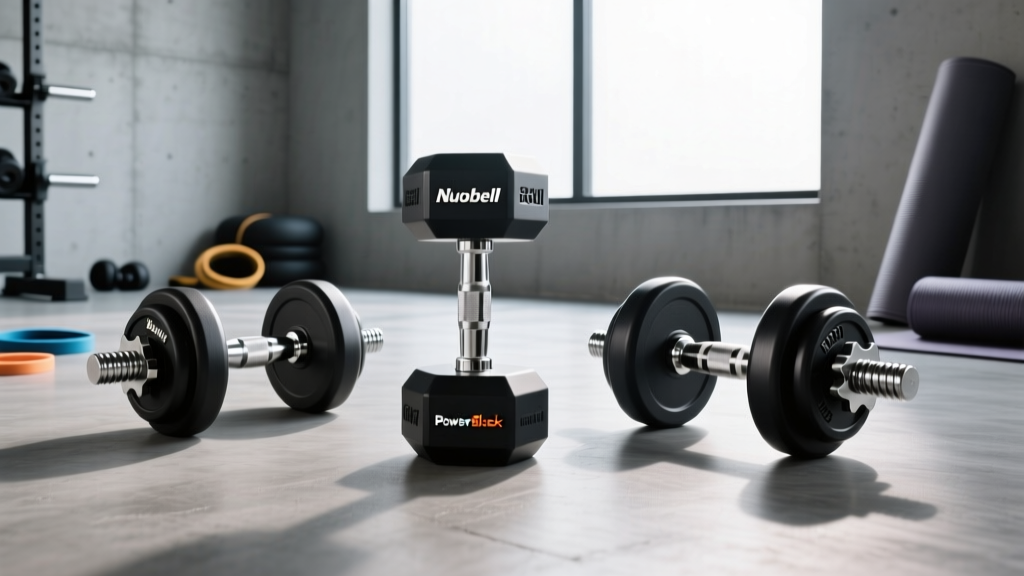
Best Adjustable Dumbbells for Your Shoulders Dumbbell Workout (2026)
Compare Nuobell, Bowflex, and PowerBlock to find the best adjustable dumbbells for your shoulders dumbbell workout. Expert 2026 review.

The Biomechanics of a Shoulders Dumbbell Workout
Designing an effective shoulders dumbbell workout requires more than just picking up any available weight. The shoulder joint (glenohumeral joint) is the most mobile joint in the human body, but this mobility comes at the cost of inherent instability. When targeting the three heads of the deltoid (anterior, lateral, and posterior) alongside the rotator cuff stabilizers, the physical dimensions and weight increment capabilities of your dumbbells drastically alter the biomechanical stress placed on your joints.
According to ExRx.net's shoulder kinesiology database, the lateral deltoid operates on a remarkably long lever arm during abduction movements like lateral raises. Because of this mechanical disadvantage, jumping from a 15 lb to a 20 lb dumbbell represents a 33% increase in load—a massive spike that often forces the upper trapezius to take over, leading to shoulder impingement. Therefore, micro-loading (2.5 lb increments) and ergonomic handle clearance are non-negotiable features for a safe, hypertrophic shoulder routine.
⚠️ Rotator Cuff Warning: Bulky dumbbell housings can force your wrists into unnatural ulnar deviation during overhead presses. As noted by Johns Hopkins Medicine, repetitive impingement from poor wrist alignment is a leading cause of supraspinatus tendon wear. Your equipment should adapt to your anatomy, not the other way around.Head-to-Head Contender Profiles & 2026 Pricing
To determine the ultimate tool for shoulder development, we are pitting the three market leaders against each other in a strict head-to-head comparison. All prices reflect the 2026 direct-to-consumer and authorized retailer averages.
1. Nuobell 552 (The Ergonomic King)
- Price: $429
- Weight Range: 5 - 50 lbs
- Increments: 2.5 lbs (up to 25 lbs), then 5 lbs
- Overall Length: 16.1 inches
Nuobell utilizes a twisted-handle mechanism that mimics the exact feel, knurling, and dimensions of a traditional fixed steel dumbbell. For shoulder isolation movements, this is a massive advantage.
2. Bowflex SelectTech 552 (The Classic Bulk)
- Price: $399
- Weight Range: 5 - 52.5 lbs
- Increments: 2.5 lbs (up to 25 lbs), then 5 lbs
- Overall Length: 16.9 inches
The Bowflex 552 remains a staple in home gyms. However, its fixed-length plastic housing means the dumbbell remains 16.9 inches long even when set to just 5 lbs.
3. PowerBlock Elite USA (The Compact Tank)
- Price: $369
- Weight Range: 5 - 50 lbs (Base Model)
- Increments: 2.5 lbs (via internal adder weights), otherwise 5 lbs
- Overall Length: 12.0 inches (Cage design)
PowerBlock's cage design drastically reduces the footprint of the weight, keeping the center of gravity incredibly close to the wrist joint.
Feature Comparison Matrix
| Feature | Nuobell 552 | Bowflex 552 | PowerBlock Elite |
|---|---|---|---|
| Max Weight | 50 lbs | 52.5 lbs | 50 lbs (Expandable) |
| Micro-loading (2.5lb) | Yes (Dial) | Yes (Dial) | Yes (Adder pins) |
| Fixed Length Issue? | No (Scales down) | Yes (Always 16.9") | No (Compact cage) |
| Handle Knurling | Aggressive Steel | Rubberized Grip | Straight Steel |
| Wrist Supination Freedom | Full 360° | Full 360° | Restricted by Cage |
Performance in Key Shoulder Movements
Overhead Pressing (Stability & Wrist Alignment)
During strict seated or standing overhead presses, wrist stability is paramount. The PowerBlock Elite excels here. Because the weight is caged tightly around the hand, the center of mass sits directly over the radius and ulna, reducing wrist fatigue during heavy 4-rep max sets. However, the Nuobell offers a more natural grip width. The Bowflex suffers slightly here; the bulky plastic dials at the ends of the handle can dig into the forearms of lifters with shorter arm spans when pressing heavy loads near the clavicle.
Lateral & Front Raises (Clearance & Micro-loading)
This is where the Nuobell 552 completely dominates the competition. When performing lateral raises, the physical length of the dumbbell matters. At 16.9 inches, the Bowflex 552 ends will frequently clack together at the bottom of the movement if you have a narrow frame, forcing you to widen your stance or alter your natural arm path. The Nuobell scales down in physical length as you drop the weight plates, meaning a 10 lb Nuobell is significantly shorter than a 10 lb Bowflex, allowing for flawless, unobstructed lateral raises.
Arnold Presses (Rotational Freedom)
The Arnold Press requires a full rotation from supination (palms facing you) to pronation (palms facing forward) at the top of the movement. PowerBlock's closed rectangular cage physically blocks this rotation, forcing an awkward, abbreviated range of motion that limits anterior deltoid activation. Both Nuobell and Bowflex allow for seamless rotational mechanics, making them vastly superior for this specific exercise.
Failure Modes & Edge Cases
As fitness equipment reviewers, we must address how these tools fail under real-world conditions. Shoulder workouts often involve high-rep sets to failure, increasing the likelihood of dropping a weight.
🛠️ Maintenance Insight: Never drop adjustable dumbbells on bare concrete or hardwood. The internal selector mechanisms are precision-engineered and will shatter or misalign upon high-impact drops. Always use 3/4-inch horse stall mats or interlocking EVA foam tiles.- Nuobell Vulnerability: The twisting handle mechanism is brilliant for ergonomics but fragile upon impact. If dropped vertically on the handle end, the internal selector pin can shear, rendering the weight adjustment useless.
- Bowflex Vulnerability: The dial mechanism requires the dumbbell to be placed perfectly flat in its cradle to change weights. If you set it down on an uneven floor mat and try to twist the dial, the internal plates will cross-thread and jam.
- PowerBlock Vulnerability: While virtually indestructible when dropped, the open cage design presents a pinching hazard. During rapid drop-sets on rear delt flyes, grabbing the dumbbell hastily can result in pinched fingers between the steel cage and the internal weight block.
Progressive Overload Framework for Deltoids
To maximize hypertrophy without destroying your rotator cuff, implement this 2026 micro-loading protocol using 2.5 lb increments (available on all three models):
- Weeks 1-3 (Volume Accumulation): Select a weight you can lift for 15 reps on lateral raises. Focus on the eccentric (lowering) phase, taking 3 full seconds to lower the weight.
- Weeks 4-6 (Micro-Load Jump): Increase the weight by exactly 2.5 lbs per hand. Your reps will naturally drop to 10-12. Do not jump by 5 lbs; the lever arm of the shoulder cannot adapt to a 20% load increase in a single mesocycle.
- Weeks 7-8 (Mechanical Tension): Increase by another 2.5 lbs. Reps will drop to 8. Utilize strict form, eliminating all lower-back momentum.
Expert Verdict: Which Pair Wins?
If your primary goal is a dedicated, high-volume shoulders dumbbell workout focusing on isolation, joint health, and natural biomechanics, the Nuobell 552 is the undisputed 2026 champion. Its ability to scale down in physical length prevents the clacking and path-alteration issues inherent to the Bowflex, and its traditional handle allows for the full rotational freedom that the PowerBlock cage restricts.
However, if your shoulder workouts consist almost entirely of heavy, low-rep overhead pressing and you prioritize indestructible build quality over isolation ergonomics, the PowerBlock Elite USA remains a phenomenal, compact choice. The Bowflex 552, while a great general-purpose tool, simply falls short for dedicated shoulder training due to its fixed, bulky housing.
Frequently Asked Questions (FAQ)
Can I use adjustable dumbbells for shrugs?
Yes, but be aware that the 50 lb or 52.5 lb maximum cap on these models is often insufficient for advanced trap development. If shrugs are a priority, consider buying a dedicated pair of 70+ lb fixed hex dumbbells or utilizing a barbell.
Why do my wrists hurt during adjustable dumbbell lateral raises?
Wrist pain during lateral raises is usually caused by 'pouring the pitcher' (internal rotation at the top of the movement). This grinds the greater tubercle of the humerus into the acromion. Keep a neutral grip or slightly externally rotate the dumbbell to clear the joint space.
More gear to consider
All reviews
mcgregor dumbbell Rack Review: Brands, Cost & MMA Guide

2026 Trends: Loadable Dumbbells & Best Dumbbell Exercises for Abs
Olympic vs Standard Plates: Dumbbell Exercises for Upper Body Strength

Olympic Barbell Buying Guide: Weight, Knurling & Dumbbell Cable Flyes Pairings

Olympic vs Standard Plates for the Ultimate Dumbbell Farmer Walk
