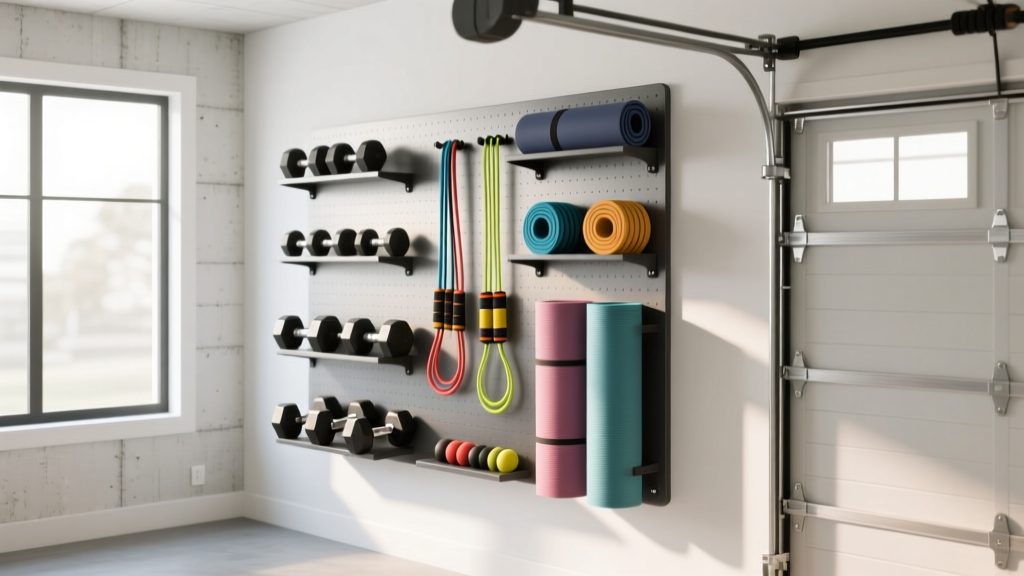
Wall Mounted Sports Equipment Organizer: 2026 Garage Budget Guide
Discover the true cost of garage gym organization. We break down budget tiers for wall mounted sports equipment organizers to maximize space and value.

The Economics of Garage Gym Clutter
When building a home gym, the focus is almost exclusively on the equipment you lift, pull, and push. Yet, the most common point of failure in a garage gym isn't a snapped cable or a torn callus; it is the slow, creeping accumulation of clutter. By 2026, with home fitness spaces becoming permanent fixtures rather than pandemic-era novelties, the need for a systematic garage gym organization and storage system is paramount. A disorganized garage doesn't just frustrate you; it actively degrades your workout efficiency and poses severe tripping hazards.
The ultimate solution for reclaiming floor space is vertical storage. Specifically, implementing a robust wall mounted sports equipment organizer network transforms dead air space into high-density storage. But how much should you actually spend? As fitness equipment reviewers and home gym builders, we have analyzed the budget breakdown and value proposition of wall-mounted storage tiers to help you maximize your return on investment (ROI) without compromising structural safety.
Budget Tiers: Wall Mounted Sports Equipment Organizers
Not all wall storage is created equal. The market is saturated with options ranging from flimsy wire baskets to over-engineered steel rigs. Here is the 2026 breakdown of the three primary budget tiers, analyzing the real-world costs and material realities of each.
Tier 1: The Budget DIY & Entry-Level Commercial ($50 - $150)
At the entry level, you are primarily looking at slatwall panels (like the Gladiator GearTrack or generic PVC alternatives) and basic wire hooks, or entry-level plate trees like the Yes4All Wall Mount Weight Plate Tree ($65-$85).
- Material Reality: Typically 14-gauge to 16-gauge steel or heavy-duty extruded PVC.
- Failure Mode: Spot welds on cheap steel brackets frequently snap under dynamic loading. If you drop a 45lb plate onto a Tier 1 rack rather than placing it gently, the kinetic energy can sheer the welds or pull the mounting screws straight out of the drywall.
- Best For: Resistance bands, jump ropes, yoga mats, and lightweight accessories under 20 lbs.
Tier 2: The Mid-Range Modular Systems ($150 - $400)
This is the sweet spot for 80% of garage gym owners. Systems like the Titan Fitness Wall Mounted Dumbbell Rack ($149-$199) or Fringe Fitness wall-mounted medicine ball racks fall here. These units utilize continuous MIG welds and thicker steel.
- Material Reality: 11-gauge to 12-gauge steel with powder-coat finishes that resist chipping when metal dumbbells scrape against them.
- Value Proposition: You are paying for static load security. A mid-range dumbbell rack rated for 500 lbs will comfortably hold ten pairs of rubber hex dumbbells without bowing, provided it is anchored correctly into wall studs.
- Best For: Dumbbells, kettlebells, medicine balls, and standard Olympic plates.
Tier 3: Premium Heavy-Duty Steel Rigs ($400 - $800+)
At the top tier, you find integrated systems like the Rogue Monster Utility Pegboard ($395+) or custom-fabricated steel wall rigs. These aren't just storage; they are modular ecosystems.
- Material Reality: 7-gauge to 11-gauge steel, laser-cut for precision, featuring standardized hole patterns (like the 5/8-inch or 1-inch Rogue Monster spacing) that allow you to swap out pegs, J-cups, and band pegs dynamically.
- Value Proposition: Infinite modularity. As your gym evolves, the storage evolves with it without requiring new drill holes in your wall.
- Best For: Serious lifters with extensive accessory collections, specialized bars, and a desire for a unified, commercial-grade aesthetic.
Value Analysis Matrix: Space Reclaimed vs. Capital Deployed
To truly understand the value of a wall mounted sports equipment organizer, we must calculate the Cost Per Square Foot Reclaimed. In a standard 2-car garage (roughly 400 to 500 square feet), floor space is a premium commodity. Moving bulky items to the wall reclaims usable square footage for lifting platforms, squat racks, or simply parking your vehicle.
| Storage System Type | Avg. Capital Cost | Floor Space Reclaimed | Cost Per Sq. Ft. Reclaimed | Max Static Load |
|---|---|---|---|---|
| PVC Slatwall + Hooks | $120 | 12 sq. ft. | $10.00 / sq. ft. | 150 lbs (distributed) |
| Wall Plate Tree (Tier 1) | $75 | 4 sq. ft. | $18.75 / sq. ft. | 300 lbs |
| Wall Dumbbell Rack (Tier 2) | $180 | 8 sq. ft. | $22.50 / sq. ft. | 500 lbs |
| Modular Pegboard (Tier 3) | $450 | 24 sq. ft. | $18.75 / sq. ft. | 1,000+ lbs |
Consider that finishing or expanding a garage costs anywhere from $150 to $300+ per square foot in current construction markets. By spending $450 on a Tier 3 modular pegboard to reclaim 24 square feet of floor space, you are effectively 'buying' that space for $18.75 per square foot—a fraction of the cost of a physical home addition.
Hidden Costs: Hardware, Studs, and Shear Strength
The most critical mistake home gym owners make when budgeting for wall storage is ignoring the hidden costs of installation and structural physics. A $300 dumbbell rack is useless if it pulls out of the wall and destroys your drywall—or worse, injures someone.
The Physics of Wall Anchoring
Drywall alone cannot support heavy fitness equipment. Standard 1/2-inch drywall has a pull-out strength of less than 20 lbs per anchor. You must anchor heavy organizers directly into wooden or steel wall studs. According to structural guidelines highlighted by Bob Vila's home improvement experts, lag bolts are mandatory for heavy loads. For a wall-mounted weight rack, you should be using 3/8-inch by 3-inch hex lag screws driven into the center of a stud.
Finding those studs reliably requires a quality magnetic or electronic stud finder. As detailed in The Family Handyman's guide to locating wall studs, relying on the 'knock test' is a recipe for disaster in modern garages where insulation and exterior sheathing can muffle acoustic feedback. Budget an extra $30-$50 for a high-quality stud finder and structural lag screws if your organizer doesn't include them (many budget brands include cheap wood screws that will shear under a 200lb dynamic load).
Dynamic vs. Static Loading
Warning: A rack rated for 500 lbs of 'static' load may fail catastrophically under a 200 lb 'dynamic' load. Dropping a heavy kettlebell onto a wall rack generates kinetic force that multiplies the sheer stress on the lag bolts and the welds. Always place weights down with control on wall-mounted units.
Step-by-Step Framework for Maximizing Wall Storage ROI
To ensure your budget is deployed effectively, follow this four-step decision framework before purchasing any wall mounted sports equipment organizer.
- Audit the 'Dead Zone' Footprint: Map out your garage and identify the 12-inch to 18-inch perimeter against the walls. This is your primary storage zone. Measure the exact linear footage of available wall space, subtracting door frames, windows, and electrical panels.
- Map the Stud Lines: Standard US framing places studs 16 inches on-center (OC). Mark every stud with painter's tape. Your storage purchases must align with these 16-inch intervals. If a premium rack's mounting holes don't align with your 16-inch OC studs, you will need to buy and install a horizontal wooden cleat (like a 2x6 backer board) to bridge the gap, adding $20 and 30 minutes to your project.
- Categorize by Frequency of Use: Store daily-use items (belts, straps, chalk, primary dumbbells) between waist and eye level. Store seasonal or low-use items (extra bands, foam rollers, cleaning supplies) on the highest tiers of your slatwall or pegboard.
- Calculate the True Cost: Add the cost of the organizer, the heavy-duty lag bolts, the stud finder, and the potential wooden backer board. Compare this total against the square footage reclaimed to find your true Cost Per Square Foot.
Expert Verdict: Where to Splurge and Where to Save
When building your garage gym organization and storage system, the budget should be allocated based on risk and load. Save your money on lightweight accessory storage; generic PVC slatwalls and budget wire hooks from big-box hardware stores are perfectly adequate for jump ropes, resistance bands, and towels. There is zero ROI in buying a $150 premium steel hook to hold a $10 resistance band.
Conversely, splurge heavily on any organizer that holds dense, heavy iron or steel. Dumbbell racks, plate trees, and barbell wall hangers endure massive sheer forces. Investing in 11-gauge or 7-gauge steel systems from reputable fitness brands ensures that your $1,500 investment in iron weights doesn't end up crashing through your drywall because you tried to save $40 on a budget rack. A well-planned wall mounted sports equipment organizer setup not only protects your equipment and your home but fundamentally upgrades the psychology of your training space, turning a cluttered garage into a dedicated sanctuary for performance.
More gear to consider
All reviews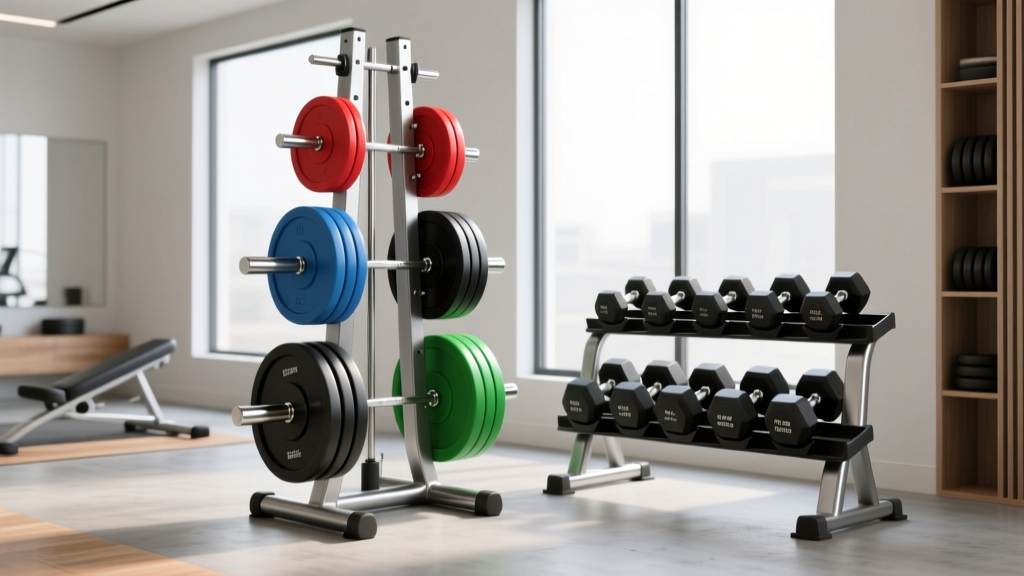
Weight Plate Trees & Dumbbell Rack Saddles: 2026 Storage Guide
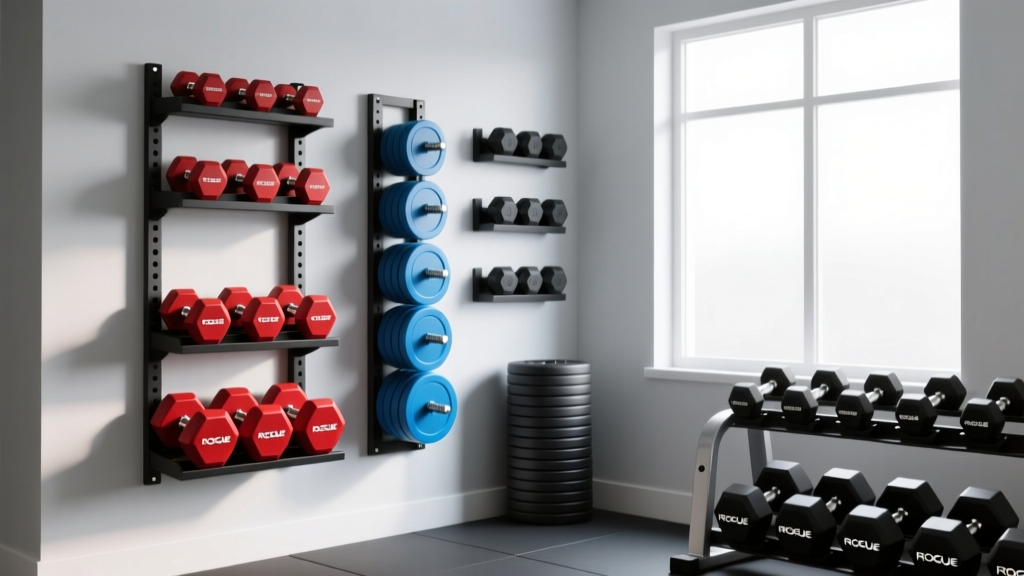
Rogue Dumbbell Storage for Small Spaces: Step-by-Step Guide
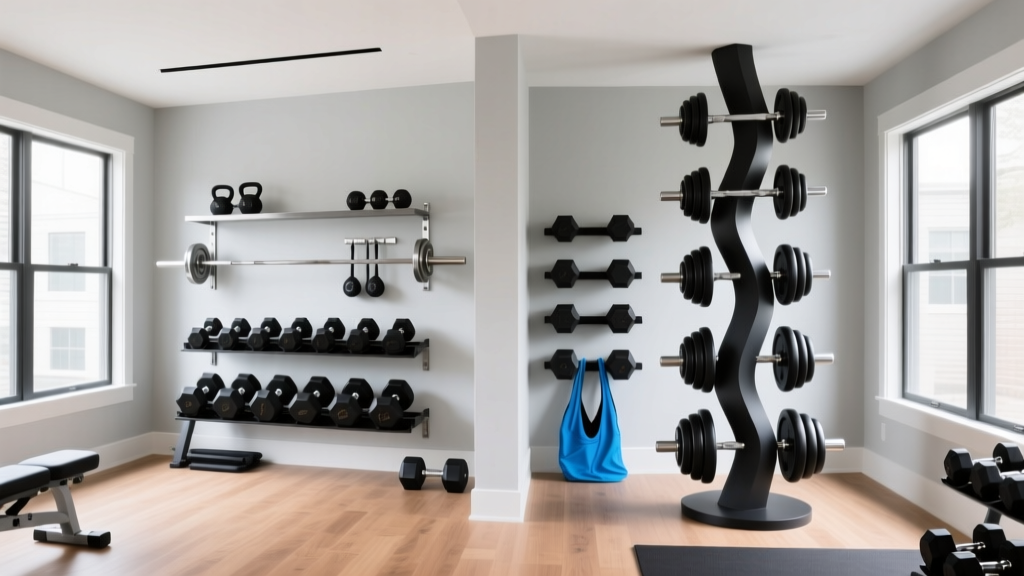
Wall Storage vs a Dumbbell Tree with Weights: Space Layout Guide

Best Dumbbell Racks & Home Gym Equipment Storage Ideas for 2026

Resistance Band Storage & VTX Dumbbell Rack: 2026 Budget Breakdown
