
How Much Weight You Need: Home Gym Equipment News & Space Guide
Discover how much weight you need for your setup. We analyze the latest home gym equipment news to optimize weight selection and save space.

The Spatial Cost of Iron: Rethinking Weight Selection
When building a home gym, the most common mistake lifters make is purchasing weight plates based solely on their current one-rep max (1RM) or ego, completely ignoring the physical volume that iron occupies. In a space-optimized layout, every square inch of floor and wall space is a premium commodity. You aren't just buying weight; you are buying spatial density.
If you have been following the latest home gym equipment news in 2026, you already know the industry is shifting heavily toward high-density, space-saving strength solutions. Manufacturers are moving away from massive, thick crumb-rubber bumpers and pushing calibrated steel, slim-profile virgin rubber, and advanced adjustable systems. This guide bridges the gap between your strength progression needs and your spatial constraints, ensuring you buy exactly the weight you need—without turning your garage or spare room into an unnavigable obstacle course.
💡 The Space-Optimization Golden Rule: Never buy a 45-pound plate when two 25-pound plates or an adjustable system can achieve the same load with a smaller storage footprint or greater layout flexibility.The Physics of Iron: Calculating Your Weight Footprint
To understand how much weight you need, you must first understand how much space that weight demands. Not all plates are created equal. According to comprehensive testing by Garage Gym Reviews, the material and manufacturing process drastically alter the physical dimensions of weight plates, which directly impacts your storage layout.
Plate Dimensions & Spatial Cost Comparison
| Plate Type (45 lb / 20 kg) | Diameter | Thickness | Cost per lb (Avg) | Space Layout Impact |
|---|---|---|---|---|
| Standard Cast Iron | 14.5 inches | 1.45 inches | $1.50 - $2.00 | High density, but chips floors and cannot be dropped. Requires thick matting. |
| Crumb Rubber Bumper | 17.7 inches | 3.25 inches | $2.00 - $2.50 | Massive spatial footprint. Takes up excessive sleeve and storage space. |
| Virgin Rubber Slim Bumper | 17.7 inches | 1.90 inches | $3.50 - $4.50 | Optimal for Olympic lifting. High density, safe for dropping on standard mats. |
| Calibrated Steel (Competition) | 17.7 inches | 1.15 inches | $6.00 - $8.00 | Ultimate spatial efficiency. Extremely thin, but requires specialized storage. |
The Takeaway: If you are outfitting a small apartment gym or a tight single-car garage, standard cast iron or calibrated steel offers the highest weight-to-volume ratio. However, if your layout includes a dedicated dropping zone over horse-stall mats, slim virgin rubber bumpers (like the Rogue Echo Slim series) provide the necessary shock absorption without the excessive thickness of recycled crumb rubber.
How Much Weight Do You Actually Need? (The 80/20 Matrix)
The National Strength and Conditioning Association (NSCA) emphasizes progressive overload, but that doesn't mean you need 500 pounds of iron on day one. Most lifters spend 80% of their training time using only 50% of their total available weight. Here is a space-optimized weight selection matrix based on your training age and spatial reality.
Beginner to Intermediate (0-2 Years Training)
- Total Weight Needed: 150 lbs - 235 lbs
- Optimal Layout Configuration: One pair of 45s, one pair of 25s, one pair of 10s, two pairs of 5s, and a set of fractional plates.
- Spatial Footprint: Easily stored on a single wall-mounted vertical plate peg system. Requires roughly 36 inches of lateral wall space and 8 inches of depth.
Advanced Lifter (3+ Years Training / Powerbuilding)
- Total Weight Needed: 300 lbs - 450 lbs
- Optimal Layout Configuration: Four to six 45lb plates, supplemented by 25s, 10s, 5s, and 2.5s.
- Spatial Footprint: Requires a heavy-duty A-frame plate tree or a dual-peg wall mount. An A-frame requires a dedicated 24-inch radial clearance zone to prevent tripping hazards in tight garages.
'The biggest mistake I see in garage gym layouts is the placement of the plate tree. Lifters buy massive A-frame trees and shove them in the corner of their squat rack footprint, creating a dangerous choke point. Wall-mounted vertical pegs free up the floor plan entirely, allowing for seamless transitions between the barbell and dumbbell zones.' — Home Gym Layout Specialist
Insights from Recent Home Gym Equipment News
If you track home gym equipment news, you will notice a massive surge in the popularity of adjustable systems and micro-loading accessories in 2026. Space optimization is driving these innovations. Here is how you can leverage current market trends to reduce your physical weight footprint:
1. The Adjustable Dumbbell Revolution
Instead of buying a full rack of fixed hex dumbbells from 10 lbs to 50 lbs (which requires a 4-foot tiered rack and costs upwards of $1,200), the latest generation of adjustable dumbbells like the Nuobell 80 or PowerBlock Pro 100 EXP condenses 15 pairs of weights into the footprint of a single shoebox. This frees up massive amounts of linear wall space, allowing you to reallocate that area to a functional turf strip or a cable machine.
2. Fractional Plates and Micro-Loading
Upper body lifts like the overhead press and bench press often stall when lifters are forced to make 5-pound jumps. Buying multiple sets of 1.25 lb and 2.5 lb plates clutters your storage pegs. The modern space-saving solution is a fractional plate set (ranging from 0.25 lbs to 1.0 lb). These tiny magnetic or steel rings allow for precise progressive overload without adding bulk to your plate tree.
3. Loadable Dumbbell Handles
For those who already own a massive collection of 2-inch Olympic plates for their barbell, purchasing Olympic loadable dumbbell handles (like those from Rogue or Titan Fitness) eliminates the need to buy a separate dumbbell set entirely. You leverage your existing plate inventory, though you must factor in the spatial width of the 45lb plates when performing movements with a high range of motion.
Space-Optimized Storage Layouts for Weight Plates
Once you have determined how much weight you need, you must decide where it lives. Improper weight storage ruins the flow of a home gym. Here is a breakdown of storage solutions based on spatial constraints:
Vertical Wall Pegs
Best For: Tight garages and apartment gyms.
Clearance Needed: 6-8 inches depth.
Pros: Keeps floor entirely clear for deadlifts and kettlebell swings. Visually clean.
Cons: Requires drilling into structural studs. Loading/unloading heavy 45s from a wall can strain the lower back if not positioned at hip height.
Freestanding A-Frame Tree
Best For: Dedicated basement gyms with high ceilings.
Clearance Needed: 24-inch radial footprint.
Pros: No drilling required. Easy to load at ground level. High weight capacity (up to 800+ lbs).
Cons: Creates a physical obstacle. Can disrupt the 'triangle flow' between rack, bench, and dumbbell zone.
Integrated Rack Storage
Best For: All-in-one functional trainers and power racks.
Clearance Needed: 0 extra inches (uses rack uprights).
Pros: Ultimate space efficiency. Weights live exactly where they are used.
Cons: Adds width to the rack, potentially blocking walkways if the rack is placed near a wall or garage door track.
Finalizing Your 2026 Weight Inventory
Ultimately, figuring out how much weight you need is an exercise in forecasting your strength potential while respecting your physical boundaries. Start with a baseline of 200 lbs of high-density cast iron or slim virgin rubber. Supplement your barbell work with a premium adjustable dumbbell set to cover unilateral movements without sacrificing square footage. By paying attention to the latest home gym equipment news and prioritizing spatial efficiency over sheer volume, you can build a world-class training environment that feels expansive, organized, and primed for progress.
More gear to consider
All reviews
Outdoor Weather Considerations: Marcy MWM-988 150 lb Stack Home Gym

Home Gym Shelving & Weight Selection: How Much Do You Really Need?

Powering the Aesthetic Home Gym: 2026 Electrical Safety Trends

Home Gym Ideas Small Space: Garage Flooring & Ventilation Errors
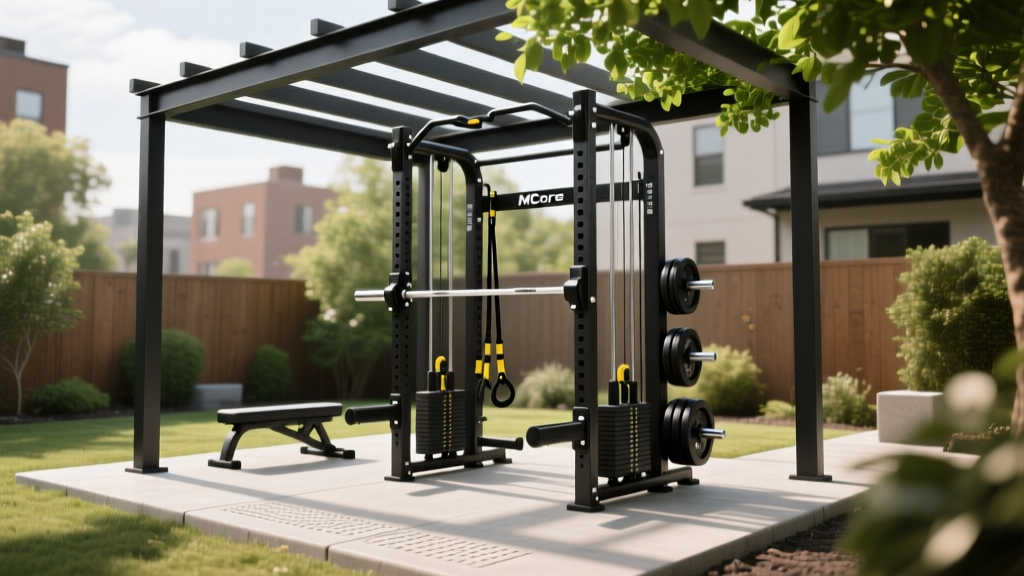
Weatherproofing Your MCore Home Gym: Outdoor Setup
