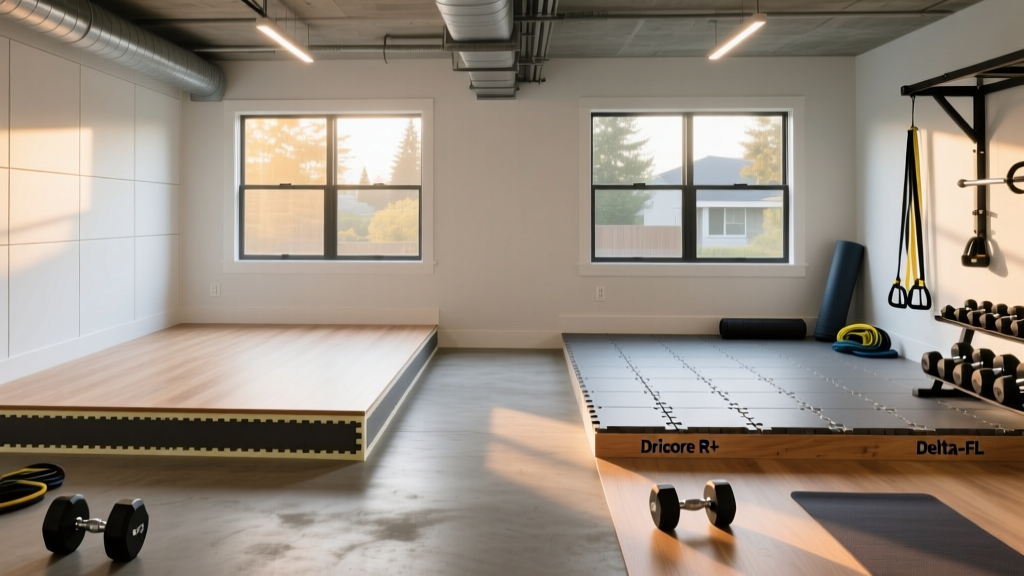
Custom Home Gym Design Portland OR: Dricore vs. Delta-FL Subfloors
Planning a custom home gym design in Portland, OR? We compare Dricore R+ and Delta-FL subfloor systems for moisture management, impact, and cost.

The Pacific Northwest Moisture Challenge in Basement Gyms
Executing a flawless custom home gym design Portland OR homeowners can rely on requires confronting the region's most relentless adversary: moisture. With the Willamette Valley experiencing over 150 days of precipitation annually and winter basement slab temperatures hovering between 50°F and 55°F, condensation and hydrostatic pressure are guaranteed. If you are converting a basement or uninsulated garage into a dedicated lifting space, laying rubber mats directly over concrete is a catastrophic failure point. Mold, mildew, and degraded equipment will follow within months.
To protect your investment in high-end gear like a Rogue R-3 Power Rack or Concept2 RowErg, you must install a dimpled or insulated subfloor system that creates an air gap, allowing the concrete to breathe while protecting your flooring. In 2026, the two dominant contenders for residential gym remodels are Dricore R+ Insulated Subfloor and DELTA-FL. This head-to-head comparison breaks down the exact specifications, failure modes, and installation nuances of each system for heavy-impact gym environments.
Head-to-Head Specification Matrix
Before diving into the installation realities, let us look at the raw data. Both products solve the moisture problem, but their structural engineering dictates how they handle the extreme point-loads generated by dropped bumper plates and loaded squat racks.
| Feature | Dricore R+ Insulated Panels | DELTA-FL Dimpled Mat |
|---|---|---|
| Core Material | XPS Foam + OSB Top Layer | High-Density Polyethylene (HDPE) |
| Thickness | 1.125 inches | 5/16 inch (mat only) |
| R-Value (Insulation) | 3.0 | 1.4 (requires added foam for R-3+) |
| Compressive Strength | 10,400+ psi | 5,500 psi |
| 2026 Avg. Material Cost | $3.15 - $3.45 per sq. ft. | $1.85 - $2.10 per sq. ft. |
| Installation Format | 2' x 2' Interlocking Tongue & Groove | Rolls or 4' x 4' Interlocking Tiles |
| Best Gym Application | Heavy Powerlifting, Olympic Lifting | Cardio Zones, Light Dumbbell Areas |
Deep Dive: Dricore R+ Insulated Subfloor Panels
Dricore R+ is a premium, all-in-one structural subfloor. It bonds a high-density oriented strand board (OSB) top layer to an XPS (extruded polystyrene) foam base. The foam features a dimpled underside to channel moisture, while the OSB provides a rigid, nail-able surface.
The Gym Advantage: Point-Load Distribution
When you drop a 400-pound barbell, the kinetic energy transfers through your 3/4-inch rubber flooring directly into the subfloor. Dricore's 10,400 psi compressive strength and rigid OSB top layer distribute this impact across a wider surface area. This prevents 'telegraphing'—a failure mode where the dimples of a softer subfloor permanently press through the rubber, creating an uneven lifting surface that can destabilize heavy squats.
CRITICAL FAILURE MODE: Edge WickingDricore's primary vulnerability in a Portland basement is the exposed OSB edges. If your foundation experiences seasonal hydrostatic leakage and water pools against the perimeter, the OSB will wick moisture like a sponge, swelling and ruining the tongue-and-groove joints. Solution: You must seal all perimeter edges with a high-quality polyurethane concrete sealant and maintain a 1/2-inch expansion gap filled with acoustic backer rod and waterproof silicone.
Installation Realities for Heavy Gyms
While Dricore is marketed as a 'floating floor,' a heavy gym requires mechanical fastening. For a custom home gym design in Portland, OR, where seismic activity is a consideration and heavy equipment is present, you should anchor the Dricore panels. Use 1/4-inch Tapcon concrete screws every 4 feet, driving them through the OSB and foam into the slab. This eliminates the 'trampoline effect' that can occur when dropping weights on a purely floating floor.
Deep Dive: DELTA-FL Dimpled Mat
DELTA-FL is a high-density polyethylene membrane featuring a raised dimple pattern. It is exceptionally durable, completely impervious to water, and significantly cheaper than Dricore. However, it is not a standalone subfloor for a heavy lifting space; it is a moisture-management membrane that requires a secondary load-spreading layer.
The Gym Advantage: Unmatched Moisture Protection
Unlike Dricore, DELTA-FL contains zero wood products. If your Portland basement suffers a catastrophic sump pump failure or a burst pipe, the DELTA-FL membrane will survive indefinitely without rotting, swelling, or harboring mold. According to the EPA's guidelines on indoor moisture and mold prevention, eliminating organic materials (like wood or paper backing) in below-grade damp environments is the most effective way to prevent long-term biological growth.
The Catch: The 'Telegraphing' and Deflection Problem
DELTA-FL has a compressive strength of 5,500 psi. While this sounds high, the 5/16-inch air gap creates a deflection zone. If you place a power rack with 2x2-inch steel uprights directly on top of DELTA-FL and a standard rubber mat, the immense point-load will crush the dimples over time. Furthermore, the dimple pattern can 'telegraph' through thinner rubber mats, creating a wavy floor.
PRO INSTALLATION TIP: The Double-Layer MethodTo use DELTA-FL in a heavy lifting zone, you must decouple the moisture barrier from the impact zone. Lay the DELTA-FL directly on the concrete. Then, install a layer of 1/2-inch or 3/4-inch tongue-and-groove plywood or OSB over the DELTA-FL, staggering the seams. Finally, apply your 3/4-inch vulcanized rubber gym mats. This mimics the rigidity of Dricore at a slightly lower material cost, though it requires double the labor.
Anchoring Equipment: A Remodeling Nightmare if Ignored
One of the most overlooked aspects of basement gym remodeling is anchoring your equipment. You cannot safely bolt a squat rack or a cable crossover machine directly into a floating subfloor. If you attempt to pull up on a floating floor, you will compromise the interlocking joints and void the warranty of both Dricore and DELTA-FL.
- For Dricore: You must use specialized structural anchors that penetrate through the OSB, the foam, and bite at least 1.5 inches into the concrete slab below. Use a rotary hammer drill with a 1/2-inch masonry bit, vacuum the dust, and inject epoxy before setting your anchor bolts.
- For DELTA-FL: Because DELTA-FL is a thin membrane, anchoring is easier but requires sealing. Drill through the membrane into the concrete. Once the anchor is set, you must apply a bead of marine-grade polyurethane sealant (like Sikaflex-221) around the bolt head where it pierces the plastic membrane to maintain the vapor barrier's integrity.
Portland-Specific Permitting and Egress Requirements
Before purchasing materials, you must navigate local building codes. Converting an unfinished basement into a conditioned, habitable space (which includes a home gym) often triggers specific requirements. The Portland Bureau of Development Services (BDS) requires that any newly finished basement space intended for regular occupancy meet strict egress window standards for fire safety. If your gym design includes adding drywall to the walls or altering the HVAC to condition the space, a building permit is mandatory.
Furthermore, Portland's energy code requires specific insulation values for below-grade walls. If you are framing out the perimeter walls of your gym, you will need to install rigid XPS foam insulation against the concrete before framing, which pairs perfectly with the floor insulation provided by the Dricore R+ system, creating a continuous thermal break.
HVAC and Airflow Considerations
Subfloors only manage the moisture that comes from below. You must also manage the moisture generated above by your workouts. A vigorous hour on an assault bike or treadmill can raise the ambient humidity in a sealed 400-square-foot basement gym by 15-20%. Without proper ventilation, this humid air will condense on the cold concrete walls above your subfloor, leading to drywall mold. When designing your layout, ensure your ductless mini-split system (highly recommended for Portland basement retrofits) includes a dedicated 'Dry' or dehumidification mode, and install a continuous exhaust fan tied to a humidistat set to trigger at 55% relative humidity.
The Final Verdict for Your Portland Gym
Choosing between Dricore R+ and DELTA-FL ultimately depends on your budget, your DIY tolerance, and the specific equipment you plan to house.
If your custom home gym design Portland OR project centers around heavy Olympic lifting, powerlifting, and dropping weights from overhead, Dricore R+ is the superior choice. Its rigid OSB top layer provides the necessary point-load distribution to protect your concrete slab and keep your lifting surface perfectly flat. The higher upfront cost (roughly $1,260 for a 400 sq. ft. space vs. $760 for DELTA-FL) is offset by the elimination of a secondary plywood layer and the built-in R-3 insulation, which keeps the floor noticeably warmer during damp January mornings.
Conversely, if your basement has a history of severe water intrusion, or if your gym is primarily focused on cardio machines, yoga, and light dumbbell work, DELTA-FL offers unparalleled peace of mind. Its 100% synthetic composition guarantees it will never rot, making it the ultimate insurance policy against Pacific Northwest dampness. Just remember to pair it with a load-spreading plywood layer if you plan to introduce heavy, static point-loads like a loaded leg press or power rack.
By prioritizing moisture management and structural integrity at the subfloor level, you ensure that your home gym remains a safe, hygienic, and high-performance environment for decades to come.
More gear to consider
All reviews
Powering Your Hoist MI1 Home Gym: Electrical & Safety Trends

Garage Gym Troubleshooting: Protecting Gym Equipment in Home Setups

Building DIY Home Gyms: The Essential Starter Kit Guide
Building an Ethos Home Gym for Couples: Step-by-Step

Home Gym Workout Schedule: Complete Setup & Floor Plan Guide
