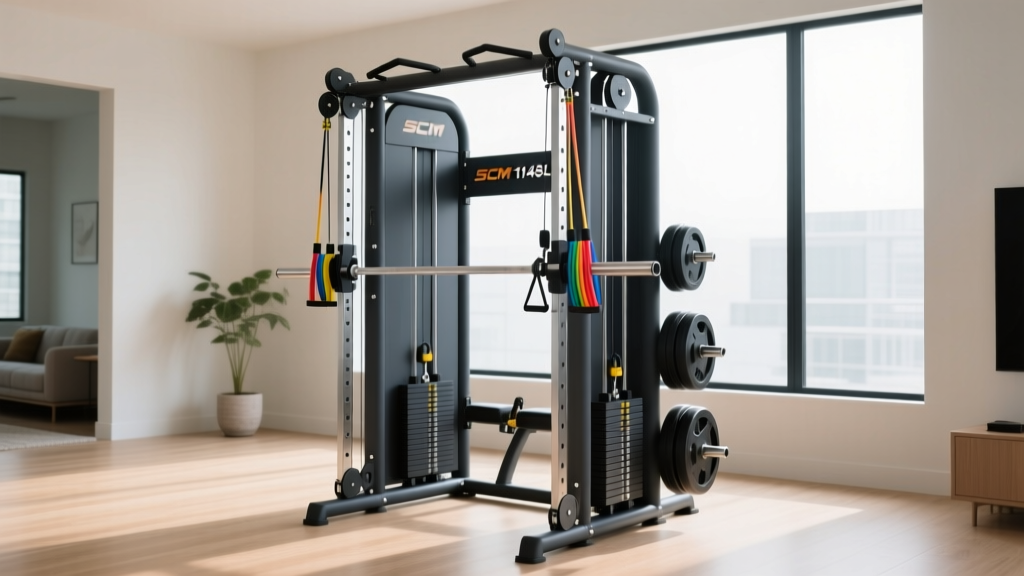
Vectra 1850 Home Gym: Weight Selection & Space Layout
Discover how much weight you really need for the Body-Solid Vectra 1850 home gym. Expert space planning, pulley ratios, and layout optimization tips.

The Spatial Reality of the Vectra 1850 Home Gym
Designing a high-functioning fitness space in a constrained environment requires a ruthless evaluation of both physical dimensions and biomechanical output. The Body-Solid Vectra 1850 home gym is frequently shortlisted by buyers in 2026 because it promises a commercial-grade multi-station experience within a relatively compact footprint. However, evaluating this machine strictly by its static dimensions is a critical error. True space optimization demands an understanding of operational clearances, user ergonomics, and, most importantly, the nuanced reality of its weight stack capacity.
Before addressing the core question of how much weight you actually need, we must establish the spatial baseline. The Vectra 1850 measures approximately 83 inches in height, 54 inches in width, and 71 inches in depth. While the static footprint consumes roughly 26.5 square feet, the operational footprint is vastly different. To safely execute a full range of motion on the lat pulldown and chest press stations, you must allocate a minimum of 24 inches of clearance on the primary user sides, and 18 inches behind the weight stack for cable maintenance and plate travel. This brings the realistic spatial requirement to a 10-foot by 9-foot dedicated zone.
Decoding the 210 lb Weight Stack: How Much Weight Do You Need?
The most common point of friction when planning a home gym layout is balancing spatial efficiency with resistance capacity. The Vectra 1850 comes equipped with a 210-pound selectorized weight stack. For many prospective buyers, this prompts a vital question: Is 210 pounds enough, or will spatial optimization compromise your strength progression?
To answer this, we must look at strength standards and the principle of progressive overload. According to data compiled by ExRx Strength Standards, an intermediate male lifter (weighing 180 lbs) typically has a 1-rep max (1RM) of around 215 lbs on the bench press and 250 lbs on the lat pulldown. For novices and early intermediates, a 210 lb stack provides ample resistance for hypertrophy, which generally requires lifting 65% to 85% of your 1RM for 8-12 repetitions. Therefore, for the first 18 to 24 months of consistent training, the 210 lb stack is mathematically sufficient.
⚠️ The Pulley Ratio TrapDo not confuse stack weight with actual resistance. The Vectra 1850 utilizes a complex cable routing system. On exercises like the leg extension or certain low-pulley rows, the machine employs a 2:1 mechanical advantage ratio. This means selecting 210 lbs on the stack only delivers 105 lbs of actual resistance to the user. Conversely, the chest press often operates closer to a 1:1 ratio. When calculating your weight needs, you must factor in these pulley ratios, meaning advanced lifters will max out the 210 lb stack much faster on isolation movements than on compound presses.
Weight Selection Framework for Constrained Spaces
When space is at a premium, choosing between a selectorized multi-gym like the Vectra 1850 and a traditional free-weight power rack is a battle of spatial volume versus unlimited load. Below is a comparative matrix to help you decide if the Vectra's weight profile aligns with your spatial constraints and strength goals.
| Feature | Vectra 1850 (Selectorized) | Standard Power Rack + Plates |
|---|---|---|
| Total Spatial Volume | ~45 sq ft (incl. clearances) | ~60-80 sq ft (incl. plate storage) |
| Max Resistance Capacity | 210 lbs (approx. 105-210 lbs actual) | 500+ lbs (limited only by plates bought) |
| Setup & Teardown Time | Instant (pin selection) | 2-5 mins per exercise change |
| Ideal User Profile | Novice to Intermediate; Space-restricted | Advanced; Powerlifters; Ample space |
Evaluating Your Personal Weight Requirements
To determine if the Vectra 1850's weight selection meets your long-term needs, conduct a simple audit of your current lifting metrics. If your working sets for chest presses, shoulder presses, and lat pulldowns currently exceed 160 lbs for 10 repetitions, the 210 lb stack (especially factoring in friction and pulley ratios) will become a bottleneck within 12 months. If your working sets are below 130 lbs, the Vectra 1850 offers a multi-year runway for progressive overload without requiring the spatial footprint of a 7-foot Olympic barbell and iron plates.
Space-Efficient Weight Expansion Strategies
If you are committed to the spatial efficiency of the Vectra 1850 but anticipate outgrowing the 210 lb stack, you do not need to abandon the machine or sacrifice your room layout. Modern home gym design in 2026 heavily favors hybrid resistance models. By integrating heavy-duty loop resistance bands into your cable routine, you can artificially increase the weight selection without adding physical mass to the room.
- Band-Assisted Pin Loading: By looping a 50-lb or 100-lb resistance band around the base of the weight stack guide rods and attaching it to the selector pin, you can add progressive accommodating resistance. This increases the load at the peak contraction point of the movement, effectively simulating a 300+ lb stack.
- Isometric Holds and Tempo Training: When physical weight is capped, manipulate the time under tension (TUT). Slowing the eccentric phase of a lat pulldown to a 4-second count increases muscle fiber recruitment, making 150 lbs feel significantly heavier without requiring extra plates.
- Unilateral Cable Work: Utilizing single-arm cable presses and rows forces the core to act as a stabilizer, increasing the overall systemic demand of the exercise even if the absolute load on the stack remains moderate.
Layout Integration: Flooring and Vibration Dampening
A critical, often overlooked aspect of weight selection and layout design is how the resistance impacts the physical room. Dropping a 210 lb weight stack repeatedly generates significant kinetic energy and low-frequency vibration. If your Vectra 1850 is situated in a basement, garage, or second-floor apartment, improper flooring will lead to structural noise transfer and premature wear on the machine's linear bearings.
According to guidelines on home fitness environments highlighted by ACE Fitness, protecting your subfloor and equipment is paramount. Do not use interlocking EVA foam tiles; they compress unevenly under the 600+ lb total weight of the Vectra 1850, causing the machine to sit out of level. This misalignment introduces lateral friction on the weight stack guide rods, effectively 'stealing' weight from your lifts and making a 210 lb stack feel sluggish and heavier than it is.
✅ Optimal Flooring SpecificationInstall 3/8-inch (8mm) vulcanized rubber tiles with a minimum density of 72 lbs per cubic foot. This provides a non-compressive, level base that absorbs the acoustic shock of the weight stack dropping, preserving the machine's biomechanical integrity and keeping your neighbors happy.
Final Layout and Clearance Checklist
To finalize your space optimization plan, use this step-by-step checklist before unboxing your equipment:
- Map the Primary User Zone: Tape off a 54-inch wide by 71-inch deep rectangle on your floor. This is the machine's hard boundary.
- Establish the Action Radius: Extend the tape measure 30 inches outward from the front and sides of the taped area. This is your movement zone for exercises like standing cable curls and triceps pushdowns.
- Verify Ceiling Height: The Vectra 1850 stands at 83 inches. Ensure your ceiling is at least 96 inches (8 feet) high to allow for overhead clearance, ventilation, and lighting fixtures. Tall users performing standing overhead cable extensions will require this extra headroom.
- Align with Natural Light and Ventilation: Position the machine so the user faces a window or a fan. The enclosed nature of multi-station gyms can trap heat; facing an airflow source improves endurance during high-volume hypertrophy sets.
Conclusion: Balancing Space and Strength
The decision to integrate the Vectra 1850 home gym into your living space ultimately hinges on a realistic appraisal of your strength trajectory. For the vast majority of home users focused on general fitness, body recomposition, and intermediate hypertrophy, the 210 lb weight stack—when combined with intelligent tempo manipulation and band-assisted overload—provides years of viable resistance. By respecting the machine's operational clearances, investing in high-density rubber flooring, and understanding the mechanical realities of its pulley system, you can engineer a highly efficient, space-optimized training environment that rivals commercial facilities without dominating your square footage.
More gear to consider
All reviews
Designing the Dream Home Gym: Floor Plans & Expert Gear Picks

Build a Home Gym Chuck Norris Style: Budget Setup Under $500

Troubleshooting Your Bio Force Home Gym in a Rental Apartment

Weatherproofing Outdoor Home Workout Gyms: Full Setup Guide

Bowflex PR1000 Home Gym: The Ultimate Beginner Starter Kit Guide