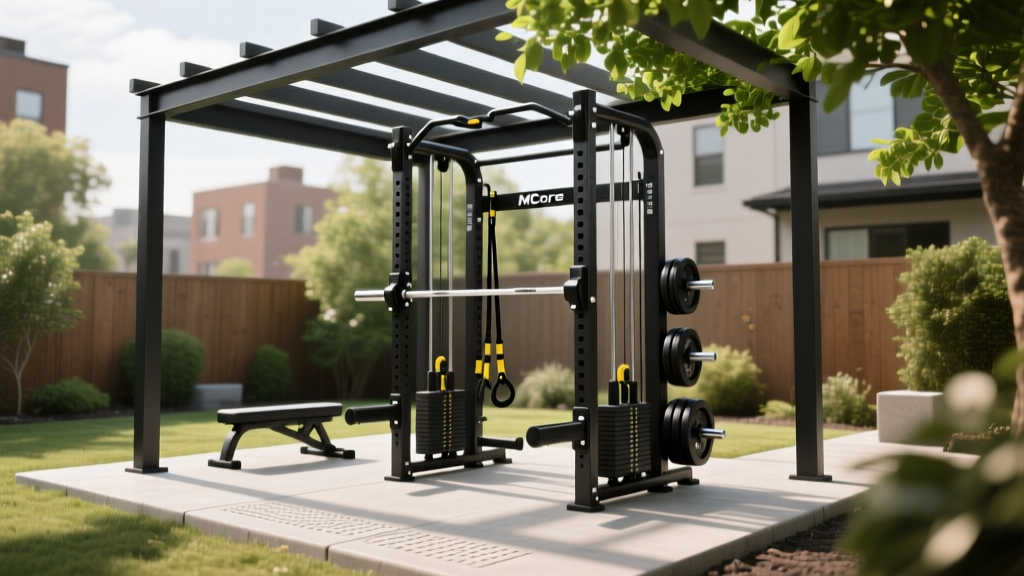
Weatherproofing Your MCore Home Gym: Outdoor Setup
Learn how to install and weatherproof your MCore home gym outdoors. Expert guide on concrete pads, rust prevention, and UV protection for exterior rigs.

The Reality of Outdoor Fitness Environments
Taking your training outdoors offers unmatched ventilation and mental clarity, but exposing a modular rig to the elements introduces severe engineering challenges. When installing an MCore home gym in an exterior environment, you are battling three primary adversaries: moisture-induced oxidation, ultraviolet (UV) polymer degradation, and thermal expansion. As of 2026, modern powder-coating techniques have improved significantly, but no factory finish is entirely impervious to standing water or coastal salt air. This complete setup and installation walkthrough provides a master-class in weatherproofing your outdoor MCore home gym, ensuring your investment survives decades of harsh environmental exposure.
Quick Climate Assessment MatrixBefore breaking ground, identify your primary environmental threat to dictate your material choices.
| Climate Zone | Primary Threat | MCore Rig Requirement | Flooring Choice |
|---|---|---|---|
| Coastal / Marine | Salt Spray / High Humidity | Hot-dip galvanized steel + Marine-grade wax | Permeable rubber pavers |
| Arid / Sunbelt | Intense UV / Extreme Heat | UV-stabilized powder coat + Polycarbonate roof | Vulcanized interlocking tiles |
| Freeze-Thaw | Ice Expansion / Snow Load | Sealed base plates + Angled snow canopy | High-density EVA over gravel base |
Step 1: Site Selection and Concrete Pad Preparation
The most critical failure point in any outdoor gym setup is the foundation. Never install an MCore home gym directly over dirt, grass, or existing wooden decks. Wood retains moisture and will rot, while dirt shifts under heavy deadlifts, causing the rig to twist and snap hardware.
Pouring a Gym-Rated Exterior Slab
You must pour a dedicated concrete pad that extends at least 18 inches beyond the footprint of your rig on all sides. For a standard 8x10 foot MCore functional trainer footprint, pour a 12x14 foot slab. Specify a 4000 PSI concrete mix with air-entrainment (crucial for freeze-thaw climates to prevent surface spalling). The slab must be a minimum of 4 inches thick, reinforced with a #4 rebar grid set at 18-inch centers. Crucially, request a broom finish rather than a smooth trowel finish; a smooth surface becomes dangerously slippery when wet or covered in morning dew. Ensure the contractor grades the pad with a 1/4-inch per foot slope away from your home's foundation to prevent hydrostatic pooling beneath the rig's base plates.
Step 2: Weatherproofing the MCore Home Gym Rig
Even premium 11-gauge steel uprights will succumb to rust if the joints and hardware are left vulnerable. According to the American Galvanizers Association, the intersection of dissimilar metals and trapped moisture is where structural degradation accelerates exponentially.
Combating Galvanic Corrosion at the Joints
The MCore home gym utilizes high-tensile zinc-plated or stainless-steel hardware to secure carbon-steel uprights. When moisture acts as an electrolyte between these dissimilar metals, galvanic corrosion occurs, effectively eating away the zinc hardware. To prevent this, coat all bolt threads and washer surfaces with a dielectric anti-corrosion compound like Tef-Gel or a marine-grade lanolin grease before tightening.
Internal Tube Protection
Condensation will inevitably form inside the hollow 3x3 inch uprights of your rig. To prevent rust from blooming from the inside out, spray the interior of all open uprights with Fluid Film NAS (Non-Aerosol Solvent). This lanolin-based compound creeps into microscopic pores and creates a self-healing barrier that stops internal oxidation dead in its tracks. Cap all open tube tops with fitted UV-resistant silicone or rubber end caps to block rain entry and prevent wasps from nesting in the steel columns.
"The number one failure point in outdoor gym rigs isn't the uprights—it's the unsealed base plates where water pools and creates a micro-climate of accelerated oxidation. Always seal the perimeter of your base plates with exterior-grade polyurethane caulk."
Step 3: Outdoor Flooring and Drainage Solutions
Standard 3/4-inch rolled rubber flooring or cheap horse stall mats are entirely unsuitable for outdoor installations. They trap water underneath, creating a breeding ground for toxic black mold and accelerating the rusting of your MCore base plates. Furthermore, the intense heat of a Sunbelt summer will cause rolled rubber to expand, buckle, and separate at the seams.
- The Solution: Install 2-inch thick vulcanized rubber pavers (typically priced between $5.00 and $8.00 per square foot in 2026).
- The Sub-Base: Lay the pavers over a 4-inch bed of compacted 3/4-inch crushed angular gravel. This allows rainwater to pass through the permeable rubber and drain into the gravel bed, keeping the surface dry and preventing hydrostatic pressure buildup.
- Acoustic Damping: If you are dropping heavy bumper plates, the gravel base provides excellent kinetic energy dispersion, reducing the ground-shock transmitted to neighboring properties.
Step 4: Equipment Storage and UV Protection
While steel rusts, polymers degrade. UV radiation breaks down the molecular chains in polyurethane, latex, and nylon. Leaving your MCore resistance bands, lifting belts, and upholstery-covered benches exposed to direct sunlight will result in catastrophic material failure within a single season. The National Weather Service notes that extreme heat and UV indices can rapidly degrade synthetic materials left unsheltered.
Building a Climate-Controlled Storage Footprint
Integrate a heavy-duty, waterproof deck box (minimum 50-gallon capacity) directly inside the rig's footprint. Look for boxes featuring a silicone gasket seal and a UV-stabilized polyethylene shell. Inside the box, place two or three rechargeable silica gel desiccant canisters (such as Eva-Dry units) to pull ambient humidity out of the air, protecting your leather belts and chalk. For the bench, invest in a custom-fitted, marine-grade vinyl cover with a breathable under-layer to prevent condensation buildup against the upholstery.
Step 5: Bi-Annual Maintenance Protocol
An outdoor MCore home gym is not a "set it and forget it" installation. To maintain structural integrity and warranty compliance, adhere to this strict maintenance schedule:
- Weekly: Sweep the vulcanized pavers to remove organic debris (leaves, pine needles) that can trap moisture and stain the rubber.
- Monthly: Inspect all structural hardware with a torque wrench. Thermal expansion and contraction will loosen bolts over time. Retorque to the manufacturer's specified foot-pounds (usually 60-80 ft-lbs for 1/2-inch structural bolts).
- Bi-Annually (Spring/Fall): Wash the entire rig with a mild, non-acidic automotive soap. Once dry, inspect the powder coat for any chips or deep scratches. Immediately touch up bare metal with a zinc-rich cold galvanizing compound (e.g., Rust-Oleum Cold Galvanizing Spray) to restore the sacrificial anode layer. For a comprehensive understanding of how coatings protect steel, refer to the extensive guides on Corrosionpedia.
FAQ: Outdoor MCore Installations
Can I leave my urethane-coated weight plates outside?
No. While urethane is highly durable against impact, prolonged exposure to UV rays and freezing temperatures will cause the outer shell to become brittle, crack, and eventually peel away from the steel core. Store all plates vertically on a covered rack or inside your sealed storage box when not in active use.
How do I handle snow load on the rig's canopy?
If you install a polycarbonate roof panel over your MCore pull-up area, you must ensure the panel is pitched at a minimum 3:12 ratio to allow snow shedding. A flat polycarbonate sheet will buckle under the weight of wet, heavy snow (which can weigh up to 20 lbs per cubic foot). Always clear heavy snow accumulation manually using a soft foam pusher to avoid scratching the UV-protective coating on the polycarbonate.
More gear to consider
All reviews
Weider Flex CTS Home Gym: Layout & Space Optimization

Strength Setup Guide: Installing Flooring for Home Gym Over Carpet

How Much Is a Home Gym Renovation? 2026 Cost Breakdown

Are Home Gyms Worth It? The Outdoor Weather-Proof Setup Guide

Troubleshooting Your Bio Force Home Gym in a Rental Apartment
