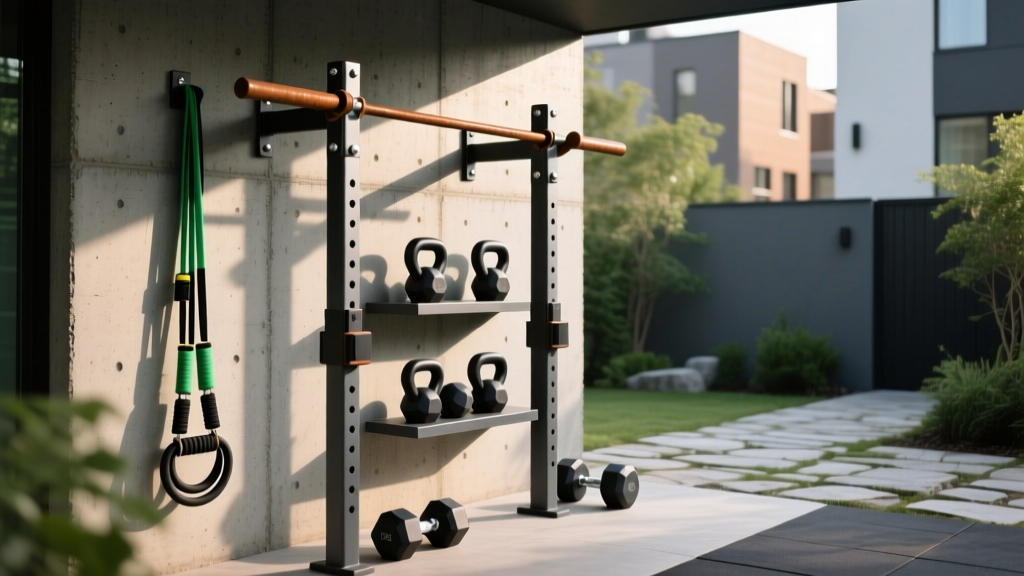
Outdoor Gym Weatherproofing: Home Gym Wall Storage and Equipment Care
Protect your outdoor home gym setup from the elements. Learn weather considerations, rust prevention, and how to maintain home gym wall storage longevity.

The Reality of Outdoor Home Gym Setups in 2026
The shift toward semi-outdoor and fully outdoor home gyms—utilizing covered patios, pergolas, and screened lanais—has accelerated through 2026. While training in fresh air offers immense psychological and physiological benefits, exposing fitness equipment to the elements introduces severe longevity challenges. Unlike a climate-controlled garage or basement, an outdoor setup is subjected to UV radiation, ambient humidity, driving rain, and extreme temperature fluctuations.
When planning an outdoor fitness space, most lifters focus on weatherproofing their squat racks and barbells. However, home gym wall storage is frequently an afterthought, leading to catastrophic failures. Pegboards rust at the welds, slatwalls warp and lose their load-bearing capacity, and shelving brackets corrode at the anchor points. According to corrosion standards outlined by the Association for Materials Protection and Performance (AMPP), the combination of high humidity and temperature cycling accelerates galvanic corrosion in mixed-metal assemblies by up to 40% compared to stable indoor environments.
This guide provides a comprehensive maintenance and longevity framework for outdoor home gyms, with a critical deep-dive into selecting, installing, and maintaining home gym wall storage in harsh weather conditions.
Weather Considerations for Outdoor Fitness Spaces
Before hanging a single J-cup or resistance band, you must understand the specific environmental stressors acting on your equipment. Outdoor setups generally fall into two categories: fully exposed (under a basic roof overhang) and semi-enclosed (screened or walled pergolas). Both face three primary enemies:
- UV Degradation: Ultraviolet light breaks down the molecular bonds in plastics, rubber flooring, and standard epoxy powder coatings, causing them to chalk, crack, and become brittle.
- Moisture and Condensation: Even under a solid roof, nighttime temperature drops cause ambient moisture to condense on cold steel surfaces. This micro-condensation is the primary catalyst for flash rusting.
- Thermal Expansion and Contraction: Daily temperature swings of 30°F or more cause metal and wood to expand and contract, which can slowly loosen wall anchors and compromise the structural integrity of heavy storage systems.
Protecting Your Home Gym Wall Storage Outdoors
Your home gym wall storage system is the organizational backbone of your setup, holding everything from 45-pound bumper plates to delicate resistance bands. In an outdoor environment, the material you choose for this storage dictates its lifespan.
The Slatwall and Pegboard Material Matrix
Never use indoor-rated MDF (Medium Density Fiberboard) slatwalls outdoors. MDF acts like a sponge for ambient humidity. Once it swells, the aluminum inserts pull out under load, dropping heavy equipment. Similarly, standard steel pegboards will rust at the punched holes where the protective zinc or powder coating is broken during manufacturing.
| Material Type | UV Resistance | Moisture Resistance | Max Load Capacity | Estimated Cost (per sq ft) |
|---|---|---|---|---|
| MDF Slatwall (Indoor) | Poor | Very Poor (Swells) | 15 lbs / bracket | $2.50 - $4.00 |
| PVC / Polymer Slatwall | Excellent | Excellent (Waterproof) | 75 lbs / bracket | $6.00 - $9.00 |
| Galvanized Steel Pegboard | Good | Good (Zinc sacrificial layer) | 50 lbs / hook | $3.50 - $5.50 |
| TGIC Powder-Coated Steel | Excellent | Very Good | 100+ lbs / hook | $7.00 - $12.00 |
Note: Always specify TGIC (Triglycidyl Isocyanurate) polyester powder coating for outdoor steel storage. Standard epoxy powders will chalk and degrade within six months of UV exposure. Brands like Rogue Fitness utilize high-grade powder coats, but even these require overhead shelter for maximum longevity.
⚠️ Critical Warning: Galvanic CorrosionNever mount aluminum storage brackets directly to untreated steel wall studs or use standard zinc-plated lag screws on aluminum slatwalls in a humid environment. The dissimilar metals will create a galvanic cell, rapidly corroding the less noble metal (the zinc or aluminum). Always use dielectric nylon washers to separate dissimilar metals.
The Hardware Imperative: Anchoring Storage in the Elements
The most robust home gym wall storage system is only as strong as the hardware anchoring it to the wall. In an outdoor or semi-outdoor setup, standard zinc-plated lag screws will rust and snap under the dynamic load of someone pulling a heavy medicine ball off a shelf.
The 316 Marine-Grade Standard:
For any outdoor wall storage installation, you must upgrade to 316 Marine-Grade Stainless Steel hardware. While 304 stainless steel is sufficient for indoor use, it is highly susceptible to pitting corrosion in coastal areas or environments with high chloride exposure (such as areas where winter road salt is tracked in). A box of fifty 3/8" x 3" 316 stainless steel lag screws costs roughly $45—about $20 more than standard zinc—but it ensures your 200lb kettlebell rack doesn't rip away from a rotted, rusted anchor point.
Equipment Maintenance and Rust Prevention Protocols
Even with the right materials, proactive maintenance is non-negotiable for outdoor gym longevity. Implement this tri-fold rust prevention protocol for all exposed metal storage racks, hooks, and the equipment resting on them.
1. The Solvent Myth (Stop Using Standard WD-40)
A common mistake is spraying standard WD-40 on metal storage hooks and racks. Standard WD-40 is primarily a solvent and water displacer, not a long-term lubricant or protectant. It strips away existing protective oils and leaves the metal bare to oxidize.
2. The Lanolin and Wax Solution
Instead, use dedicated marine and aerospace protectants:
- Fluid Film NAS (~$16/can): A lanolin-based (sheep wool wax) inhibitor that creeps into the microscopic pores of metal and welds. It never fully dries, meaning it continuously self-heals when scratched by heavy iron plates being loaded onto storage pegs.
- Boeshield T-9 (~$18/can): Developed by Boeing for marine-grade aluminum and steel. It leaves a dry, hard waxy film that is excellent for storage hooks where you don't want a greasy residue transferring to your hands or equipment.
3. The Monthly Wipe-Down Routine
Keep a microfiber cloth and a bottle of 3-in-One silicone spray near your home gym wall storage. Once a month, wipe down all metal pegs, J-cups, and shelving brackets. This removes acidic sweat residue and ambient dust that traps moisture against the metal.
Flooring and Structural Drainage Considerations
Wall storage longevity is directly tied to the floor beneath it. If water pools at the base of your wall, capillary action will wick moisture up into the drywall, wood studs, or bottom plates of your steel storage racks, causing rot and rust from the bottom up.
Avoid Standard Rubber Mats: Traditional 3/4" horse stall mats are impermeable. In an outdoor setup, rain blow-in and condensation will get trapped underneath them, creating a breeding ground for black mold and accelerating the rusting of any floor-anchored storage units.
The Solution: Interlocking Drainage Tiles
Invest in rigid PVC drainage tiles (such as Swisstrax Ribtrax or similar modular outdoor tiles, typically costing $4.00 to $6.00 per square foot). These tiles feature a raised grid system that allows water to flow freely underneath to a graded concrete slope, keeping the base of your wall storage systems completely dry and allowing ambient airflow to evaporate condensation.
Seasonal Maintenance Checklist
To ensure your outdoor setup and home gym wall storage survive the harshest months, follow this seasonal checklist:
- Spring (Post-Winter): Inspect all wall anchors for loosening caused by freeze-thaw expansion. Torque all 316 stainless steel lag screws to 40 ft-lbs. Wash polymer slatwalls with a mild dish soap solution to remove pollen and acidic bird droppings.
- Summer (Peak UV): Apply a UV-protectant spray (like 303 Aerospace Protectant) to any plastic storage bins, resistance bands, and PVC slatwalls to prevent polymer chain breakdown.
- Autumn (Pre-Moisture): Apply a fresh coat of Boeshield T-9 to all steel pegboard hooks, shelving brackets, and the weld points of your squat rack. Clear any debris from the floor drainage tiles to prevent water damming against the wall.
- Winter (Freeze Protection): If your outdoor gym is in a freezing climate, bring all liquid-filled equipment (like water-filled slam balls or adjustable dumbbells with liquid-filled housings) indoors. Ensure roof gutters above the gym space are clear to prevent ice dams from forcing meltwater behind your wall storage panels.
By treating your outdoor home gym with the same respect for material science and weatherproofing as a marine environment, your equipment—and specifically your home gym wall storage—will remain safe, functional, and visually pristine for decades. For further insights on outdoor material degradation, refer to long-term testing data published by Consumer Reports on exterior structural polymers and coatings.
More gear to consider
All reviews
Planet Fitness Switching Home Gym: Apartment Setup Mistakes

Troubleshooting Your Bio Force Home Gym in a Rental Apartment
Home Gym Construction: Rubber Rolls vs. Tiles Compared

Home Gym Setup Guide: Floor Plans for Home Gym Workout Exercises
How Much Weight You Need: Home Gym Weight Selection & Boxing Equipment
