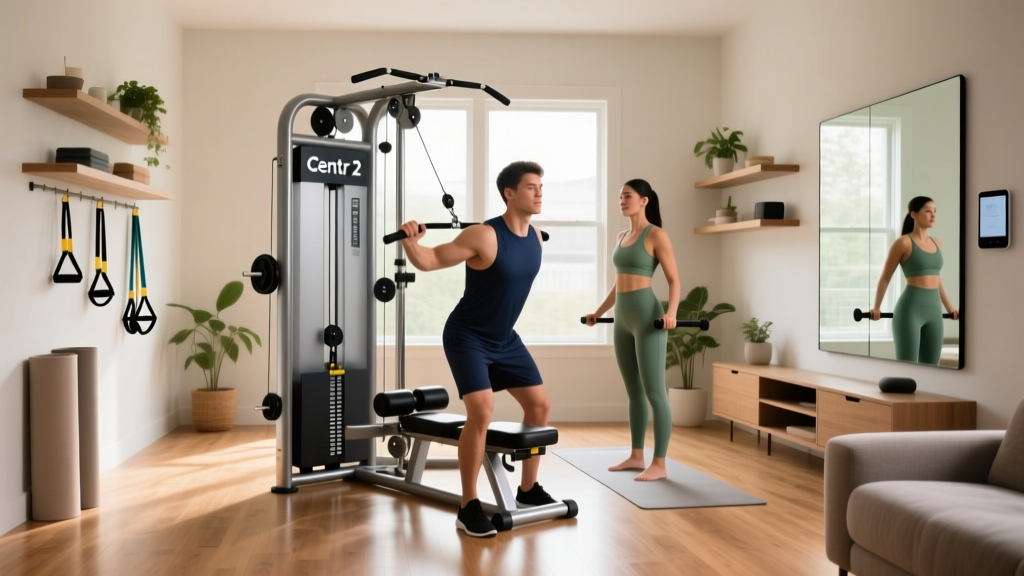
Shared Home Gym Setup: The Centr 2 Home Gym Functional Trainer Guide
Design a shared home gym for couples with our step-by-step guide. Learn space planning, flooring, and setup tips for the Centr 2 home gym functional trainer.

The Diplomacy of Dual Fitness: Designing a Shared Home Gym
Setting up a home gym for one person is a straightforward exercise in personal preference. Setting one up for a couple, however, is an intricate balancing act of spatial geometry, acoustic management, and biomechanical compromise. When two people with potentially divergent fitness goals—one pursuing heavy hypertrophy, the other focusing on mobility and functional endurance—share a single room, traditional bulky equipment quickly becomes a point of friction.
As of 2026, the evolution of smart fitness technology has solved the shared-space dilemma. By anchoring your room around an all-in-one smart rig, specifically the Centr 2 home gym functional trainer, couples can reclaim their square footage without sacrificing exercise variety. This beginner-friendly, step-by-step guide will walk you through assessing your space, installing the right infrastructure, and configuring a shared environment that keeps both partners motivated and safe.
Step 1: Mapping the Shared Footprint and Clearance Zones
The most common mistake couples make is measuring the static footprint of the equipment while ignoring the dynamic footprint of the human body in motion. According to the National Safety Council (NSC), preventing trip hazards and ensuring proper clearance is the foundation of home safety, especially in high-activity zones.
The Triangle of Movement
For a functional trainer setup, you must account for lateral cable pulls and dynamic lunges.
- Static Equipment Footprint: The Centr 2 home gym functional trainer boasts a remarkably compact wall-mounted or floor-bolted footprint, generally requiring about 36 inches of depth and 60 inches of width.
- Dynamic Clearance: You need a minimum of 48 inches of lateral clearance on both sides of the rig to allow for unrestricted cable crossover movements and rotational exercises.
- Overhead Clearance: Ensure a minimum ceiling height of 84 inches (7 feet) to accommodate pull-up attachments and overhead presses without knuckle-scraping.
Step 2: Acoustic and Impact Flooring for High-Traffic Zones
When two people share a home gym, the volume of dropped weights and foot traffic doubles. If your gym is located in a basement, garage, or apartment, acoustic dampening is not optional; it is essential for household harmony.
Selecting the Right Rubber
Skip the interlocking EVA foam tiles found in big-box stores; they compress permanently under heavy loads and degrade with high-frequency use. Instead, invest in 3/8-inch (8mm) vulcanized rubber tiles.
- Cost Expectation: Expect to pay between $2.50 and $4.00 per square foot for high-density vulcanized rubber.
- Acoustic Benefit: This thickness reduces impact noise transmission by up to 15 decibels, meaning early morning deadlifts won't wake up the rest of the house.
- Installation: Use a heavy-duty double-sided flooring tape around the perimeter rather than gluing the entire floor, allowing for moisture inspection underneath if your gym is in a basement.
Step 3: Anchoring the Setup with the Centr 2 Home Gym Functional Trainer
Why choose the Centr 2 home gym functional trainer as the centerpiece for a shared space? Traditional dual-stack cable machines require massive weight stacks, loud selectorized pins, and take up over 16 square feet of floor space. The Centr 2 replaces this with electromagnetic digital resistance, offering a silent, sleek, and highly adaptable experience.
Digital Profiles and the 'No-Argument' Weight Stack
The biggest friction point for couples sharing a traditional machine is constantly swapping 10-pound plates or moving selector pins between vastly different strength levels. The Centr 2 eliminates this via dual-user digital profiles. With a quick tap on the interface or via a connected wearable, the machine instantly adjusts its resistance profile, tracking individual volume, one-rep max estimates, and progressive overload metrics for both partners independently.
| Feature | Traditional Dual-Stack Machine | Centr 2 Smart Functional Trainer |
|---|---|---|
| Footprint | ~16 to 22 sq. ft. | ~8 to 10 sq. ft. (Wall/Stand mounted) |
| Acoustic Output | High (clanking plates/pins) | Near-Silent (Magnetic resistance) |
| Partner Tracking | Manual logging required | Automatic dual-profile cloud syncing |
| Resistance Type | Static gravity (weight stacks) | Dynamic (Eccentric overload, isokinetic) |
Step 4: Supplementing for Divergent Fitness Goals
While the Centr 2 home gym functional trainer covers 85% of your strength and hypertrophy needs, a shared gym must cater to the remaining 15% of modalities. If Partner A focuses on heavy cable work and Partner B prefers yoga, Pilates, or functional kettlebell flows, you need supplementary gear that stores easily.
The Shared Accessory Arsenal
- Adjustable Dumbbells (e.g., Nuobell or PowerBlock): Essential for unilateral work that doesn't require the cable rig, allowing Partner B to work out simultaneously while Partner A uses the functional trainer.
- Competition-Grade Kettlebells: Purchase three distinct weights (e.g., 16kg, 20kg, 24kg) for ballistic movements like swings and snatches.
- Wall-Mounted Mat Rack: Keep yoga and mobility mats off the floor to maintain the NSC-recommended clear pathways, reducing trip hazards in a shared space.
Step 5: Climate Control and Indoor Air Quality
Two people exercising in a closed room generate significant heat, humidity, and CO2. Poor ventilation leads to rapid fatigue and mold growth in basement gyms. The Environmental Protection Agency (EPA) emphasizes that adequate ventilation is critical for maintaining indoor air quality (IAQ) during physical exertion.
HVAC and Airflow Strategies
- Active Exhaust: Install a wall-mounted exhaust fan rated for at least 150 CFM (Cubic Feet per Minute) to pull stale, CO2-heavy air out of the room.
- Dehumidification: If your shared gym is in a basement, run a 50-pint ENERGY STAR-certified dehumidifier. Keep ambient humidity between 40% and 50% to protect the electronic components of your smart trainer from moisture ingress.
- Air Purification: A HEPA air purifier with an activated carbon filter will manage sweat odors and keep the space feeling fresh for the second user.
'Working out with a partner significantly increases adherence to fitness programs. However, the environment must support both individuals' autonomy and shared goals to prevent the space from becoming a source of domestic friction.' — Principles derived from the American Council on Exercise (ACE) behavioral coaching guidelines.
Step 6: Establishing Shared Gym Etiquette
The best equipment in the world won't save a shared gym if the rules of engagement aren't established. Treat your home gym like a premium boutique studio.
The 'Reset' Rule
Implement a strict 'reset to neutral' policy. Because the Centr 2 relies on digital handles and specialized attachments (like ankle straps, tricep ropes, and lat bars), the user finishing their set must re-rack the attachment on a designated wall-mounted pegboard. Never leave a cable fully extended or a handle on the floor.
Sanitation Station
Mount a small dispenser for hospital-grade, electronics-safe disinfectant wipes near the smart screen. Warning: Never spray liquid cleaners directly onto the Centr 2's touchscreen or digital dials. Spray the cloth first, then wipe the interface and handles to prevent liquid damage to the internal sensors.
Conclusion: A Space That Grows With You
Building a home gym for couples requires foresight, but the payoff is immense. By prioritizing dynamic clearance, investing in acoustic flooring, and leveraging the adaptive technology of the Centr 2 home gym functional trainer, you create an environment where both partners can thrive. You aren't just buying fitness equipment; you are investing in a shared lifestyle, eliminating the commute to the commercial gym, and building a private sanctuary that supports your unique, individual, and shared fitness journeys for years to come.
More gear to consider
All reviews
Centr 3 Home Gym vs Custom Budget Setup Under $500

Why Your Garage Home Gym Idea Needs Better Flooring and Airflow

Equipment for Home Gym: The Ultimate Weight Selection Guide

Designing Amazing Home Gyms for Serious Strength Training

Inspire Fitness BL1 Body Lift Home Gym: 2026 Beginner Starter Kit
