Marcy Cage Home Gym vs. Foldable Rigs: 2026 Space Guide
Compare the Marcy cage home gym footprint against 2026 foldable wall-mounted rigs. Expert analysis on pricing, clearance, and structural limits.

The Small-Space Dilemma: Fixed Cages vs. Foldable Rigs
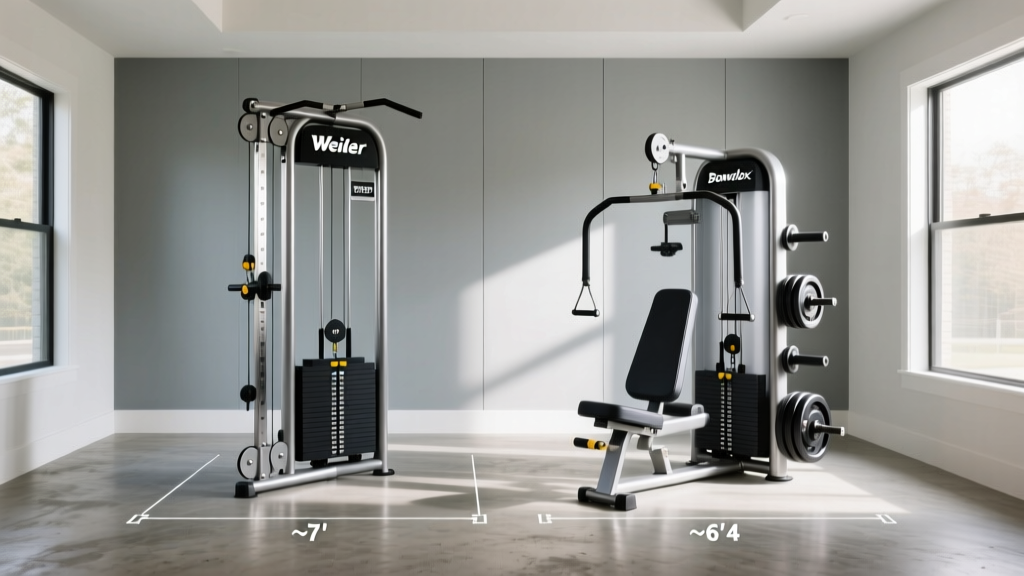
Designing a functional strength training area in a sub-200-square-foot footprint requires ruthless prioritization. For years, budget-conscious lifters have defaulted to the Marcy cage home gym (specifically models like the SM-4903 or SM-4008) as a catch-all solution for garages and spare bedrooms. However, the 2026 fitness equipment market has seen a massive surge in compact foldable home gym solutions—wall-mounted, hinged power racks that disappear when not in use.
This in-depth buying guide bypasses the marketing fluff to compare the structural engineering, true spatial footprint, and long-term failure modes of traditional budget cages against modern foldable rigs. Whether you are outfitting a tight apartment or a multi-purpose garage, understanding the kinetic and spatial differences between these two categories is critical before you start drilling holes or bolting down steel.
The Quick Verdict
Choose a Marcy cage home gym if you have a dedicated 4x4 foot floor space, need an integrated Smith machine/cable system out of the box, and are lifting under 300 lbs. Choose a foldable wall-mounted rig (like PRx or Titan) if your space must serve dual purposes (e.g., a garage for parking or a living room), you require 1,000+ lb capacity, and you can safely anchor lag bolts into structural wood studs.
Deep Dive: The Marcy Cage Home Gym Experience
The Marcy Pro SM-4903 remains one of the most popular entry-level all-in-one systems. It combines a Smith machine, a dual-pulley cable crossover, and a free-weight power rack into a single 14-gauge steel frame. Priced around $349 in 2026, it offers immense versatility for the cost. However, evaluating it for small spaces requires looking past the brochure dimensions.
Real-World Footprint & Clearance Math
The SM-4903 frame measures roughly 48.5 inches long by 43 inches wide, with an 80-inch height. While the physical footprint is about 14.5 square feet, the operational footprint is vastly larger. According to safety guidelines from the American Council on Exercise (ACE), you must maintain a minimum of 36 inches of clearance on all sides of free-weight equipment for safe spotting and emergency bail-outs.
- Physical Footprint: 14.5 sq. ft.
- Operational Footprint (with clearance): ~75 sq. ft.
- Weight Capacity: 300 lbs (Smith bar), 300 lbs (Cable system)
- Steel Gauge: 14-gauge (thinner, prone to micro-flexing under heavy asymmetrical loads)
Structural Failure Modes & Edge Cases
The primary failure mode of the Marcy cage home gym is not catastrophic collapse, but mechanical binding. The Smith bar utilizes linear bearings on 14-gauge steel guide rods. If you load the bar unevenly or apply excessive lateral force during heavy shrugs, the frame torques. This micro-flexing causes the linear bearings to bind, resulting in a jerky bar path. Furthermore, the plastic pulleys on the cable crossover system show significant groove wear after 18 to 24 months of heavy, high-volume lat pulldowns, requiring aftermarket replacements.
The Foldable Revolution: Wall-Mounted Alternatives
Compact foldable home gym solutions solve the spatial problem by utilizing vertical wall space and hinged uprights. When folded, these rigs protrude merely 4 inches from the wall, effectively reclaiming 100% of the floor space for parking, yoga, or daily living. The two dominant players in this space are the PRx Performance Profile and the Titan Fitness T3 Fold-In.
Engineering the Fold: PRx vs. Titan
Unlike the 14-gauge steel of budget cages, premium foldable racks utilize 11-gauge, 3x3-inch steel uprights. This provides a 1,000+ lb static capacity. However, the engineering challenge lies in the hinge mechanism and wall transfer.
Critical Installation Warning
Foldable racks transfer kinetic energy directly into your wall studs during failed reps or heavy re-racking. You must mount these units into structural wood studs (typically 16 inches on-center) using 3/8-inch or 1/2-inch structural lag screws. Mounting into drywall, metal studs, or masonry without specialized toggle anchors will result in catastrophic wall failure and severe injury.
The PRx Performance Profile One (approx. $595) uses a patented gas-shock assisted hinge, allowing you to fold and unfold the 3x3 uprights with one hand. It requires 22 inches of depth when deployed. The Titan Fitness T3 Fold-In (approx. $499) uses a manual pin-hinge system. It is slightly more cumbersome to fold but offers a deeper 42-inch working depth when open, which is vastly superior for heavy barbell squats and bench pressing where you need interior spotter arms.
Head-to-Head Comparison Matrix
Below is a direct comparison of the leading options in both categories, reflecting current 2026 pricing and specifications.
| Feature | Marcy Pro SM-4903 | PRx Profile One | Titan T3 Fold-In |
|---|---|---|---|
| Type | Freestanding All-in-One | Wall-Mounted Foldable | Wall-Mounted Foldable |
| Stored Depth | 43" (Fixed) | 4" from wall | 4" from wall |
| Deployed Depth | 43" (Fixed) | 22" | 42" |
| Steel Gauge | 14-Gauge (2x2) | 11-Gauge (3x3) | 11-Gauge (3x3) |
| Max Capacity | 300 lbs | 1,000+ lbs | 1,000+ lbs |
| Integrated Cables? | Yes (Dual Pulley) | No (Add-on required) | No (Add-on required) |
| Approx. Price | $349 | $595 | $499 |
Kinetic Energy Transfer: Flooring and Vibration
An often-overlooked factor in small-space gym design is how equipment handles kinetic energy. The National Strength and Conditioning Association (NSCA) emphasizes that proper flooring is essential not just for equipment protection, but for force dampening in multi-use residential spaces.
When you drop a barbell or aggressively re-rack weights on a freestanding Marcy cage, the kinetic energy travels down the uprights and disperses horizontally across the floor. If you are using interlocking EVA foam tiles, this energy will cause the floor to compress and shift, eventually tearing the interlocking teeth. For a Marcy cage, 3/4-inch vulcanized rubber horse stall mats are mandatory to stabilize the 14-gauge frame and prevent walking.
Conversely, foldable wall-mounted racks transfer a significant portion of re-racking force directly into the wall studs via the lag bolts. While this saves your floor from lateral shearing, it creates structural vibration. If your foldable rack is mounted on a shared wall in an apartment or a townhouse, the low-frequency thud of a 300-lb barbell hitting the J-cups will easily penetrate drywall and annoy neighbors. In these scenarios, utilizing a freestanding cage on top of high-density sound-dampening rubber is the only viable option.
Expert Insights on Long-Term Usability
According to equipment teardowns and long-term reviews by experts at Garage Gym Reviews, the total cost of ownership heavily favors modular foldable rigs. A Marcy cage is a closed ecosystem; if the Smith bar bends or the cable pulleys shatter, the entire unit is often compromised. Foldable racks like the Titan T3 or PRx Profile utilize standard 3x3-inch uprights with 1-inch holes. This means you can easily upgrade to UHMW-lined J-cups, attach modular cable attachments, or swap out spotter arms as your strength progresses, effectively future-proofing your investment.
Frequently Asked Questions (FAQ)
Can I mount a foldable home gym rack to a concrete block wall?
Yes, but it requires specialized hardware. You must use structural wedge anchors or epoxy-set sleeve anchors rated for at least 1,000 lbs of sheer force per bolt. Standard drywall toggle bolts will fail under the dynamic load of re-racking heavy barbells.
Is the Marcy SM-4903 safe for heavy barbell squats?
The SM-4903 includes a free-weight rack section, but the 2x2-inch 14-gauge uprights and 300-lb total capacity limit its utility for advanced powerlifters. It is safe for novice to intermediate lifters, provided the frame is bolted to a wooden subfloor or weighed down with heavy floor plates to prevent tipping.
Do foldable racks come with pull-up bars?
Most premium foldable rigs include a multi-grip pull-up bar that folds flat against the wall alongside the uprights. However, you must ensure your ceiling height is at least 84 inches to allow for full dead-hangs without your head striking the ceiling or overhead drywall joints.
Final Recommendation: Which Setup Fits Your Floorplan?
If your primary constraint is budget and versatility, and you have a dedicated 8x10 foot room that will never be used for anything else, the Marcy cage home gym remains an unbeatable value at under $400. It provides immediate access to cables, Smith machine work, and light free-weight movements without requiring structural modifications to your home.
However, if your primary constraint is space reclamation and heavy lifting, investing $500 to $700 into a compact foldable home gym solution like the Titan T3 or PRx Profile is vastly superior. The 11-gauge steel construction ensures lifetime durability, and the ability to fold the rig to a 4-inch profile allows you to maintain a functional living space, park a vehicle in your garage, or roll out a yoga mat the second your workout is complete.
More gear to consider
All reviews
Apartment Home Gym Size Dimensions: Avoid These No-Damage Mistakes

Apartment Home Gym Inspo: Longevity & Maintenance Secrets

Jacked Up Home Gym Renovation: 2026 Budget Breakdown
Weider Flex CTS Home Gym: Layout & Space Optimization

Syedee Home Gym Reviews: How Much Weight You Need