
Foldable Home Gym Cost: Compact Setup Pricing Guide
Discover the true home gym cost of compact, foldable setups. We break down 2026 pricing, spatial layouts, and hidden installation fees for micro-gyms.

The Spatial Economics of the Micro-Gym
As urban living spaces shrink and multi-use rooms become the standard, the fitness industry has pivoted hard toward space optimization. But compressing a full strength-training facility into a 50-square-foot footprint introduces a unique financial paradox: saving physical space often increases your upfront equipment budget. When calculating the total home gym cost for a compact, foldable setup, you are no longer just paying for steel; you are paying for the mechanical engineering required to make that steel disappear into your wall.
Traditional power cages are static, gravity-anchored structures. Foldable squat racks, wall-mounted cable systems, and collapsible benches rely on heavy-duty gas shocks, reinforced 11-gauge steel hinges, and precision-machined pivot points. In 2026, this 'spatial premium' typically adds 15% to 30% to the base price of comparable static gear. However, when you factor in the real estate savings—especially for apartment dwellers paying premium rent per square foot or homeowners sacrificing valuable garage storage—the return on investment becomes undeniable.
2026 Spatial Premium Index: On average, foldable home gym equipment costs $1.85 more per pound of steel than traditional static racks, driven by the inclusion of commercial-grade pneumatic struts and structural mounting hardware.Core Foldable Equipment Breakdown & Pricing Matrix
To accurately forecast your budget, you must look at the anchor pieces of a foldable gym. Below is a comparative matrix of the most reliable compact solutions available in 2026, balancing structural integrity with true space-saving dimensions.
| Equipment Model | Unfolded Footprint | Folded Depth / Storage | 2026 MSRP | Primary Use Case |
|---|---|---|---|---|
| PRx Performance Profile Folding Rack | 24' x 44' | 4 inches from wall | $595.00 | Heavy barbell lifting, kipping pull-ups |
| Rogue Fold-Up Utility Bench 2.0 | 17.5' x 47' | Flat wall-mount or under-bed | $215.00 | Dumbbell pressing, seated accessory work |
| Speediance Gym Monster 2 (Smart) | 28' x 16' (Base) | Folds down to 10' height | $3,999.00 | Cable resistance, rehab, apartment living |
| Bells of Steel Wall-Mount Cable Tower | 20' x 14' | Flush against wall (6' depth) | $1,299.00 | Lat pulldowns, tricep pushdowns, rows |
Brands like PRx Performance have pioneered the folding rack category, utilizing a patented lever system that allows a 1,000-pound capacity rack to fold flat against the wall in under five seconds. While the $595 price tag for the rack itself seems reasonable, the true cost of a foldable gym lies in the peripheral requirements and installation.
The Hidden Installation Costs to Budget For
Unlike a freestanding rack that you simply bolt to a concrete floor, foldable equipment transfers dynamic kinetic energy directly into your wall studs. If your home gym cost calculator doesn't include structural reinforcement, you are setting yourself up for catastrophic failure.
- Stud Location & Reinforcement ($50 - $150): Standard 16-inch on-center wood studs may not align with the rack's mounting brackets. You may need to open the drywall and install horizontal 2x6 blocking between studs to create a secure mounting plane.
- Heavy-Duty Hardware ($35 - $60): Never use the generic lag bolts included in some budget import kits. Upgrade to 3/8' x 3' structural lag screws (like Simpson Strong-Tie SDWS) or, for masonry walls, 1/2' wedge anchors.
- Professional Mounting ($150 - $300): If you are renting an apartment or lack the tools to drill into concrete, hiring a licensed handyman to ensure the wall mount is perfectly plumb and structurally sound is a non-negotiable safety expense.
Layout Blueprint: Designing a 50-Square-Foot Micro-Gym
Space optimization is not just about buying foldable gear; it is about understanding human biomechanics and equipment clearance. According to spatial guidelines discussed by the American College of Sports Medicine, adequate clearance is vital for both safety and proper form execution. Here is a step-by-step layout flow for a standard 5' x 10' (50 sq ft) micro-gym corner.
- Establish the 'Drop Zone' (Front 3 Feet): Leave a minimum of 36 inches of clear space in front of your folded rack. This is where you will load plates, perform deadlifts, and drop dumbbells. Use 3/4-inch thick interlocking EVA foam tiles over a rubber underlayment to dampen acoustic vibrations for downstairs neighbors.
- Mount the Rack at Exact Clearances: When installing a foldable rack, measure exactly 14 inches from the wall to the center of the uprights when unfolded. This specific measurement ensures that a standard 7-foot Olympic barbell will not scrape the drywall during squats, while still allowing the knurling to sit comfortably on your back.
- Vertical Clearance Check: Standard US ceilings are 8 feet (96 inches). If you mount an 84-inch foldable rack, you are left with only 12 inches of overhead clearance. This is insufficient for pull-ups. You must either opt for a shorter 72-inch rack or mount the rack slightly lower, accepting a reduced max barbell catch height.
- Bench Storage Integration: The Rogue Fold-Up Utility Bench 2.0 is designed to hang directly on the wall or the uprights of compatible racks. Store it vertically on the adjacent wall to keep the central floor space entirely clear for kettlebell flows or yoga when the gym is 'closed'.
'The biggest mistake consumers make with micro-gyms is ignoring the 'swing radius.' A foldable rack saves square footage, but if you mount it in a corner where a loaded barbell sleeve extends past the wall boundary, you've created a drywall-destroying hazard. Always map the 7-foot barbell arc before drilling a single hole.'
— Marcus Vance, Certified Strength and Conditioning Specialist (CSCS) and Home Gym Layout Consultant
Long-Term ROI: Foldable vs. Traditional Racks
Is the premium home gym cost of foldable equipment worth it over a 5-year timeline? To answer this, we must compare the 'Garage Build' to the 'Apartment Build'.
A traditional static 4-post power cage costs roughly $450, requires a dedicated 4' x 4' permanent footprint, and necessitates bolting into a concrete slab. In a suburban garage, this is highly cost-effective. However, in an urban apartment or a multi-purpose guest room, that 16-square-foot permanent footprint represents lost utility. If your rent is $3.50 per square foot, dedicating 16 square feet to a static rack costs you $56 per month, or $3,360 over five years, in 'wasted' spatial utility.
Conversely, a $600 foldable rack utilizes only 2 square feet of wall space when stored. The ability to fold the gym away allows the room to serve as a home office, guest room, or living area, effectively neutralizing the spatial cost. Furthermore, foldable setups drastically reduce floor protection costs; because the equipment is moved and the floor is swept regularly, you avoid the trapped moisture and subfloor rot that often occurs under permanent rubber stall mats in garages.
Acoustic Dampening: The Apartment Tax
When optimizing a compact layout in a shared building, sound transfer is your biggest enemy. Foldable gear introduces a unique acoustic challenge: the 'slam' of the rack unfolding and the vibration of wall-mounted cable pulleys. Budget an additional $150 to $250 for acoustic isolation. This includes placing high-density neoprene pads between the rack's mounting brackets and the drywall, and using rubber-coated bumper plates exclusively to eliminate the high-frequency 'clank' of iron on iron.
Frequently Asked Questions (Compact Setups)
Do foldable squat racks wobble during heavy lifts?
High-end foldable racks from reputable manufacturers feature zero-wobble tolerance when locked into the unfolded position, utilizing heavy-duty steel pins and gas-strut tension. However, budget imports under $300 often suffer from lateral sway during kipping pull-ups or heavy barbell squats. Always check the weight capacity and lateral stability reviews before purchasing.
Can I mount a foldable rack on drywall alone?
Absolutely not. Drywall cannot support the dynamic sheer force of a loaded barbell. You must anchor the mounting brackets directly into wooden wall studs, steel studs (using toggle bolts rated for 500+ lbs), or solid masonry. If your studs do not align with the rack's pre-drilled holes, you must install a structural plywood or 2x6 backer board anchored to multiple studs first.
What is the best flooring for a foldable micro-gym?
For space-optimized setups, especially over hardwood or carpet, use 3/4-inch thick, high-density EVA foam tiles with a faux-wood or carpet-top finish. They provide the necessary shock absorption for dropped dumbbells, protect the underlying floor from the folding mechanism's feet, and can be easily stacked in a closet when you need to reclaim the entire room for entertaining.
More gear to consider
All reviews
How to Set Up a Bowflex Classic Home Gym for Couples

Troubleshooting Your Home Gym Weider Pro 9940 in a Rental Apartment
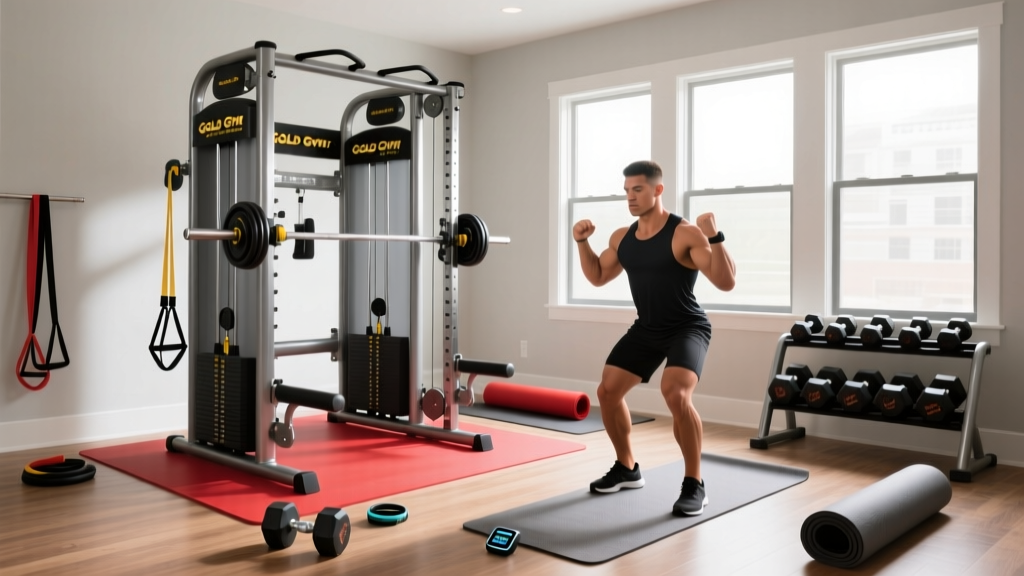
Building a Gold Gym Home Gym Setup Under $500: Value Analysis

Home Gym Color Schemes & Strength Setup: Full Walkthrough

Budgeting Home Gym Items: Mirrors and Lighting Guide
