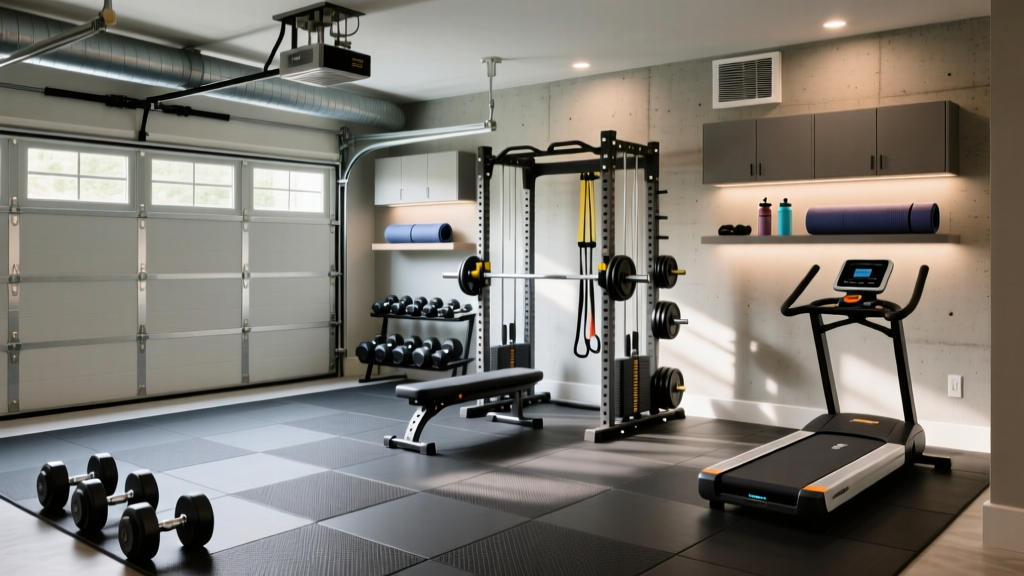
Compact Home Gym Equipment Ideas: Apartment Setup Guide
Discover space-saving home gym equipment ideas for apartments. Follow our complete setup, flooring, and installation walkthrough for compact spaces.

The Micro-Space Blueprint: Assessing Your Apartment's Constraints
Building a functional training space in a 600-square-foot apartment requires a radical shift in how you view square footage. When searching for viable home gym equipment ideas, most mainstream guides ignore the structural and acoustic realities of multi-family living. You aren't just fighting for floor space; you are negotiating with 8-foot ceilings, shared drywall, and strict lease agreements regarding impact noise.
The first step in our complete setup walkthrough is defining your 'Movement Triangle.' In a small apartment, you cannot dedicate a room to a single modality. You must identify a 6x8 foot corner (48 square feet) that can accommodate hinging, pressing, and pulling. Standard apartment ceilings sit at exactly 96 inches. If you are 6 feet tall (72 inches), a standard pull-up bar mounted at 84 inches leaves only 12 inches of clearance—far too tight for overhead pressing or muscle-ups. Therefore, your equipment selection must prioritize low-profile, multi-vector gear over traditional powerlifting setups.
The 6x8 Footprint Rule
An effective apartment gym requires a maximum permanent footprint of 24 square feet, with an additional 24 square feet of 'active deployment' space. If a piece of equipment exceeds 4 square feet of permanent floor space and does not offer at least three distinct exercise modalities, it fails the apartment viability test.
High-Yield Home Gym Equipment Ideas for Tight Footprints
To maximize your 6x8 zone, we must eliminate redundancy. Traditional barbell setups require 8-foot clearance and massive weight storage, making them hostile to apartment living. Instead, we leverage adjustable mechanics and wall-mounted infrastructure. Below is our curated matrix of the most efficient gear for 2026 micro-gyms.
| Equipment Model | Permanent Footprint | Weight / Capacity | Est. Price | Apartment Utility |
|---|---|---|---|---|
| Rogue RML-3W Fold Back Rack (Wall Mount) | 43" x 4" (Folded) | 1,000 lb capacity | $595.00 | High (Frees floor space) |
| Nuobell Adjustable Dumbbells (5-80 lbs) | 16.5" x 8" x 7.5" | Replaces 16 pairs | $649.00 | Critical (No plate storage) |
| WalkingPad R2 Foldable Treadmill | 10" x 28" (Stored) | 240 lb user limit | $499.00 | Moderate (Slips under sofa) |
| TRX Pro4 Suspension System (Door Anchor) | 0 sq ft (Stored) | 1,200 lb tensile | $229.00 | High (Zero floor impact) |
When evaluating adjustable dumbbells, experts at BarBend recommend mechanisms that utilize a rotating handle rather than a dial pin, as the Nuobell's internal spline system drastically reduces the handle length, allowing for proper form during chest presses without the bulky ends of traditional adjustable models colliding at the top of the movement.
Complete Installation Walkthrough: Acoustics and Anchoring
The most common failure point in apartment gyms is not a lack of motivation, but a noise complaint from the downstairs neighbor. Dropping a 40-pound dumbbell on standard laminate flooring generates upwards of 105 decibels of low-frequency impact noise, which easily penetrates standard wood-frame subfloors. Proper acoustic decoupling is non-negotiable.
Step-by-Step Flooring and Soundproofing Installation
- Subfloor Preparation: Remove all baseboards and clean the existing laminate or hardwood with a degreaser. Any debris left under the flooring will create pressure points that crack the acoustic layer.
- Mass Loaded Vinyl (MLV) Deployment: Lay down a 1 lb/sq ft MLV acoustic barrier. According to BarBend's comprehensive flooring guide, MLV is essential for blocking low-frequency structure-borne noise (the 'thud' of a dropped weight) that standard foam mats cannot absorb. Overlap seams by 2 inches and seal with acoustic caulk.
- Vulcanized Rubber Installation: Install 8mm (5/16-inch) high-density vulcanized rubber tiles over the MLV. Avoid EVA foam puzzle mats; they compress entirely under heavy point-loads (like a barbell rack leg) and offer zero structural protection to the floor below.
- Wall Stringer Mounting (For Racks): If installing a fold-back rack, do not bolt directly into drywall studs. Install two 2x6 wooden stringers horizontally across the wall, securing them into at least four distinct studs using 3/8" x 3" structural lag screws. Mount the rack hinges to the stringers. This distributes the dynamic load of kipping or heavy racking across a wider surface area, preventing drywall blowout.
Ventilation, Mirrors, and Spatial Illusions
Small spaces trap heat and carbon dioxide rapidly. A 6x8 enclosed corner with a closed door can see CO2 levels spike above 1,500 ppm during a high-intensity interval session, leading to premature fatigue and dizziness.
- Airflow Strategy: Install a wall-mounted oscillating fan (like the Vornado Pivot Clip) directed at the primary lifting zone. If the room lacks a window, use a portable HEPA air purifier with an activated carbon filter to manage sweat odors and maintain perceived air freshness.
- Mirror Placement for Depth: Mounting a 48" x 60" frameless mirror on the wall opposite the entryway visually doubles the room's depth and provides crucial form feedback for dumbbell work. Use mirror mastic adhesive rather than rigid clips, which can rattle and crack the glass during heavy bass-heavy music playback or dropped weights.
Real-World Troubleshooting: Edge Cases in Small Spaces
Even with perfect planning, apartment gyms present unique edge cases. Here is how to troubleshoot the most common spatial conflicts:
The Overhead Press Dilemma: If your ceiling is 96 inches and your rack's pull-up bar sits at 84 inches, you cannot safely perform standing overhead barbell presses. The Fix: Switch to seated Z-presses on the floor or utilize the adjustable bench set to a 75-degree incline with your Nuobell dumbbells. This keeps the weight path well below the ceiling clearance while actually increasing core engagement demands.
Another frequent issue is the storage of accessories like resistance bands, lifting belts, and jump ropes. In a micro-gym, floor space is sacred. Install a heavy-duty pegboard (minimum 3/4" MDF or steel) on an adjacent wall. Use 2-inch steel pegs to hang belts and bands, keeping them visible and accessible without consuming a single inch of your 6x8 active footprint. For further space optimization guidelines, the Mayo Clinic's fitness resources emphasize that maintaining an uncluttered environment is directly correlated with higher adherence rates in home exercise programs.
Frequently Asked Questions
Can I use a spin bike in a second-floor apartment?
Yes, magnetic resistance spin bikes (like the Schwinn IC4) are exceptionally quiet and generate minimal vertical vibration. However, you must still place the bike on a 6mm rubber mat to prevent sweat damage to the landlord's flooring and to distribute the 150+ lb point load of the bike's stabilizer feet.
Are doorframe pull-up bars safe for apartment doors?
Leverage-style doorframe pull-up bars rely on the structural integrity of the door casing trim, not the actual door frame. In many modern apartments, trim is glued MDF that will snap under dynamic loads. For apartments, a wall-mounted cantilever bracket or a TRX door anchor (which uses a reinforced nylon wedge over the top of the door hinge) is vastly safer and will not destroy your security deposit.
More gear to consider
All reviews
Building an Ethos Home Gym for Couples: Step-by-Step

Fitness Care and Maintenance: A Practical, Brand-Specific Guide for Home Gym Longevity and Safety
Home Gym with Sauna Setup: How Much Weight You Really Need
Best Paint Color for a Home Gym: Optimizing Compact Foldable Setups

How Much Weight Do You Need for a Tiny Home Gym?