
Space Layouts for Working Out Only With Dumbbells: Loadable Plates
Optimize your home gym layout for working out only with dumbbells. Explore loadable plate systems, spatial math, and storage solutions for tight spaces.

The Spatial Reality of the Dumbbell-Only Home Gym
For lifters committed to working out only with dumbbells, spatial constraints are often the ultimate limiting factor. A traditional rubber hex dumbbell set ranging from 5 to 50 pounds (in 5-pound increments) requires a massive three-tier A-frame rack. This setup easily consumes 8 to 10 square feet of floor space when accounting for the rack footprint and the necessary pull-out clearance. In small apartments, converted garages, or multi-use rooms, sacrificing that much square footage simply isn't viable.
Enter the loadable dumbbell with interchangeable plates. By decoupling the handle from the weight, you can achieve a 5-to-100+ pound adjustable range using a fraction of the floor space. However, designing an efficient layout for loadable dumbbells requires a deep understanding of equipment dimensions, plate diameters, and ergonomic clearances. This guide breaks down the exact spatial math, equipment specifications, and layout strategies to optimize your micro-gym in 2026.
The Spatial Math: Hex Rack vs. Loadable Systems
To understand the spatial efficiency of loadable dumbbells, we must compare the physical footprint of traditional sets against modern loadable handles and plate storage. The data below illustrates the dramatic space savings achieved by switching to a plate-loadable system.
| Equipment Setup (5-50 lbs Range) | Floor Footprint (Including Clearance) | Vertical Storage Requirement | Approximate Cost (2026) |
|---|---|---|---|
| Traditional Urethane Hex Set + A-Frame Rack | 12.5 sq ft (48' W x 30' D) | 36' H (Fixed) | $1,800 - $2,400 |
| Rogue Loadable Handles + 200lbs Olympic Plates | 2.0 sq ft (Vertical Plate Tree) | 48' H (Tree) or Wall-Mount | $650 - $850 |
| Ironmaster Quick-Lock V2 (75lb Base System) | 1.5 sq ft (Proprietary Tray) | 12' H (Floor Tray) | $459 - $600 |
As the table demonstrates, working out only with dumbbells doesn't require dedicating an entire wall to a dumbbell rack. A vertical plate tree or a wall-mounted storage solution reduces the footprint to nearly zero, freeing up valuable square footage for an adjustable bench or a lifting platform.
The Ergonomic Trap: Sleeve Length and Plate Diameter
When outfitting a space-optimized gym, many lifters make a critical error: they purchase Olympic loadable dumbbell handles and pair them with standard 45-pound bumper plates. This creates an ergonomic nightmare.
Expert Insight: Standard Olympic bumper plates have a uniform diameter of 17.5 inches. If you load a 25lb bumper plate onto a dumbbell handle for a floor press or a renegade row, the massive 17.5-inch diameter will prematurely hit the floor, severely restricting your range of motion and altering the biomechanics of the lift.
To maintain the natural feel and utility of a dumbbell, you must carefully select your interchangeable plates based on the handle's sleeve length and the plate's profile.
Optimal Plate Pairings for Loadable Handles
- Machined Steel Plates: The gold standard for loadable dumbbells. A 10-pound machined steel plate is typically only 6 to 8 inches in diameter, allowing for deep ranges of motion on presses and flyes. Expect to pay around $3.50 to $4.50 per pound for high-quality machined steel.
- Fractional and Narrow Urethane Bumpers: Brands like Rogue and REP Fitness offer 10lb and 15lb urethane bumpers that maintain a narrower profile than standard competition bumpers, though they are still thicker than cast iron.
- Proprietary Square Plates (Ironmaster): The Ironmaster Quick-Lock V2 utilizes proprietary square plates that stack tightly against the handle. While this eliminates the diameter issue entirely, it locks you into their ecosystem—you cannot use these plates on a standard Olympic barbell.
Designing the 50-Square-Foot Micro-Gym Layout
When working out only with dumbbells in a compact 50-square-foot space (e.g., a 7' x 7' area), every inch matters. Here is a step-by-step layout framework to maximize movement clearance while keeping your loadable plates accessible.
- Anchor the Adjustable Bench: Place an adjustable FID (Flat/Incline/Decline) bench in the center of the room, oriented parallel to the longest wall. Ensure you have at least 24 inches of clearance on both sides for dumbbell flyes and lateral raises.
- Mount the Plate Storage: Install a wall-mounted plate tree or heavy-duty shelf brackets on the wall directly behind the head of the bench. This keeps the heavy plates off the floor and allows you to load the dumbbells while standing in one spot.
- Designate the 'Loading Zone': Leave a 3-foot by 3-foot reinforced rubber-matted area adjacent to your plate storage. This is where you will physically swap the interchangeable plates. Never load dumbbells over your lifting area; a dropped 10lb steel plate will shatter standard subflooring.
Top Loadable Dumbbell Systems for Tight Spaces
Not all loadable handles are created equal. Based on 2026 market availability, spatial efficiency, and knurling quality, here are the top contenders for space-constrained lifters.
1. Rogue Loadable Dumbbell Handles
Priced at approximately $195 per pair, the Rogue Loadable Dumbbell Handles feature a 10.25-inch sleeve length and a 1.9-inch diameter, perfectly mimicking a standard Olympic barbell grip. The aggressive Rogue knurling is ideal for heavy, chalk-free lifting. However, the 10.25-inch sleeve means you will need to use collars, which adds an extra 2 inches of length per side, slightly reducing the usable plate-loading space.
2. Ironmaster Quick-Lock V2
Starting around $459 for the 75lb base set, the Ironmaster system is a hybrid. It uses a drop-in pin and screw mechanism rather than standard Olympic plates. The primary spatial advantage is the dumbbell's compact, blocky profile, which feels much closer to a traditional hex dumbbell than a plate-loaded Olympic handle. The trade-off is the proprietary nature of the plates and the slightly longer time required to swap weights compared to a quick-release collar.
3. Titan Fitness Loadable Dumbbell Handles
For budget-conscious lifters, Titan offers loadable handles for roughly $130 per pair. The sleeves are slightly shorter (10 inches), and the chrome finish requires more maintenance to prevent rust in humid garages. However, for the price point, they offer an excellent entry point into the loadable dumbbell ecosystem without sacrificing structural integrity.
Programming Adjustments for Loadable Dumbbells
One of the most overlooked aspects of working out only with dumbbells using a loadable system is the time cost of changing weights. Swapping plates, re-tightening collars, and verifying balance takes 20 to 45 seconds per dumbbell. In a superset or a high-volume hypertrophy block, this downtime can cool you down too much or disrupt your heart rate.
To optimize your training around this constraint, leverage programming styles endorsed by institutions like the National Strength and Conditioning Association (NSCA) that minimize weight changes:
- Rest-Pause Sets: Load the dumbbells to a heavy 10-rep max. Perform as many reps as possible, rack them, take 15 deep breaths (no plate changes), and go again. Repeat until you hit your target volume.
- Mechanical Drop Sets: Keep the exact same weight on the loadable handles, but change the leverage of the exercise to induce fatigue. For example, transition from Incline Dumbbell Presses to Flat Dumbbell Presses, and finally to Floor Presses, all without removing a single plate.
- Antagonist Supersets: Pair a heavy pulling movement (e.g., Dumbbell Rows) with a pushing movement (e.g., Overhead Press) using the same or very similar weights, eliminating the need to strip the handles between sets.
Final Thoughts on Spatial Optimization
Transitioning to a loadable dumbbell system is the single most effective way to reclaim floor space in a home gym. By understanding the relationship between sleeve length, plate diameter, and room clearance, you can build a highly functional, 50-square-foot training environment. Working out only with dumbbells doesn't mean compromising on heavy progressive overload; it simply requires a smarter, more calculated approach to your equipment and layout design.
More gear to consider
All reviews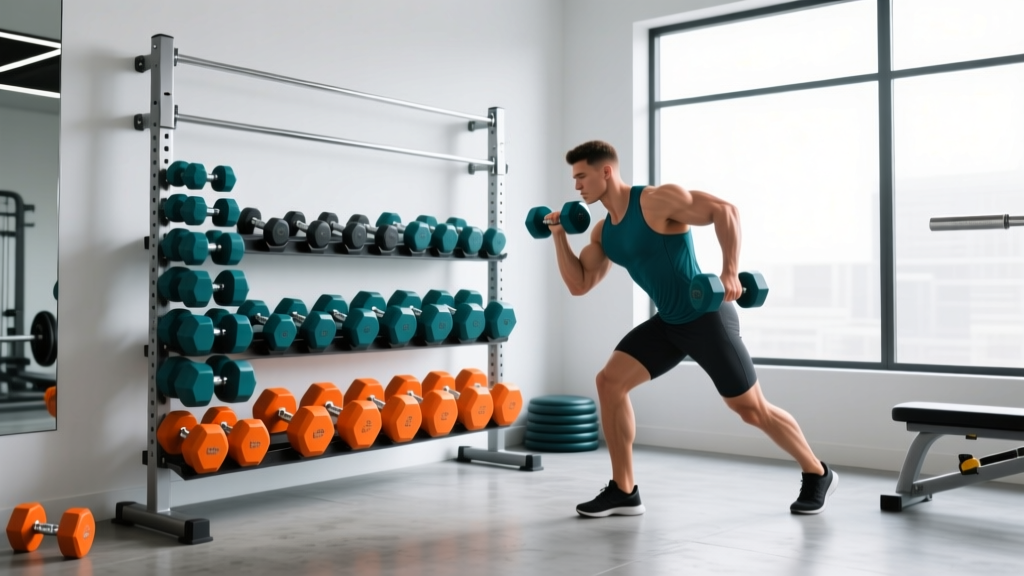
How to Build Lats With Dumbbells: Space-Saving Rack Layouts

Obliques Exercises with Dumbbells: Beginner Guide & 2026 Review

Best Neoprene Dumbbells for Stomach Exercises: 2026 Matchup

Power Rack vs Squat Rack vs Squat Stand: Triceps Pushdown with Dumbbells

2026 Market Trends: Loadable Dumbbells for Progressive Lunges with Dumbbells
