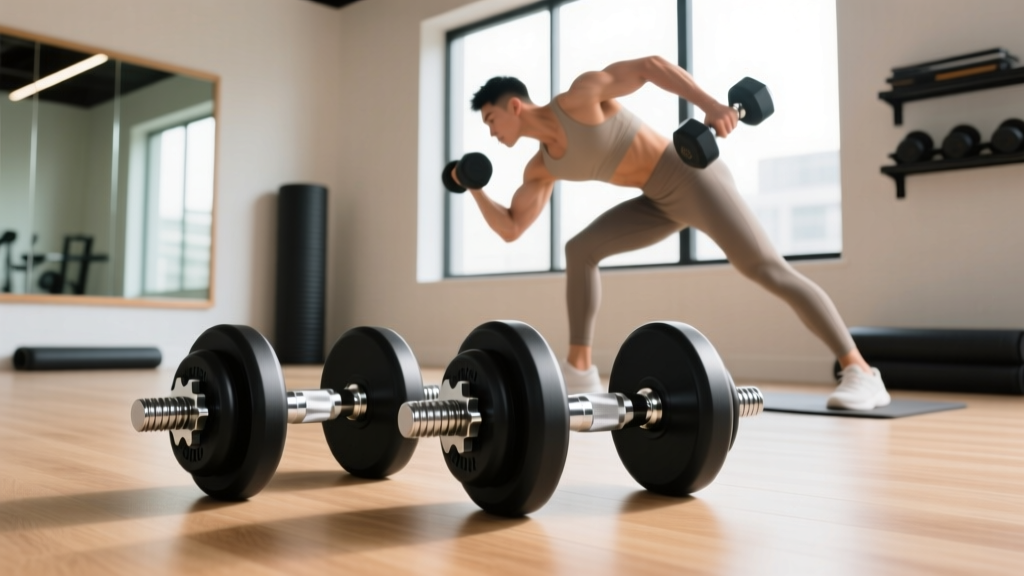
Best Adjustable Dumbbells for Dumbbell Oblique Exercises: 2026 Guide
Discover the best adjustable dumbbells for dumbbell oblique exercises in 2026. Includes a step-by-step beginner guide, gear reviews, and safety tips.

The Beginner’s Blueprint: Mastering Dumbbell Oblique Exercises with Adjustable Gear
When most beginners start building a home gym, they prioritize the chest, back, and legs, often leaving the core as an afterthought. More specifically, the obliques—the muscles wrapping around the sides of your torso responsible for rotation and lateral flexion—are frequently neglected or trained improperly with endless bodyweight side crunches. To build functional, athletic core strength, you need progressive overload. This is where dumbbell oblique exercises become essential.
However, the obliques are relatively small, endurance-oriented muscle groups. Jumping from a 15 lb to a 25 lb fixed dumbbell is a massive 66% load increase that can easily strain the lumbar spine. In 2026, the smartest solution for home athletes is investing in a high-quality adjustable dumbbell set that allows for 2.5 lb to 5 lb micro-increments. Below, we break down the best adjustable dumbbells for rotational and lateral movements, followed by a step-by-step beginner guide to executing these exercises safely.
💡 The Micro-Load Principle for Core TrainingAccording to biomechanical research on core stabilization, the obliques respond best to controlled, incremental tension rather than maximal heavy loading. Adjustable dumbbells allow you to increase weight in 2.5 lb increments, matching the natural strength adaptation curve of the transverse abdominis and obliques without compromising spinal integrity.
2026 Adjustable Dumbbell Comparison Matrix for Core Work
Not all adjustable dumbbells are created equal, especially when it comes to dynamic movements like woodchoppers or seated twists. Bulky ends can clip your knees, and fragile selector dials can break if accidentally dropped. Here is how the top 2026 models compare specifically for oblique training.
| Model | Max Weight & Increments | Form Factor & Grip | 2026 Price |
|---|---|---|---|
| Nuobell 80 | 5-80 lbs (5 lb jumps) | Sleek, mimics fixed dumbbells. 6.5' handle. | $699 / pair |
| Bowflex SelectTech 552 | 5-52.5 lbs (2.5 lb jumps up to 25 lbs) | Bulky ends. 15.75' overall length. | $399 / pair |
| PowerBlock Elite EXP | 5-50 lbs (2.5 lb jumps via add-on) | Caged block design. Highly durable. | $419 / pair |
Deep Dive: Which Should You Choose?
The Nuobell 80 is the undisputed champion for dumbbell oblique exercises. Because its weight plates slide over the handle rather than stacking on the ends, it maintains the exact physical profile of a traditional hex dumbbell. When performing high-to-low woodchoppers, the compact ends will not catch on your thigh. Furthermore, the 6.5-inch knurled handle allows for a comfortable, stacked two-hand grip required for heavy rotational work.
The Bowflex SelectTech 552 shines in its 2.5 lb micro-adjustments up to 25 lbs, which is perfect for beginners doing weighted side bends. However, its 15.75-inch overall length is a distinct disadvantage for seated Russian twists; the elongated ends frequently bump into the knees during rotation, disrupting the movement pattern.
The PowerBlock Elite EXP is virtually indestructible, making it a safe bet if you struggle with grip fatigue. However, the caged, blocky design makes holding the dumbbell vertically by the top bell (a common grip for woodchoppers) awkward and slightly abrasive against the forearms.
Step-by-Step Beginner Guide to Dumbbell Oblique Exercises
Once you have selected your adjustable dumbbells, it is time to put them to work. The Mayo Clinic emphasizes that core exercises should promote functional stability and balance, rather than just aesthetic muscle isolation. Below are three foundational movements, scaled for beginners.
1. The Seated Dumbbell Russian Twist
This exercise targets the internal and external obliques through transverse (rotational) plane movement.
- The Setup: Sit on the floor with your knees bent and feet flat. Hold your adjustable dumbbell by the handle with both hands. Lean back to a 45-degree angle until you feel your abdominal muscles engage.
- The Execution: Keeping your chest up and spine neutral, rotate your torso to the right, bringing the dumbbell toward the floor beside your hip. Pause for one second.
- The Return: Rotate smoothly to the left side. That is one repetition.
- Beginner Parameters: 3 sets of 10-12 reps per side. Start with just 10 to 15 lbs to master the deceleration phase.
Never drop dial-based adjustable dumbbells (like Bowflex or Core Home Fitness) on the floor between sets. The internal selector pins and plastic retaining clips are highly susceptible to shearing under impact. Always set them down gently, or better yet, keep them on a low rack or mat.
2. High-to-Low Woodchoppers
Woodchoppers mimic real-world athletic movements, integrating the hips, core, and shoulders. An EMG analysis published in the Journal of Sports Science & Medicine highlights that rotational chopping movements elicit significantly higher oblique activation compared to static lateral holds.
- The Setup: Stand with feet shoulder-width apart. Hold one adjustable dumbbell (Nuobell or a fixed-style adjustable is best here) horizontally with both hands. Raise it above your left shoulder.
- The Execution: Initiate the movement by pivoting your left foot and driving the dumbbell diagonally downward across your body toward your right hip. Exhale forcefully on the way down.
- The Return: Control the weight back to the starting position above the left shoulder. Do not use momentum to swing it up.
- Beginner Parameters: 3 sets of 8 reps per side. Focus on the hip pivot; the power should come from the ground up, not just the arms.
3. Unilateral Weighted Side Bends
Side bends target lateral flexion. This movement is often botched by beginners who lean too far forward or backward.
- Stance: Stand tall, feet hip-width apart. Hold a single adjustable dumbbell in your right hand, letting it hang at your side. Place your left hand behind your head.
- Descent: Slowly slide the dumbbell down the outside of your right leg, bending strictly to the side. Imagine you are stuck between two panes of glass; do not lean forward.
- Ascent: Use your left oblique to pull your torso back to the starting position. Stop when you are perfectly upright; overextending past neutral places unnecessary shear force on the lumbar discs.
- Beginner Parameters: 3 sets of 12 reps per side. Utilize the 2.5 lb micro-adjustments on your dumbbells to progressively overload this movement every two weeks.
Grip Mechanics and Edge Cases
When performing dumbbell oblique exercises, your grip will often fail before your core does. This is a common point of frustration for beginners. Adjustable dumbbells with aggressive knurling (like the Nuobell or PowerBlock) help mitigate this, but handle diameter also plays a role. Most adjustable dumbbells feature a 35mm handle diameter, which is thicker than standard cheap fixed dumbbells (usually 28mm).
The Solution: If you are doing high-rep Russian twists (15+ reps), use lifting straps or chalk. Furthermore, when holding the dumbbell for woodchoppers, avoid gripping the extreme edges of the handle. Center your hands to distribute the load evenly across the adjustable mechanism's internal locking teeth, reducing the chance of the weight plates shifting or rattling during the swing.
Your 8-Week Progressive Overload Framework
To see actual results, you must systematically increase the demand on your obliques. Use this timeline to guide your adjustable dumbbell weight selections:
- Weeks 1-2 (Neuromuscular Adaptation): Focus purely on form. Use the lightest setting (5-10 lbs). Master the hip pivot in woodchoppers and the spinal neutrality in side bends.
- Weeks 3-4 (Volume Accumulation): Increase the weight by 2.5 to 5 lbs. Aim to add 2 extra repetitions to each set while maintaining strict tempo (2 seconds down, 1 second up).
- Weeks 5-6 (Load Intensification): Increase the weight by another 5 lbs. Drop the reps back down to 8-10 per set. Focus on the eccentric (lowering) phase to maximize muscle fiber recruitment.
- Weeks 7-8 (Peak Strength): Add isometric pauses. At the deepest point of the side bend or the furthest point of the twist, hold the dumbbell static for 2 full seconds before returning to the start.
Final Thoughts on Gear and Gains
Training the obliques requires precision, control, and the right equipment. While fixed dumbbells have their place in heavy pressing movements, the micro-adjustability and space-saving nature of modern adjustable dumbbells make them the superior tool for nuanced core training. By selecting a set that matches your biomechanical needs—like the sleek Nuobell for rotation or the granular Bowflex for lateral flexion—and following a structured, step-by-step progression, you will build a resilient, functional core that supports every other lift in your routine.
More gear to consider
All reviews
Why Is Dumbbell Bench Harder Than Barbell? Hex vs Urethane Care

TRX Dumbbells & Neoprene Weights: The Ultimate 2026 Home Gym Guide

Bumper vs Iron Plates: Budget Breakdown & Dumbbell Glute Workout

Kettlebell Budget Breakdown & Incline Dumbbell Rowing Alternatives
Bumper vs Iron Plates & Back Exercises with Dumbbells for Women
