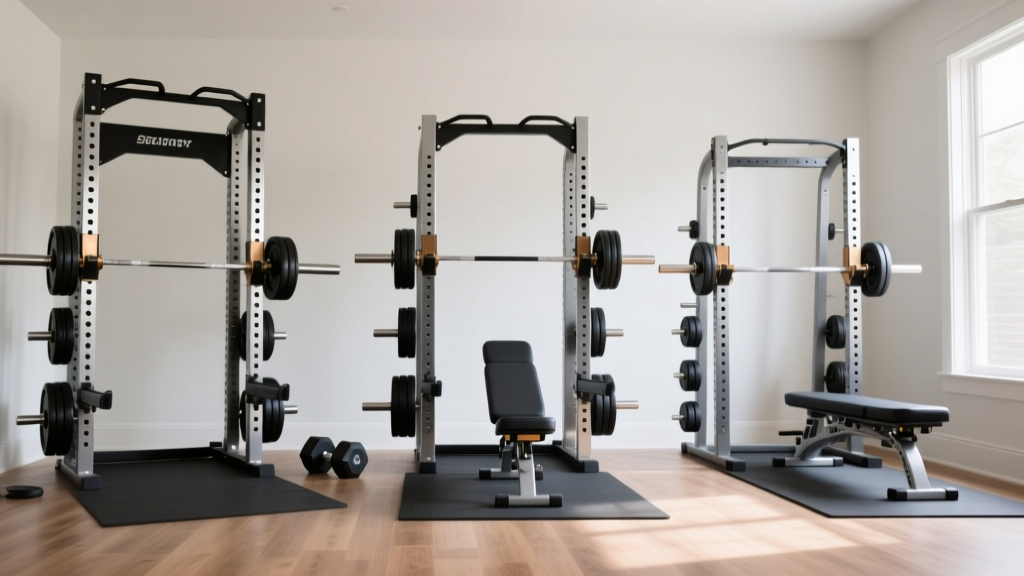
Power Rack vs Squat Rack vs Stand: Dumbbell Chest Workouts at Home
Compare power racks, squat racks, and stands to find the best setup for heavy dumbbell chest workouts at home. Footprints, prices, and safety analyzed.

The Core Dilemma: Space, Safety, and Dumbbell Mechanics
As home gym designs evolve in 2026, the demand for versatile, space-efficient equipment has never been higher. While most lifters associate power racks and squat stands strictly with barbell back squats and bench presses, these structures are actually the unsung heroes of heavy dumbbell training. When programming intense dumbbell chest workouts at home, the rack you choose dictates your safety parameters, your range of motion, and your ability to utilize advanced techniques like accommodating band resistance or drop sets.
Choosing between a fully enclosed power rack, an open-concept squat rack (half rack), or a minimalist squat stand requires a deep understanding of footprint dimensions, steel gauge thickness, and internal clearance. This guide breaks down the exact specifications, real-world pricing, and biomechanical advantages of each setup to help you build the ultimate home pressing station.
Quick Decision Matrix
- Choose a Power Rack if: You lift near-failure without a spotter and need maximum safety for heavy floor presses and bench work.
- Choose a Squat Rack (Half Rack) if: You want a balance of safety and unrestricted dumbbell maneuverability for deep flyes and incline presses.
- Choose a Squat Stand if: Your home gym is under 50 square feet, you primarily do dumbbell floor presses, and you need to move the equipment out of the way frequently.
Power Racks: The Ultimate Enclosed Ecosystem
A traditional power rack (or full cage) consists of four vertical uprights connected by horizontal crossmembers, creating a fully enclosed lifting environment. In 2026, the industry standard for premium home gym power racks is 11-gauge steel with 3"x3" uprights and Westside hole spacing (1-inch hole spacing in the bench press and squat zones).
Advantages for Dumbbell Training
For heavy dumbbell chest workouts at home, the power rack offers unparalleled safety. By setting pin-pipe safeties or flip-down spotter arms just below your chest cavity, you can push 100+ lb dumbbells to absolute muscular failure. Furthermore, the enclosed uprights provide robust attachment points for resistance bands. Looping bands over the base crossmembers and attaching them to your dumbbell handles via micro-bands creates accommodating resistance, a technique heavily endorsed by the American College of Sports Medicine for overcoming sticking points in the pressing movement.
The Drawbacks: Footprint and Internal Clearance
The primary drawback is the footprint. A standard 48"x48" power rack consumes 16 square feet of floor space. More critically, the internal width of a 49-inch exterior rack is only about 43 inches. When holding massive urethane hex dumbbells, your total loaded wingspan can easily exceed 50 inches, forcing you to angle your bench diagonally to avoid scraping the uprights.
Top 2026 Models: Titan T-3 Series Power Rack (approx. $1,199) and Rogue RM-3 Fort Monster Rack (approx. $1,850). You can view the full specifications of these enclosed systems on the Rogue Fitness Racks Directory.
Squat Racks (Half Racks): The Hybrid Compromise
Squat racks, commonly referred to as half racks, feature two main rear uprights and an open front, often stabilized by a front crossmember or extended base feet. This design fundamentally changes the geometry of your dumbbell chest workouts at home.
Unrestricted Maneuverability
Because the front is completely open, you are not boxed in. This is a massive advantage for exercises like dumbbell pullovers, wide-grip flyes, and incline presses where the dumbbells travel far outside the lateral boundaries of your torso. You can easily kick heavy dumbbells up and drop them to the sides without worrying about chipping the paint off vertical uprights or damaging the knurling on the dumbbell handles.
Safety and Storage Integration
Modern half racks, like the REP Fitness PR-4000 PowerRack (which offers open-front configurations) or the Rogue Monster Lite Half Rack, feature extended front spotter arms. These arms catch the dumbbells if you fail a rep, though they require careful height calibration. Additionally, half racks often integrate vertical plate storage horns on the rear uprights, acting as a counterweight to stabilize the rack when you are violently dropping heavy dumbbells to the floor between sets.
Pricing Expectation: Expect to pay between $850 and $1,300 for a high-quality 3x3 half rack with integrated storage and extended spotter arms.
Squat Stands: Minimalist Footprints for Floor Presses
Squat stands consist of two independent uprights (or two uprights connected by a single minimal crossbar). They are the lightest, most affordable, and most space-efficient option on the market.
The Floor Press Advantage
When executing dumbbell chest workouts at home using a squat stand, the optimal strategy is to abandon the bench entirely and utilize the floor press. Lying on the floor between the stands allows you to grab heavy dumbbells, press them, and safely dump them to the sides upon failure. The squat stands are then used exclusively for barbell squats or rack pulls, keeping your pressing area entirely unobstructed.
Limitations and Edge Cases
You cannot safely perform heavy dumbbell bench presses inside a standard squat stand without specialized, extended safety straps, which are rare and often unstable. If you fail a rep on a flat bench inside a squat stand, the dumbbells will fall onto your face or torso. Therefore, squat stands are strictly for lifters who prioritize floor presses, or those who have a dedicated lifting partner to spot them.
Top 2026 Models: Rogue SML-1 Monster Lite Squat Stand ($395) and Titan X-2 Series Squat Stand ($349). Browse the current inventory and base footprint options on the Titan Fitness Squat Stands page.
Head-to-Head Comparison Matrix
| Feature | Power Rack (Full Cage) | Squat Rack (Half Rack) | Squat Stand (Pair) |
|---|---|---|---|
| Avg. Footprint | 48" x 48" (16 sq ft) | 48" x 36" (12 sq ft) | 48" x 15" (5 sq ft) |
| 2026 Price Range | $1,100 - $1,900+ | $850 - $1,400 | $300 - $550 |
| Unaided DB Safety | Excellent (Pin-pipes/Straps) | Good (Extended Arms) | Poor (Floor Press Only) |
| DB Maneuverability | Restricted (43" internal width) | High (Open front) | Maximum (No cage) |
| Band Peg Integration | Built-in Base Pegs | Rear Upright Pegs | Requires External Anchors |
The 'Internal Width' Problem: A Critical E-E-A-T Warning
Most buying guides overlook the biomechanical reality of pressing heavy dumbbells inside a cage. Standard 3x3 power racks measure 49 inches on the outside, leaving roughly 43 inches of internal clearance. When executing heavy dumbbell chest workouts at home using 120-pound urethane hex dumbbells (which can measure up to 16 inches across the heads), your total loaded wingspan can easily exceed 55 inches.
Expert Troubleshooting: If you press straight up and down in a standard power rack with massive dumbbells, the dumbbell heads will violently collide with the uprights or spotter arms. This ruins the urethane coating, damages the rack's powder coat, and risks a catastrophic drop onto your face. The Fix: Angle your bench diagonally (corner-to-corner) inside the power rack to maximize the internal hypotenuse, giving you up to 58 inches of clearance.
Optimizing Spotter Arm Geometry
When using a power rack or half rack for dumbbell benching, do not use standard J-cups as safeties. Use flat strap safeties or pin-pipe safeties set exactly 2 inches below your chest cavity. This allows you to drop the dumbbells inward toward your sternum safely if your pectorals fail, rather than trying to balance them over narrow pipe safeties.
Frequently Asked Questions
Can I use a squat stand for dumbbell flyes?
Yes. In fact, squat stands are ideal for dumbbell flyes. Because there is no surrounding cage, you can lower the dumbbells into a deep stretch without spatial restrictions. Simply position the stands behind your head or at the foot of the bench to act as a visual boundary and a resting place for your weights between sets.
Is 14-gauge steel strong enough for a home power rack?
While 14-gauge steel can technically hold up to 600 lbs, it is not recommended for 2026 home gym standards. The lateral force generated when dropping heavy dumbbells or racking uneven barbells can cause 14-gauge uprights to twist or warp over time. Always invest in 11-gauge or 12-gauge steel (minimum 3x3 dimensions) for long-term structural integrity.
How do I store dumbbells if my rack doesn't have a tray?
If your power rack or squat stand lacks an integrated dumbbell tray, purchase a standalone, tiered rubber dumbbell rack. Placing a 3-tier rack adjacent to your squat stand keeps the floor clear, prevents tripping hazards, and protects your flooring from the impact of dropped hex dumbbells.
More gear to consider
All reviews
Dumbbell Rows vs Barbell Rows: 2026 Dumbbell Rack & Storage Guide

Barbell Clamps: Secure Your Triceps Workout with One Dumbbell or Bar

Power Rack vs Squat Rack vs Stand: Space for Standing Dumbbell Flys

Barbell Collars vs. Holahatha Dumbbell Locks: A Safety Comparison

Incline Dumbbell Row Muscles Worked: Home Setup & Neoprene Guide
