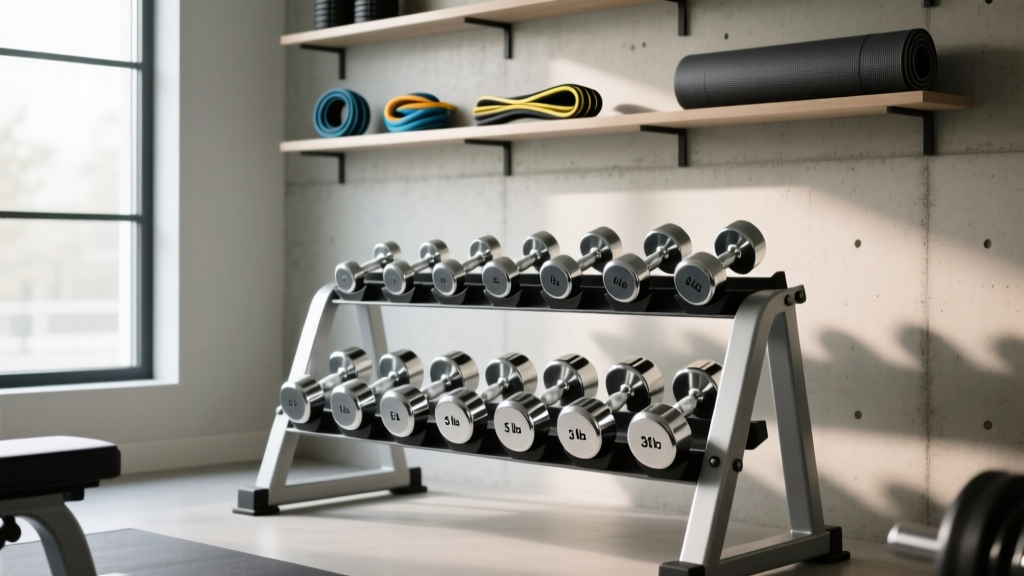
What Weight Dumbbells Should a Woman Use? 2026 Rack & Budget Guide
Discover what weight dumbbells a woman should use and explore our 2026 budget breakdown of the best dumbbell racks and storage solutions for your home gym.

Building a home gym requires more than just picking up a few weights; it requires a strategic approach to both your physiological needs and your floor plan. When researching what weight dumbbells should a woman use, most fitness guides stop at the dumbbells themselves, leaving you with a pile of iron scattered across your floor. In 2026, with home gym real estate at a premium and equipment prices fluctuating, pairing the right weight progression with the correct storage solution is a critical financial and spatial decision.
This guide bridges the gap between strength standards and structural storage. We will first establish the exact weight brackets you need based on current exercise science, and then perform a rigorous budget breakdown of the dumbbell racks and storage solutions that best support those specific weight tiers.
The Baseline: Answering 'What Weight Dumbbells Should a Woman Use?'
Before investing in a rack, you must define your weight ceiling. According to strength and conditioning principles outlined by the National Strength and Conditioning Association (NSCA), dumbbell selection is not a one-size-fits-all metric; it depends on the biomechanics of the movement (isolation vs. compound) and your training age.
Quick Reference: 2026 Female Dumbbell Weight Brackets
- Beginner (0-6 months): 5–10 lbs (Isolation) | 10–15 lbs (Compound)
- Intermediate (6-24 months): 10–20 lbs (Isolation) | 20–35 lbs (Compound)
- Advanced (2+ years): 20–35 lbs (Isolation) | 40–60+ lbs (Compound)
Source context: Adapted from general resistance training guidelines provided by the American Council on Exercise (ACE) for progressive overload in adult females.
Understanding these brackets dictates your rack capacity. If you are an intermediate lifter, your rack must comfortably hold pairs ranging from 10 lbs to 35 lbs. If you buy a lightweight A-frame rack designed for 5 lb neoprene bells, it will structurally fail under the load of 35 lb hex dumbbells. Let us break down the budget and value of storage solutions based on these exact weight tiers.
Budget Breakdown: Matching Racks to Your Weight Tier
Not all steel is created equal, and the price per storage slot varies wildly depending on the gauge of the metal and the footprint of the unit. Here is our value analysis for the three primary storage categories in 2026.
Tier 1: The 5–25 lb Range (Light Duty & A-Frames)
Best For: Beginners, physical therapy, and high-rep isolation work.
The Go-To Model: CAP Barbell A-Frame Dumbbell Rack
Estimated Cost: $65 – $85
Value Analysis: The A-frame is the undisputed king of budget storage for lighter, vinyl or neoprene-coated dumbbells. At roughly $13 per storage pair (holding up to 5 pairs), the initial cost-to-utility ratio is excellent. The vertical design requires only a 22" x 22" footprint, making it ideal for apartment gyms.
Failure Modes & Edge Cases: The hidden cost of the A-frame is its weight limit. The tier rods are typically 14-gauge steel or heavy-duty plastic. If you attempt to store 25 lb or 30 lb cast-iron hex bells on the upper tiers, the center of gravity shifts. Over time, the plastic end-caps will crack, and the tier rods will bow downward, creating a slipping hazard. Verdict: High value only if your maximum dumbbell weight stays under 20 lbs.
Tier 2: The 10–50 lb Range (Heavy Duty & 3-Tier Horizontal)
Best For: Intermediate to advanced lifters focusing on progressive overload and heavy compound movements (e.g., goblet squats, Romanian deadlifts).
The Go-To Model: Rogue Fitness 3-Tier Dumbbell Rack
Estimated Cost: $245 – $295
Value Analysis: When you cross the 25 lb threshold, you must upgrade to 11-gauge or 7-gauge steel. The Rogue 3-Tier rack is the industry benchmark. While the $295 price tag is steep, it holds up to 10 pairs of dumbbells (20 total), bringing the cost down to roughly $14.75 per slot. More importantly, Rogue includes UHMW (Ultra-High Molecular Weight) plastic liners on the shelves. This prevents the steel rack from scraping the rubber or urethane coating off your dumbbells, preserving hundreds of dollars in weight investments.
Failure Modes & Edge Cases: The primary drawback is the footprint. A fully loaded 3-tier rack spans roughly 48" wide and 28" deep. Furthermore, lifting a 50 lb dumbbell from the bottom tier requires significant lumbar hinging, which can be a biomechanical risk if your form degrades. Verdict: The best long-term investment for serious home gyms, provided you have the floor space.
Tier 3: The Adjustable Route (Compact Trays & Stands)
Best For: Space-constrained lifters who want the 5-50 lb range without buying 15 pairs of fixed dumbbells.
The Go-To Model: Nuobell or PowerBlock Official Storage Trays
Estimated Cost: $110 – $150
Value Analysis: If your answer to 'what weight dumbbells should a woman use' is 'all of them, depending on the day,' adjustable dumbbells are the logical choice. However, leaving $400 adjustable dumbbells on the floor is a recipe for damaging the internal dial mechanisms. Brand-specific storage trays cost around $130. While this seems expensive for two pieces of molded plastic or thin steel, it elevates the bells to a 28" ergonomic height, saving your lower back and protecting the fragile selector pins from impact damage.
Hidden Costs: Where Budget Racks Fail
When conducting a value analysis, you must factor in the 'replacement tax.' Buying a $50 generic rack from a big-box retailer often leads to hidden costs:
- Weld Snapping: Budget racks often use spot-welding rather than continuous MIG welding. Under the dynamic load of dropping a 30 lb dumbbell onto the rack, spot welds on 16-gauge steel will fracture within 12 to 18 months.
- Coating Degradation: Cheap racks lack protective UHMW liners. The friction of sliding rubber hex dumbbells across bare steel shelves will tear the rubber coating, leading to exposed iron that rusts and flakes onto your gym floor.
- Resale Value: Commercial-grade racks (like Rogue or Titan Fitness) retain up to 70% of their resale value on the secondary market. Budget A-frames have virtually zero resale value once assembled.
2026 Rack Investment Matrix
Use this decision matrix to align your budget, your strength level, and your spatial constraints.
| Storage Type | Ideal Weight Range | Avg. Cost (2026) | Footprint | Value Rating |
|---|---|---|---|---|
| A-Frame (Vertical) | 5 – 20 lbs | $65 - $85 | 22" x 22" | ★★★★☆ (For Beginners) |
| 3-Tier Horizontal | 10 – 50 lbs | $245 - $295 | 48" x 28" | ★★★★★ (Long-Term) |
| Adjustable Tray | 5 – 50+ lbs (Variable) | $110 - $150 | 24" x 18" | ★★★★☆ (Space-Saver) |
| Wall-Mounted Saddle | 10 – 35 lbs | $40 - $60 / pair | 0" (Zero Floor) | ★★★☆☆ (Niche) |
Final Verdict: Maximizing Your Home Gym Dollar
Determining what weight dumbbells a woman should use is only the first step in curating an effective, safe, and organized training environment. If your training protocol keeps you strictly in the 5 lb to 15 lb range for pilates, barre, or light rehabilitation, a $70 A-frame rack offers unbeatable spatial efficiency.
However, if your goal is hypertrophy, progressive overload, and functional strength—requiring you to scale from 15 lb lateral raises to 40 lb goblet squats—skimping on storage is a false economy. Investing $250+ in an 11-gauge steel 3-tier rack protects your equipment, safeguards your lower back during pick-up, and provides a permanent storage solution that will outlast multiple sets of dumbbells. Evaluate your current strength baseline, measure your available floor space, and allocate your budget toward the steel that will safely support your progression.
More gear to consider
All reviews
Power Rack vs Squat Rack vs Squat Stand for a Female Lower Body Dumbbell Workout
Power Rack vs Squat Stand: Deltoid Muscle Dumbbell Workouts & Squats

Space-Optimized Free Weight Zones: Cast Iron vs Competition Kettlebells & PowerBlock Dumbbells 90

Olympic Barbell Knurling & Seated Dumbbell Triceps Extension Errors
Top Adjustable Dumbbells for the Seated Dumbbell Curl: Setup Guide
