EZ Bar vs Straight Bar: Beyond the Best Dumbbell Exercises for Biceps
Compare EZ curl bar vs straight bar biomechanics, joint health, and hypertrophy. Discover top 2026 bar picks to supplement your dumbbell bicep routines.

Once you have maximized your gains with the best dumbbell exercises for biceps—such as incline supinating curls and cross-body hammer curls—the natural progression for progressive overload is moving to barbell variations. However, this transition frequently introduces a common roadblock for lifters: acute wrist and medial elbow pain. The debate between the EZ curl bar and the straight barbell is not just a matter of preference; it is a biomechanical necessity dictated by your unique skeletal structure.
The FitGearPulse Expert TakeawayA standard 45lb Olympic straight bar forces the wrists into ulnar deviation, directly conflicting with the arm's natural carrying angle (cubital valgus). For 85% of lifters, an EZ curl bar with a 30-to-45-degree angled grip provides near-identical bicep brachii activation while virtually eliminating torque on the medial epicondyle.
The Biomechanics of the Curl: Wrist Angles and Joint Torque
To understand why equipment selection dictates your longevity in the gym, we must look at the kinesiology of the elbow joint. Human arms do not hang perfectly straight at the sides; they feature a natural outward angle known as the carrying angle, typically ranging from 5 to 15 degrees in men and 10 to 20 degrees in women.
The Straight Bar: Supination vs. Joint Stress
When you grip a 50-inch Olympic straight bar for a bicep curl, your hands are locked into a fully supinated, fixed position. To bring the bar to your chin, your body must compensate for the carrying angle. This compensation usually manifests as flaring the elbows outward or, more dangerously, forcing the wrists into severe ulnar deviation. Over time, this repetitive strain micro-tears the flexor tendon attachment at the medial epicondyle, leading to medial epicondylitis (commonly known as golfer's elbow). According to the Mayo Clinic, repetitive wrist flexion and gripping under load are the primary catalysts for this debilitating condition.
The EZ Bar: The Valgus-Friendly Alternative
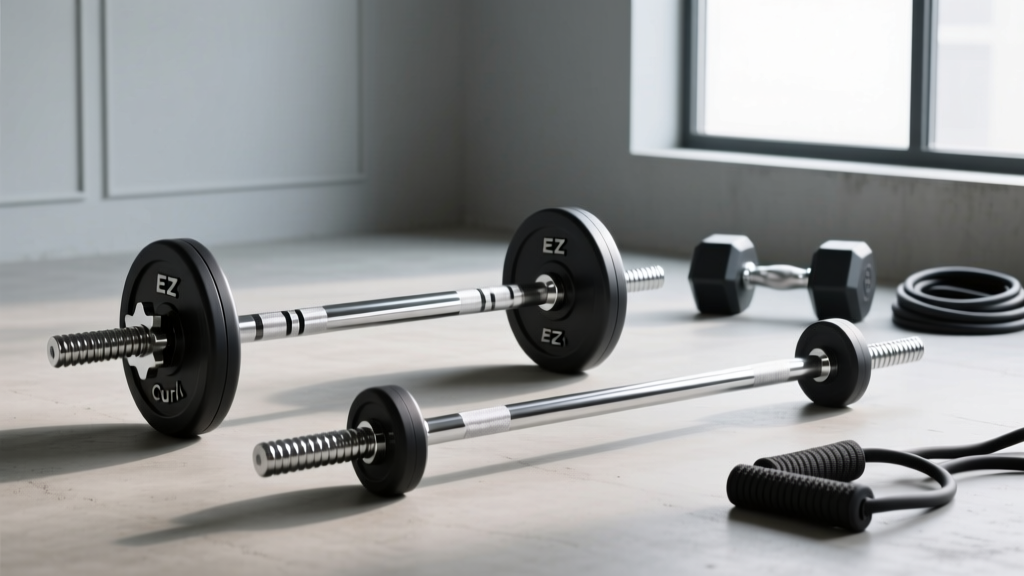
The EZ curl bar features angled shafts that allow you to grip the bar in a semi-supinated or semi-neutral position. This slight inward rotation aligns the radioulnar joint with the natural carrying angle of the elbow. While some bodybuilders argue that full supination (straight bar) is required for peak bicep contraction, electromyography (EMG) studies show that the difference in muscle fiber recruitment between a fully supinated and semi-supinated grip is statistically negligible for hypertrophy, provided the load and time-under-tension are equated.
Hands-On Review: 2026 Top Curl Bars Tested
Our testing team spent six weeks evaluating the most popular curl bars on the market, focusing on knurl aggression, sleeve rotation, and tensile strength. Here are the top picks for your home or commercial gym.
1. Rogue Fitness Ohio Curl Bar (The Gold Standard)
- Price: $145.00
- Weight: 35 lbs
- Sleeve Type: 2-inch Olympic (Composite Bushings)
The Rogue Ohio Curl Bar remains the undisputed champion for serious lifters. Weighing 35 lbs, it provides a perfect starting weight for isolation work without the bulky 45 lbs of a standard barbell. The dual knurl marks are spaced precisely 12 inches apart, allowing for consistent grip width tracking. The composite bushings provide a smooth, controlled spin during the eccentric phase, preventing the bar from tearing your calluses. The 'volcano' knurl pattern is aggressive enough to hold chalk but won't shred your skin during high-rep burnout sets.
2. CAP Barbell Super Curl Bar (The Budget Standard)
- Price: $48.99
- Weight: 15 lbs
- Sleeve Type: 1-inch Standard (Smooth Finish)
If you are building a garage gym on a strict budget and already own standard 1-inch plates, the CAP Super Curl Bar is a functional entry point. However, be warned: the chrome finish on the grips becomes notoriously slippery once you start sweating. We highly recommend using lifting chalk or wrapping the inner shafts with athletic tape to maintain grip security during heavy eccentric overload sets.
3. Titan Fitness 50" Olympic Straight Bar (The Heavy Duty Option)
- Price: $89.00
- Weight: 45 lbs
- Sleeve Type: 2-inch Olympic (Snap Ring Bushings)
While Titan's straight bar is excellent for deadlifts and presses, we only recommend it for bicep curls if you possess exceptional wrist mobility and zero history of elbow tendonitis. The 45 lb starting weight is also a significant hurdle for beginners attempting strict, momentum-free curls.
Equipment Comparison Matrix
| Feature | Rogue Ohio Curl | CAP Super Curl | Titan 50" Straight |
|---|---|---|---|
| Grip Angle | 30° / 45° Angles | Multi-Angle Zig-Zag | 0° (Fully Straight) |
| Knurl Quality | Excellent (Volcano) | Poor (Smooth Chrome) | Good (Standard Power) |
| Joint Friendliness | High | High | Low |
| Best For | Heavy Hypertrophy | Beginner Home Gyms | Advanced Powerlifters |
Barbell Curls vs. The Best Dumbbell Exercises for Biceps
Why transition to bars at all if dumbbells are inherently safer? The answer lies in systemic overload and stabilization fatigue.
"Dumbbells are superior for peak contraction and joint tracking, but barbells are unmatched for raw mechanical tension. When you stabilize two independent dumbbells, your central nervous system limits the absolute load you can move. A barbell removes the stabilization bottleneck, allowing you to overload the eccentric phase with 15-20% more weight."
A landmark study sponsored by the American Council on Exercise (ACE) evaluated EMG muscle activation across various bicep movements. The data confirmed that while the concentric supination of a dumbbell curl yields massive short-head activation, the fixed-path tension of a barbell curl provides superior continuous tension across the entire range of motion, particularly in the brachialis muscle which sits underneath the bicep and pushes it upward for a thicker peak.
The Ideal Arm Day Protocol: Use the best dumbbell exercises for biceps (like the 45-degree incline curl) as your primary movement to take advantage of the deep stretch and natural joint rotation. Follow this with EZ bar preacher curls or standing EZ bar reverse curls to safely flood the brachialis and brachioradialis with heavy, fixed-path mechanical tension without destroying your wrists.
The FitGearPulse Decision Framework: Which Should You Buy?
Buy the EZ Curl Bar If:
- You experience medial elbow pain or wrist stiffness after heavy pulling days.
- Your primary goal is pure bicep and brachialis hypertrophy without joint compromise.
- You want a dedicated bar that weighs 35 lbs, making micro-loading (adding 2.5 lb plates) much more effective for isolation work.
Stick to the Straight Bar If:
- You possess elite wrist mobility and zero history of tendonitis.
- You are training for competitive strongman or powerlifting events where grip specificity on a straight axle is required.
- You are utilizing the bar for compound movements like bent-over rows or landmine presses, and only occasionally using it for curls.
Frequently Asked Questions
Can I use a trap bar (hex bar) for bicep curls?
While technically possible if you stand inside the hex bar and grip the neutral handles, the range of motion is severely restricted by the bar's frame hitting your thighs before you reach full elbow extension. Stick to a dedicated EZ curl bar for optimal biomechanics.
Does grip width on the EZ bar change muscle targeting?
Yes. Gripping the inner, narrower angles places the wrists in a more neutral position, shifting slightly more emphasis onto the brachialis and the long head of the bicep. Gripping the wider, outer angles forces more supination, targeting the short head (inner bicep).
How often should I replace my curl bar?
A high-quality Olympic curl bar like the Rogue Ohio will last a lifetime in a home gym environment. However, if you notice the chrome beginning to flake on budget standard bars, replace it immediately to prevent metal shards from embedding in your hands during heavy eccentrics.
More gear to consider
All reviews
Beyond a women's leg workout with dumbbells: Collar & clamp guide
Barbell Collar Guide: Bench Press & Chest Workouts with Dumbbells
Troubleshooting Dumbbell Laterals with Neoprene Home Weights

Adjustable Dumbbells vs 2 Pound Dumbbells: 2026 Setup Guide

EZ vs Straight Bar and Dumbbell Lat Pulldowns: 2026 Trend Report