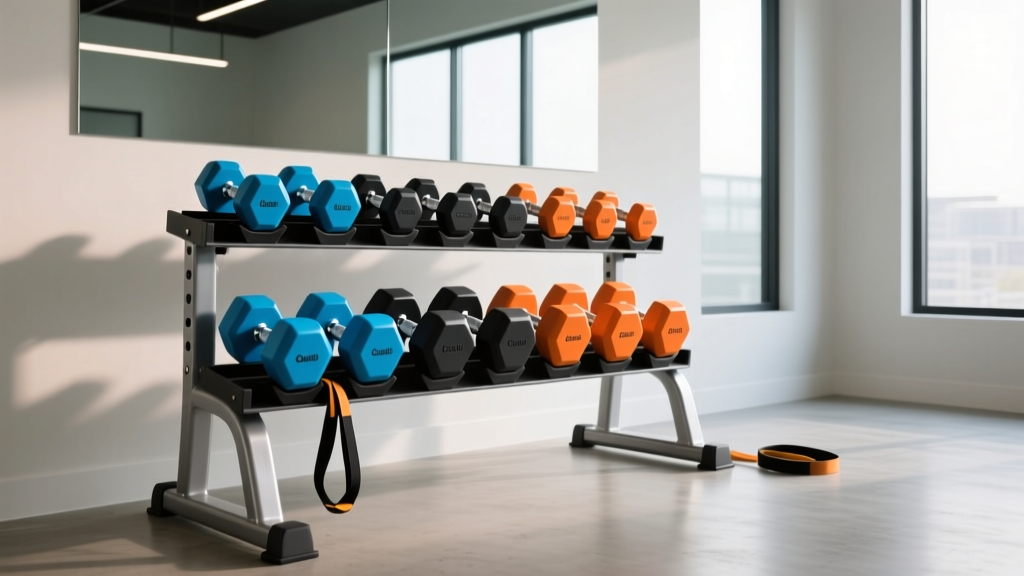
Optimizing Your Upper Chest Dumbbell Station: Storage & Layout
Maximize your home gym layout with space-saving storage and ergonomic rack placements designed specifically for heavy upper chest dumbbell workouts.

Designing a home gym requires more than just buying equipment; it demands a strategic approach to spatial geometry and biomechanics. Nowhere is this more critical than in the dedicated upper chest dumbbell zone. The incline dumbbell press is the undisputed king of clavicular pectoral development, but it is also one of the most logistically awkward movements to set up. When you are hoisting 70-pound or 80-pound dumbbells from a static rack to a 30-degree incline bench, poor spatial planning doesn't just waste square footage—it actively invites shoulder injury.
As home gym footprints shrink and equipment densities increase in 2026, optimizing your upper chest dumbbell station requires a synthesis of ergonomic storage solutions, precise clearance measurements, and intelligent layout design. This guide breaks down exactly how to configure your rack, bench, and storage systems to maximize safety, efficiency, and space.
The Biomechanics of Space: Why Layout Dictates Safety
To understand why storage placement matters, we must look at the movement itself. According to ExRx.net's biomechanical breakdown of the incline dumbbell press, targeting the upper chest requires a bench angle between 30 and 45 degrees. This incline fundamentally alters your center of gravity and restricts your lower body's ability to assist in the initial 'kick-up' phase of the lift.
When a dumbbell rack is placed too far from the bench, or at the wrong height, the lifter is forced into extreme shoulder extension and external rotation just to retrieve the weights. The Mayo Clinic notes that repetitive overstretching and awkward loading of the anterior deltoid and rotator cuff are primary catalysts for muscle strains and impingement syndromes. Your storage layout must eliminate the 'walk of death'—the dangerous 4-step shuffle with heavy dumbbells in hand before sitting on the incline bench.
Ergonomic Rack Placement: The 18-Inch Kick-Up Rule
The golden rule of upper chest dumbbell station design is the 18-Inch Kick-Up Rule. This dictates the exact distance between the edge of your dumbbell rack and the head of your adjustable bench.
⚠️ The 18-Inch Kick-Up Rule
Measure exactly 18 inches from the front lip of the dumbbell rack to the headrest of your bench when set at a 30-degree incline. This specific measurement allows the lifter to sit on the bench, lean forward to grasp the dumbbells from the rack, and fall back into the incline position using a single, fluid pivot motion without standing up or shuffling feet. Anything beyond 24 inches forces a standing retrieval; anything under 12 inches restricts knee clearance during the sit-back.
Heavy-Duty Storage: 3-Tier Rack Comparison Matrix
Upper chest training demands heavy loads. While lateral raises might utilize 20-pound dumbbells, a mature lifter will require 50 lb to 100 lb dumbbells for incline presses. Therefore, a 3-tier rack is non-negotiable for proper weight distribution and retrieval ergonomics. The middle tier should house your working weights (60-80 lbs) at thigh height, while the bottom tier holds the heaviest pairs (90-100 lbs) to prevent top-heavy tipping hazards.
| Model (2026 Specs) | Tiers | Max Capacity | Footprint | Price |
|---|---|---|---|---|
| Rogue RM-6 Monster Rack | 3 | 1,200 lbs | 47' x 32' | $495.00 |
| Rep Fitness SR-4000 | 3 | 1,000 lbs | 44' x 28' | $349.99 |
| Titan Fitness 3-Tier | 3 | 800 lbs | 42' x 26' | $249.99 |
Expert Verdict: For tight spaces, the Rep Fitness SR-4000 offers the best compromise between a narrow 28-inch depth and high weight capacity. The Rogue RM-6 is virtually indestructible but requires a larger footprint, making it better suited for dedicated garage gyms rather than multi-use rooms.
Space-Saving Alternatives: Adjustable Dumbbell Layouts
If your upper chest dumbbell zone is constrained to a 3x3 foot alcove, a traditional 3-tier rack is physically impossible. In 2026, high-end adjustable dumbbells have largely solved the space-to-weight ratio problem, but they introduce new layout challenges. Adjustable dumbbells cannot be dropped, and their cradles must be positioned perfectly for the incline kick-up.
- Nuobell 80 lb Set ($399/pair): Features a traditional handle feel and cradle. The cradle footprint is roughly 18' x 9'. Place the cradles on a low, 12-inch high platform directly behind the head of the bench to simulate a traditional rack height without the vertical footprint.
- PowerBlock Pro 100 EXP ($449/pair): The blocky, cage-like design requires a slightly wider retrieval path. Because they lack a traditional rounded handle, picking them up from the floor at an incline angle is highly discouraged. Use the dedicated PowerBlock stand ($179), positioned exactly 14 inches from the bench headrest.
Layout Blueprint: The 4x6 Foot Upper Chest Dumbbell Zone
For the optimal balance of space efficiency and safety, allocate a strict 4-foot by 6-foot rectangle for your upper chest station. Here is the exact spatial blueprint:
- The Anchor (0' - 2' depth): Place your 3-tier dumbbell rack against the back wall. Ensure it is bolted to the studs or weighted with 100+ lbs on the bottom tier to prevent forward tipping during heavy retrieval.
- The Transit Zone (2' - 3.5' depth): This 18-inch gap is your retrieval and kick-up zone. Keep this entirely clear of floor plates, kettlebells, or foam rollers. Apply 3/4-inch thick horse stall mats here to dampen acoustic shock if a heavy dumbbell is accidentally dropped during a failed incline press.
- The Press Zone (3.5' - 6' depth): Position your adjustable FID (Flat/Incline/Decline) bench here. Ensure the bench's rear stabilizer bar does not encroach into the Transit Zone when set to a 30-degree incline.
Common Layout Failure Modes (And How to Fix Them)
Even with the right equipment, subtle layout errors can ruin the functionality of your upper chest dumbbell station. Watch out for these specific failure modes:
1. The 'Wall-Bang' Failure
When setting up an adjustable bench, lifters often forget to account for the backrest's overhang. On a 30-degree incline, the top edge of the bench pad extends backward. If your rack is flush against a wall, the bench pad will strike the dumbbells or the rack uprights before you can sit down. Fix: Always measure the bench's 'incline overhang' (usually 6 to 10 inches) and add it to your 18-inch kick-up calculation.
2. The Asymmetric Retrieval Hazard
Placing a dumbbell rack parallel to the bench (rather than perpendicular to the bench's head) forces the lifter to twist their thoracic spine to grab the second dumbbell. Under 80-pound loads, this twisting motion places massive shear force on the lumbar and thoracic spine. Fix: Always orient the rack perpendicular to the head of the bench, ensuring both dumbbells are retrieved in a single, symmetrical forward reach.
3. Lighting and Shadow Blindspots
Overhead lighting placed directly above the incline bench will cast the lifter's own shadow over the dumbbell rack, making it difficult to read the weight markings on the dumbbell heads during quick rest periods. Fix: Install LED strip lighting on the front lip of the rack shelves or position floor lamps at a 45-degree angle to the station to eliminate retrieval blind spots.
Final Thoughts on Spatial Optimization
Optimizing your upper chest dumbbell station is an exercise in applied ergonomics. By respecting the 18-inch kick-up rule, investing in a structurally sound 3-tier rack or a precision-placed adjustable cradle, and strictly enforcing a 4x6 foot layout blueprint, you transform a hazardous chore into a seamless, injury-free training experience. Remember that in a home gym, space is your most valuable asset; design your layout to protect both your square footage and your rotator cuffs.
More gear to consider
All reviews
Dumbbell Exercises for Rear Delts: Neoprene Mistakes & Fixes
Optimize Space for Your Dumbbell Home Routine: Storage & Rack Guide

Bumper vs Iron Plate Longevity: Can I Buy Dumbbells With HSA?

EZ vs Straight Bar: Compact Layouts & Weighted Dips Dumbbell

Beyond Ab Workouts with Dumbbells: Cast Iron vs Competition Kettlebell Guide