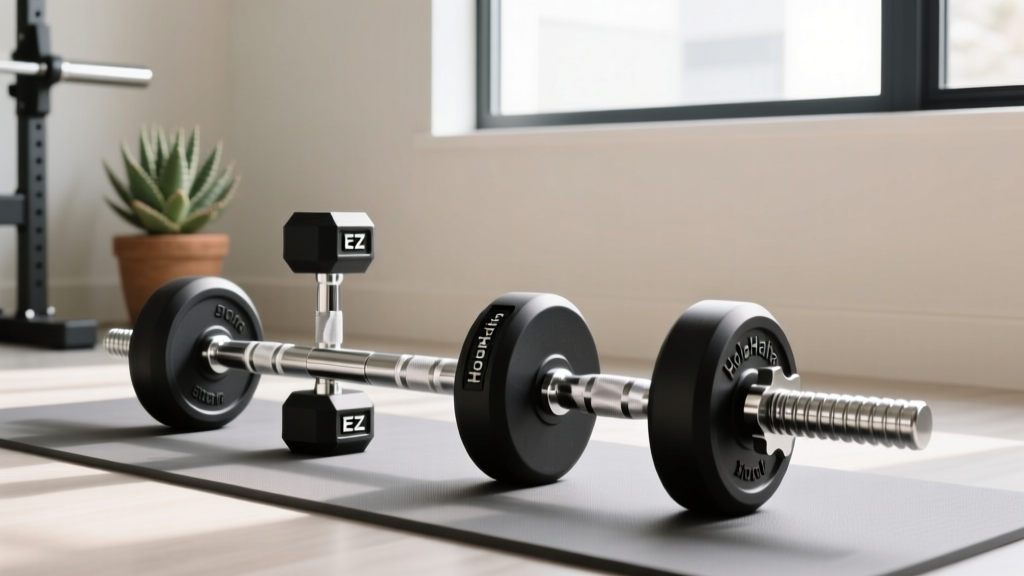
Upgrading Your HolaHatha Dumbbell Set: EZ Curl vs Straight Bar Care
Upgrading from a HolaHatha dumbbell set? Compare EZ curl vs straight bars for your home gym and learn expert maintenance tips to prevent rust and wear.

Outgrowing the HolaHatha Dumbbell Set: The Barbell Transition
If you started your home gym journey with a HolaHatha dumbbell set, you already know the value of accessible, budget-friendly resistance. Typically priced between $45 and $85 on Amazon, these neoprene or adjustable dial sets are phenomenal for light isolation work, high-rep endurance circuits, and beginners mastering mind-muscle connection. However, as your strength progresses into 2026, the 33lb to 55lb ceiling of most entry-level dumbbell sets inevitably forces a plateau. To trigger true progressive overload for your posterior chain, chest, and heavy bicep work, you need a barbell.
When transitioning from dumbbells to barbells, lifters immediately face a classic crossroads: Should I buy a standard straight bar or an EZ curl bar? While most comparisons focus purely on wrist biomechanics, few discuss the long-term maintenance, structural vulnerabilities, and care routines required to keep these specific bars rust-free and spinning smoothly. This guide breaks down the EZ curl vs. straight bar debate through the critical lens of equipment longevity and garage gym maintenance.
Structural Showdown: Straight Bar vs. EZ Curl Bar
Before applying oil or wire brushes to your new steel, you must understand the physical differences that dictate how each bar ages. A standard Olympic straight bar (like the benchmark Rogue Ohio Bar) features a continuous, uniform shaft. An EZ curl bar (such as the Titan Fitness Elite EZ Curl) features a zigzag shaft designed to put the wrists in a semi-supinated position.
| Feature | Olympic Straight Bar (20kg) | Olympic EZ Curl Bar (15kg) |
|---|---|---|
| Shaft Geometry | Uniform, straight cylinder | Angled bends and curves |
| Knurling Pattern | Continuous or center-knurled | Segmented by grip angles |
| Sweat/Chalk Traps | Low (easy to wipe down) | High (accumulates in the curves) |
| Primary Failure Point | Sleeve bushings, end-caps | Chrome flaking at the bend apex |
| Average 2026 Cost | $225 - $295 | $145 - $245 |
Biomechanics vs. Maintenance: The Hidden Trade-offs
According to biomechanics data cataloged by exercise databases like ExRx.net, the EZ bar reduces valgus stress on the wrist and elbow during flexion. But from a maintenance perspective, those ergonomic angles are a nightmare for sweat retention.
⚠️ The Chloride Threat: Human sweat contains high levels of sodium chloride and urea. When sweat pools in the tight inner curves of an EZ bar and dries, the chloride ions aggressively attack the zinc or chrome plating, leading to localized pitting and rust that is incredibly difficult to sand out without ruining the knurl.Straight bars, while harder on the wrists during heavy skull crushers, are infinitely easier to maintain. A quick pass with a microfiber towel wipes the entire shaft in one linear motion. EZ bars require meticulous attention to the crevices where the knurling meets the smooth, unknurled bend.
Failure Modes: Where Cheap Bars Go to Die
When upgrading from a budget HolaHatha set, it is tempting to buy a $99 generic EZ bar from a big-box store. Do not do this. Here is how cheap bars fail, and what to look for when investing in quality steel:
1. Chrome Flaking on the Curves
Bending a steel shaft creates immense tension on the outer radius of the curve. On cheap bars, the chrome plating is applied after the bending process, or the steel is of low yield strength. Over time, the micro-fractures in the chrome allow moisture underneath, causing the plating to flake off in sharp, dangerous shards. Solution: Buy bare steel, black oxide, or Cerakote-coated EZ bars, which do not flake.
2. Snap-Ring Sleeve Explosions
High-end straight bars use internal retaining rings or heavy-duty bolts to secure the sleeves. Budget EZ bars often use external, thin wire snap-rings. When the bar is dropped or the sleeve catches on a rack, these snap-rings can shear, sending the sleeve, bushings, and washers flying across your gym floor. Solution: Look for bars with bolt-on sleeves or internal snap-rings.
Step-by-Step Barbell Maintenance Protocol
Whether you choose a straight bar for heavy deadlifts or an EZ bar for targeted arm work, establishing a maintenance routine is non-negotiable. As outlined in BarBend's comprehensive barbell maintenance guide, neglect leads to seized sleeves and degraded knurling.
- Dry Brushing (Weekly): Use a nylon-bristle brush for Cerakote or black oxide finishes. Use a brass-bristle brush for bare steel or zinc. Never use stainless steel wire brushes, as they will strip the protective coating and embed iron particles that guarantee rust.
- Chalk Removal (Post-Workout): Gym chalk (magnesium carbonate) absorbs atmospheric moisture. If left in the knurling, it turns into a corrosive paste. Brush it out immediately after your session.
- Disinfecting (As Needed): Avoid bleach-based cleaners or Lysol, which accelerate oxidation. Use a 50/50 mix of water and white vinegar, or a specialized gym equipment wipe.
- Lubricating the Shaft (Monthly): Apply 3-IN-ONE Multi-Purpose Oil or a light synthetic gun oil to the shaft. Wipe it down with a microfiber cloth until it feels dry to the touch but leaves a microscopic protective barrier.
- Sleeve Oiling (Bi-Annually): If your bar has oil-impregnated bushings, apply a few drops of 3-IN-ONE between the sleeve and the shaft collar, spin the sleeve to work it in, and wipe the excess.
Which Bar Should You Buy for Your Garage Gym?
Your environment and training style should dictate your purchase. If your garage gym is unclimate-controlled and experiences high humidity swings, a Cerakote straight bar (like the Rogue Ohio Cerakote) is your safest bet. Cerakote provides ceramic-based corrosion resistance that outperforms traditional chrome by over 100x in salt-spray testing.
If you are strictly focused on hypertrophy, arm development, and lighter isolation work to supplement your HolaHatha dumbbell routines, an EZ Curl Bar is necessary. Opt for a Cerakote or bare steel EZ bar from reputable manufacturers like Rogue Fitness or American Barbell. As noted on the Rogue Curl Bar product page, modern manufacturing now utilizes ceramic coatings on the curved shafts, entirely eliminating the chrome-flaking failure mode that plagued older generations of EZ bars.
Frequently Asked Questions
Can I use WD-40 to clean my barbell?
No. Standard WD-40 is a solvent and a degreaser. While it will remove rust and dirt, it will also strip away the factory lubricants inside the sleeve bushings, leading to metal-on-metal grinding and a seized sleeve. Use a dedicated light machine oil instead.
Is an EZ bar worth it if I already have adjustable dumbbells?
Yes. While your HolaHatha dumbbell set is great for unilateral work, an EZ bar allows you to overload the biceps and triceps with significantly more weight than you can safely stabilize in your hands, bridging the gap between dumbbell curls and heavy straight-barbell rows.
How do I fix surface rust on a straight bar?
For light surface rust, soak the affected area in white vinegar for 5-10 minutes, then scrub vigorously with a brass brush and a Scotch-Brite pad. Wipe clean, dry completely, and immediately apply a light coat of 3-IN-ONE oil to prevent flash-rusting.
More gear to consider
All reviews
Power Rack vs Squat Rack vs Squat Stand: How Much Does a Dumbbell Weigh?

Who Invented the Dumbbell? History & Adjustable Setup Walkthrough
Olympic vs Standard Plates: Testing Pendlay Rows With Dumbbells

Best Adjustable Dumbbells for Dumbbell Chops: 2026 Review & Fixes

EZ Curl Bar vs Straight Bar: Space Layouts & Dumbbell Snatches
