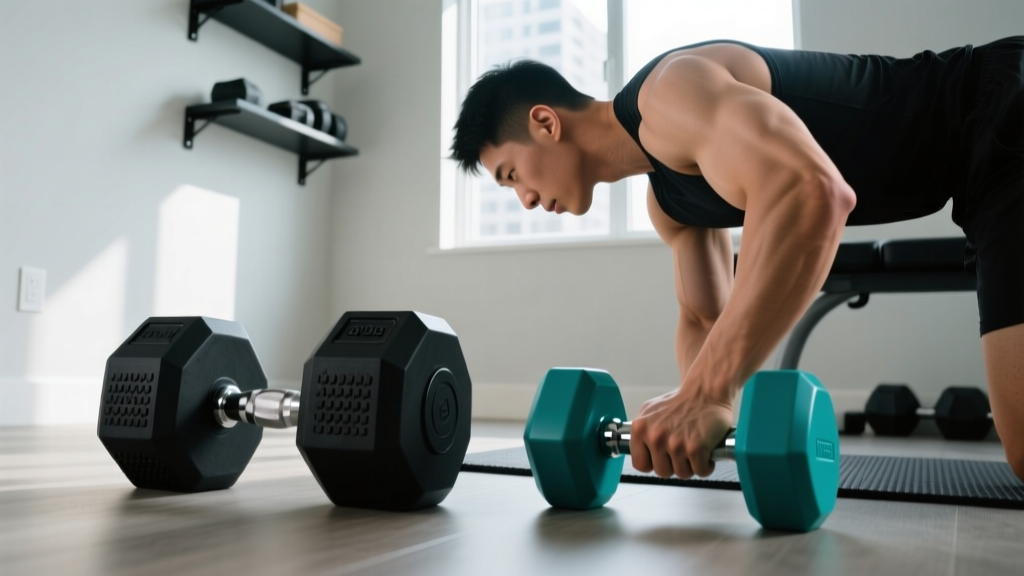
Single Arm Dumbbell Row Form: Rubber Hex vs Urethane in Small Gyms
Discover how rubber hex vs urethane dumbbells impact single arm dumbbell row form and space optimization in compact home gym layouts.

The Intersection of Equipment Density and Unilateral Biomechanics
When designing a compact home gym or optimizing a micro-gym layout in an apartment, every square inch of floor space dictates your equipment choices. However, spatial optimization is not just about storage; it directly influences your biomechanics during foundational movements. A prime example is how the physical dimensions of your free weights affect your single arm dumbbell row form. While most lifters debate the merits of rubber hex dumbbells versus urethane dumbbells based purely on durability or cost, the true differentiator in a space-constrained environment is material density, head profile, and how those factors interact with your range of motion (ROM) in tight quarters.
In 2026, urban fitness layouts and garage micro-gyms require a meticulous approach to equipment selection. Choosing the wrong dumbbell material can force you to alter your pulling mechanics, compromise lat engagement, or risk striking nearby racks and walls. This guide breaks down the spatial and biomechanical realities of rubber hex versus urethane dumbbells, providing a decision framework for lifters operating in restricted footprints.
The Spatial Biomechanics of the Pull
To understand why dumbbell head dimensions matter, we must first establish the biomechanical requirements of the exercise. According to the extensive exercise databases maintained by ExRx.net, the single arm dumbbell row requires a stabilized hip hinge, a neutral spine, and a pulling path that arcs toward the hip pocket rather than traveling in a strictly vertical line.
This arcing path is where spatial constraints become a problem. In a generous commercial gym, you have 360 degrees of clearance. In a 5x5 foot home gym corner, you are often rowing inches away from a power rack upright, a wall, or the edge of a flat bench. If the head of your dumbbell is overly bulky, it will physically clip the bench frame or rack upright at the top of the concentric phase. This premature collision forces a compensatory failure mode: the lifter either externally rotates the shoulder to clear the obstacle (shifting the load away from the lats and onto the rear delts) or artificially shortens the ROM, robbing the muscle of peak contraction.
⚠️ Form Breakdown Warning: If you find yourself twisting your torso or flaring your elbow outward at the top of your row, check your clearance. Bulky dumbbell heads striking adjacent equipment is a leading cause of unilateral form degradation in small home gyms.Material Density: Rubber Hex vs. Urethane Dimensions
The core difference between rubber hex and urethane dumbbells lies in material density, which directly dictates the physical footprint of the weight heads. Rubber is significantly less dense than high-grade polyurethane. Consequently, a rubber-encased dumbbell requires a larger volume of material to achieve the same mass, resulting in wider, bulkier heads.
Dimensional Comparison: The 70 lb Benchmark
Let us examine the spatial footprint of a 70 lb dumbbell, a common working weight for intermediate lifters performing heavy unilateral rows:
- Rubber Hex Dumbbell (e.g., CAP Barbell Cast Iron Hex): The head diameter typically spans 5.8 to 6.2 inches. The overall length from end to end is roughly 15.5 inches. The thick rubber coating adds substantial girth.
- Urethane Dumbbell (e.g., Rogue Urethane or Ironmaster): The head diameter is compact, generally measuring 4.5 to 4.8 inches. The overall length is closer to 13 inches. The high-density urethane allows for a much tighter, streamlined profile.
That 1.5-inch difference in head width might seem negligible on a spec sheet, but when you are executing single arm dumbbell row form with your torso parallel to the floor and your elbow tucked tight to your ribs, those extra inches are precisely what cause the weight to collide with a flat bench's steel support legs.
Comparative Matrix: Spatial and Environmental Factors
Beyond physical dimensions, the layout of a small gym must account for floor protection, drop tolerance, and indoor air quality. The following matrix compares the two materials across critical home gym metrics:
| Metric | Rubber Hex Dumbbells | Urethane Dumbbells |
|---|---|---|
| Average Cost (2026) | $1.40 - $1.70 / lb | $2.60 - $3.10 / lb |
| Head Density Profile | Bulky; wide lateral footprint | Compact; high mass-to-volume ratio |
| Roll Resistance | High (Hexagonal edges) | Moderate (Usually multi-sided or flat-bottomed) |
| VOC Off-Gassing | High (Noticeable odor in small rooms) | Very Low (Virtually odorless) |
| Degradation | Prone to cracking, drying, and flaking | Highly resistant to UV, sweat, and impact |
Designing the Unilateral Corridor: Layout Measurements
If you are committed to utilizing rubber hex dumbbells to save on upfront costs, your gym layout must compensate for their spatial bulk. Conversely, investing in urethane allows for tighter, more efficient floor plans. When mapping out your 'Unilateral Corridor'—the dedicated zone for single-leg and single-arm movements—adhere to these precise spatial guidelines:
- The 18-Inch Bench Offset: Never place your flat bench flush against a wall or rack upright. Position the bench at least 18 inches away from any vertical obstacle. This provides the necessary clearance for a 6-inch rubber hex head to pass without clipping during the row's arc.
- Lateral Swing Zone: Allocate a minimum 36-inch lateral clearance on the working side of the bench. Heavy dumbbell rows often require a slight torso rotation at the bottom of the eccentric phase to stretch the latissimus dorsi. If a wall is within 24 inches, you will subconsciously restrict this stretch, limiting hypertrophy.
- Storage Integration: Hex dumbbells excel in space optimization regarding storage. Their flat edges allow them to be stacked securely on narrow, multi-tier A-frame racks (which require only a 2x2 foot footprint) without the risk of rolling off. Urethane dumbbells usually require wider, heavy-duty horizontal trays or specialized vertical cradles, which can consume an extra 12 to 18 inches of lateral wall space.
Environmental Constraints: Off-Gassing in Micro-Gyms
Space optimization is not solely a physical measurement; it also encompasses the environmental quality of the space. Many home gyms are located in spare bedrooms, basements, or enclosed garages with limited HVAC circulation.
Recycled rubber hex dumbbells are notorious for off-gassing Volatile Organic Compounds (VOCs), which produce a persistent, toxic 'tire shop' odor. According to the U.S. Environmental Protection Agency (EPA), elevated indoor VOC levels can cause respiratory irritation, headaches, and long-term air quality degradation, particularly in poorly ventilated, enclosed spaces. When you are performing high-exertion, heavy-breathing sets of single arm rows in a 10x10 foot enclosed room, breathing in degrading rubber particulates and VOCs is a significant health compromise.
"In enclosed micro-gyms, the premium paid for virgin urethane is not just an investment in equipment longevity; it is an investment in indoor air quality. Urethane cures without the persistent sulfur and VOC off-gassing associated with cheap recycled rubber."
— Industrial Fitness Equipment Material Analysis, 2025
For a comprehensive look at premium, low-odor equipment standards, manufacturers like Rogue Fitness utilize high-grade, virgin urethane that remains completely odorless and stable, making it the undisputed choice for apartment dwellers and basement gym builders.
Grip Fatigue and Handle Ergonomics in Restricted Spaces
A secondary, often overlooked factor in single arm dumbbell row form is handle ergonomics. Because rubber hex dumbbells are budget-oriented, their handles often feature aggressive, shallow knurling or are coated in chrome that wears smooth over time. In a heavy 5x5 rowing protocol, grip fatigue becomes the limiting factor before the lats reach true failure.
Premium urethane dumbbells typically feature medium-depth, zinc-coated knurling with ergonomic swells at the center of the handle. When operating in a tight space where you cannot easily drop the weight or use excessive chalk (to protect nearby walls and flooring), a secure, ergonomic grip is paramount to maintaining a neutral wrist and preventing the dumbbell from shifting in your hand during the concentric pull.
Final Verdict: Optimizing Your Layout and Budget
The choice between rubber hex and urethane dumbbells ultimately hinges on the intersection of your budget, your available square footage, and your dedication to pristine biomechanics.
If you are outfitting a well-ventilated, two-car garage gym on a strict budget, rubber hex dumbbells remain a viable option. Their anti-roll hex shape makes them safe for floor storage, and their bulk can be managed by simply building a wider unilateral corridor with generous clearances around your bench.
However, if you are designing a high-density micro-gym, an apartment fitness corner, or a space where you must row within inches of a power rack upright, urethane dumbbells are non-negotiable. Their superior density provides a compact head profile that preserves your single arm dumbbell row form by eliminating collision-based ROM restrictions. Combined with zero VOC off-gassing and lifelong durability, urethane justifies its $2.80+ per pound price tag by ensuring that spatial constraints never force you to compromise on training mechanics.
More gear to consider
All reviews
EZ Curl vs Straight Bar: How Heavy Are the Dumbbells You Lift? (Season 2)

Loadable Dumbbell Only Chest Workout: Budget Breakdown & Value Analysis

Storing a Dumbbell That Shakes: Rack Layout & Stability Guide

Dumbbell Glute Kickbacks: Rubber Hex vs Urethane 2026 Market Trends

What Does Dumbbell Lateral Raise Work? & Collar Types
