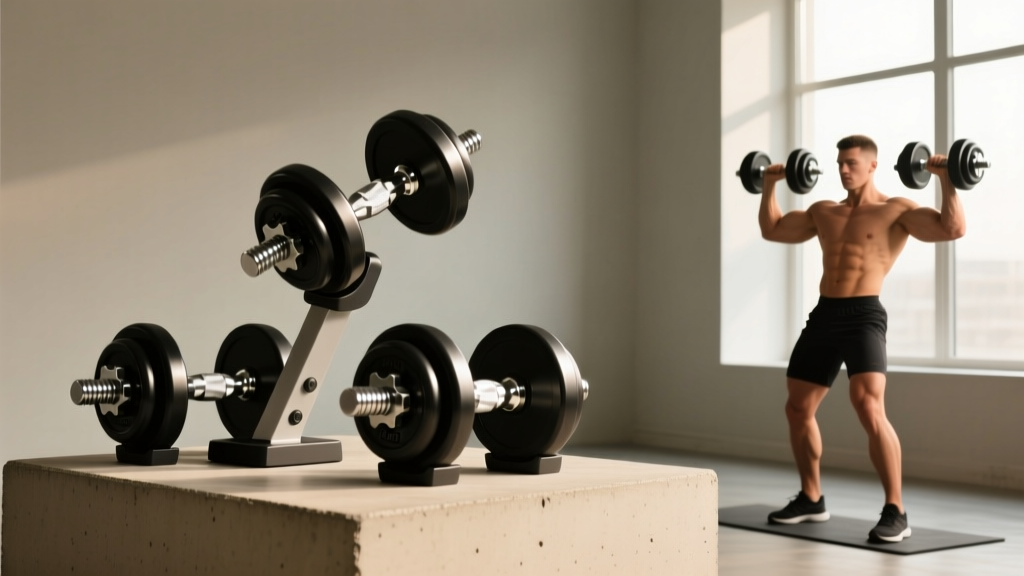
Train Your Core with Dumbbells: Adjustable Reviews & Form Mistakes
Reviewing the best adjustable sets to train your core with dumbbells. Learn to troubleshoot common form mistakes and choose the right gear for your routine.

When building a home gym, most lifters select adjustable dumbbells based solely on maximum weight and footprint. However, if you frequently train your core with dumbbells, the chassis design, handle knurling, and weight distribution become critical variables that can either optimize your gains or lead to lumbar injury. A bulky plastic casing might be fine for a chest press, but it can severely bruise your thighs during weighted V-ups or restrict your range of motion during overhead carries.
In this 2026 guide, we bridge the gap between equipment reviews and biomechanical troubleshooting. We will compare the top adjustable dumbbells on the market specifically through the lens of core training, troubleshoot gear-specific failures, and correct the most dangerous form mistakes lifters make when loading their midsection.
The Biomechanics of Loading the Midsection
Before selecting your equipment, it is vital to understand how the core functions under load. According to the National Strength and Conditioning Association (NSCA), effective core training must be divided into anti-movement (stability) and dynamic flexion/rotation. When you train your core with dumbbells, you are primarily challenging the anti-lateral flexion (obliques and quadratus lumborum) and anti-extension (rectus abdominis and transverse abdominis) systems.
Unlike fixed hex dumbbells, adjustable models often have a shifted center of gravity or an elongated handle. This alters the lever arm during exercises like the dumbbell pullover or the suitcase carry, demanding higher stabilization from the deep spinal stabilizers, such as the multifidus. Choosing a dumbbell with a balanced weight distribution is non-negotiable for safe, effective core work.
2026 Adjustable Dumbbell Matrix for Core Training
Not all adjustable dumbbells are created equal when it comes to midsection work. Below is our 2026 comparison matrix, graded specifically on core-training ergonomics, grip security, and chassis profile.
| Model (2026) | Chassis Profile | Handle & Knurling | Best Core Application | Avg. Price (Pair) |
|---|---|---|---|---|
| Nuobell 80 | Traditional, compact | Mild knurl, steel | Russian Twists, V-Ups | $429 |
| Bowflex 552 | Bulky, plastic ends | Smooth, molded grip | Standing Anti-Rotation | $399 |
| PowerBlock Sport 24 | Caged, blocky | Enclosed, narrow | Suitcase Carries | $229 |
| Ironmaster V2 | Solid steel, square | Aggressive knurl | Heavy Pullovers, Farmers Walks | $349 |
Gear-Specific Troubleshooting: When Equipment Fails Your Core
Even the best equipment can sabotage your workout if you do not understand its mechanical limitations. Here is how to troubleshoot common gear-specific issues when training your core with dumbbells.
⚠️ Troubleshooting Callout: The Bowflex Thigh Bruise
The Problem: When performing Goblet Squats or weighted V-Ups, the wide, plastic selector dials on the Bowflex 552 dig painfully into the inner thighs and collarbone.
The Fix: Shift your grip slightly off-center to clear the dial from your body, or switch to a Nuobell or Ironmaster set for any exercise where the dumbbell bell rests against your torso. If you are locked into the Bowflex ecosystem, substitute Goblet V-Ups with standing Woodchoppers to keep the chassis away from your body.
The PowerBlock Cage Slippage
PowerBlocks are phenomenal for pressing, but their caged design makes holding the dumbbell by the bell (required for Dumbbell Pullovers or Goblet holds) nearly impossible. Troubleshooting: If you are doing core-focused pullovers to target the anti-extension function of the rectus abdominis, you must use a traditional-profile adjustable dumbbell. Attempting to grip the PowerBlock cage during an overhead extension compromises wrist stability and shifts the load away from the core and onto the anterior deltoids.
The Renegade Row Wobble
Renegade rows are a premier anti-rotation core exercise. However, many adjustable dumbbells feature rounded or beveled end-caps that roll on hard floors. Troubleshooting: Always perform renegade rows on a high-density rubber mat. If your dumbbells have a severe bevel (common in older dial-system models), widen your foot stance to 2.5x shoulder width to compensate for the unstable base of support.
4 Fatal Form Mistakes When Training Your Core with Dumbbells
Equipment selection is only half the battle. According to spinal biomechanics research popularized by Dr. Stuart McGill's Backfitpro, loading the spine in compromised positions is a primary driver of disc herniation. Avoid these four common mistakes.
- Spinal Shear in Weighted Russian Twists
The Mistake: Sitting on the floor, leaning back into flexion, and twisting the spine while holding a heavy dumbbell creates massive shear force on the lumbar discs.
The Fix: Ditch the Russian Twist. Replace it with the Dumbbell Pallof Press (holding one dumbbell at chest height and pressing it out while resisting rotation) or Suitcase Carries. The ExRx Kinesiology Directory highly recommends anti-rotation movements over loaded spinal flexion for long-term core health. - Rib Flare in Dumbbell Pullovers
The Mistake: Lowering the dumbbell too far overhead, causing the lower ribs to pop up and the lumbar spine to hyperextend, entirely disengaging the core.
The Fix: Maintain a posterior pelvic tilt (think about pulling your belt buckle toward your chin). Limit the range of motion to 90 degrees. The core's job here is to prevent extension, not to stretch. - Hip Hiking in Renegade Rows
The Mistake: Allowing the hips to rotate and hike upward when pulling the dumbbell to the ribcage, which shifts the work from the obliques to the latissimus dorsi.
The Fix: Imagine balancing a glass of water on your lower back. Drop to a lighter weight (e.g., 15-20 lbs) and focus entirely on keeping the hips perfectly square to the floor. - Momentum in Dumbbell Side Bends
The Mistake: Using a heavy dumbbell and bouncing at the bottom of the lateral flexion movement, relying on the stretch reflex rather than muscular contraction.
The Fix: Implement a strict 3-second eccentric (lowering) phase. Pause for 1 second at the bottom, and contract the oblique to return to neutral. Do not lean past neutral at the top.
Programming Framework: Matching the Movement to the Gear
To maximize your results and protect your joints, pair the right core movement with the right adjustable dumbbell profile.
- For Heavy Anti-Extension (Pullovers, Overhead Carries): Use the Ironmaster Quick-Lock V2. Its solid steel construction and aggressive knurling ensure the grip does not fail before your core does.
- For High-Rep Rotational/Flexion Work (V-Ups, Woodchoppers): Use the Nuobell 80. The traditional profile prevents the chassis from bruising your torso during high-rep, close-to-body movements.
- For Unilateral Stability (Suitcase Carries, Single-Arm Farmers Walks): The PowerBlock Sport 24 excels here. The caged handle provides a secure, neutral wrist position for heavy loaded carries without the bell swinging against your legs.
"The core is not designed to produce movement; it is designed to prevent it. When you train your core with dumbbells, your primary goal should be to challenge the spine's ability to resist flexion, extension, and rotation under asymmetrical loads."
Final Thoughts on Gear and Biomechanics
Training your core with dumbbells is one of the most effective ways to build functional, athletic midsection strength, provided you respect both your spinal biomechanics and your equipment's physical limitations. By selecting an adjustable dumbbell that matches your specific core programming—and ruthlessly eliminating high-shear movements like the loaded Russian twist—you will build a bulletproof core that translates directly to heavier compound lifts and injury-free longevity in the gym.
More gear to consider
All reviews
Barbell Clamp Guide: Why a Dumbbell Drawing is Easy for Workout Logs

Rep Hex Dumbbells vs Adjustable Dumbbells: 2026 Showdown

Olympic Barbell Knurling Guide & Cute Dumbbell Set Setup
Cast Iron vs Competition Kettlebells: Best Dumbbell Workouts for Women
Beyond Back and Bicep Exercises with Dumbbells: Barbell Collar Guide
