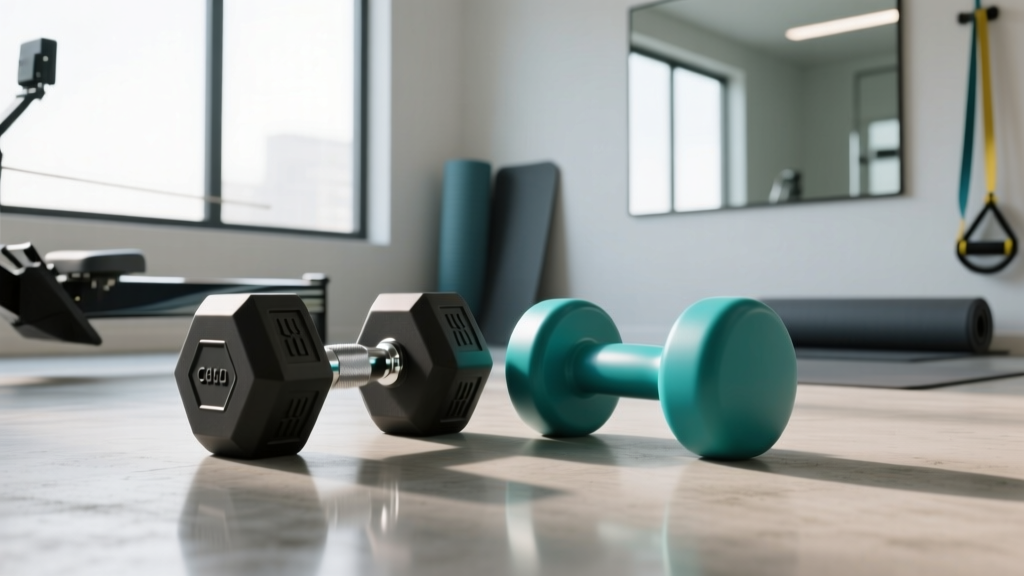
Rowing Exercise Dumbbell Guide: Rubber Hex vs. Urethane Value
Analyze the true cost of your rowing exercise dumbbell. We break down rubber hex vs. urethane value, TCO, and performance for back training.

The True Cost of Your Rowing Exercise Dumbbell: Rubber Hex vs. Urethane
When building a home gym, the search for the perfect rowing exercise dumbbell often leads to a critical crossroads: do you invest in premium urethane, or save upfront with rubber hex dumbbells? Back training—specifically single-arm rows, renegade rows, and Meadows rows—places unique demands on your equipment. You need aggressive knurling to prevent grip failure, durable heads to withstand drops, and ergonomic handles to avoid wrist strain.
In this 2026 value analysis, we break down the total cost of ownership (TCO), material degradation, and biomechanical performance of rubber hex versus urethane dumbbells to help you make a financially sound, performance-driven decision.
2026 Market Snapshot: Cost Per Pound (CPP)• Virgin Rubber Hex: $1.45 - $1.85 / lb
• Premium Urethane: $2.65 - $3.50 / lb
• Average 100lb Set (5-50lbs) Price Gap: ~$130 - $160
Material Science: What You Are Actually Paying For
To understand the value proposition, we must look past the marketing and examine the material engineering of both dumbbell types.
Virgin Rubber Hex (The Budget Entry Point)
Most budget rubber hex dumbbells are manufactured using recycled or low-grade virgin rubber molded over a cast iron core. While the hexagonal shape prevents rolling—a massive plus when setting up for renegade rows—the material itself has distinct limitations. Rubber is highly susceptible to UV degradation and ozone cracking. If your home gym is in a garage with fluctuating temperatures and sunlight exposure, the rubber heads will begin to dry rot, chip, and flake within 3 to 5 years. Furthermore, cheaper rubber off-gasses volatile organic compounds (VOCs), resulting in a persistent 'tire smell' that can make high-rep, heavy-breathing rowing sets deeply unpleasant.
Urethane (The Premium Standard)
Urethane (polyurethane) is a synthetic elastomer that sits at the top of the dumbbell hierarchy. According to BarBend's extensive dumbbell testing, urethane boasts a higher Shore A durometer rating (typically 88A-90A) compared to rubber. This means it is denser, more scratch-resistant, and completely odorless. Urethane does not degrade under UV light, making it a lifetime investment for garage gyms. The higher upfront cost reflects the complex chemical casting process and the premium hard-chrome handles that are almost universally paired with urethane heads.
The Rowing Exercise Dumbbell Stress Test
Biomechanically, the single-arm dumbbell row requires the lifter to stabilize a heavy load while pulling through a full range of motion. The limiting factor in back training is almost always grip strength and handle ergonomics. Here is how both materials perform under the specific stresses of rowing variations.
| Rowing Variation | Rubber Hex Performance | Urethane Performance |
|---|---|---|
| Single-Arm Row | Handles often exceed 35mm in thickness on heavier weights; shallow knurling leads to premature grip fatigue before lat failure. | Consistent 32mm-34mm handles with medium-depth knurling; secure grip allows for true muscular failure in the back. |
| Renegade Rows | Hex shape provides excellent floor stability. However, dropping them can cause the rubber to tear away from the inner steel core. | Round or precision-molded hex urethane absorbs impact beautifully, protecting both the dumbbell core and your gym flooring. |
| Chest-Supported Row | Thick rubber heads can clank awkwardly against the bench uprights or pad when lowering the weight. | Denser, quieter material; compact head profiles allow for a deeper stretch without bench interference. |
5-Year Budget Breakdown & Total Cost of Ownership (TCO)
Value is not just about the initial receipt; it is about the cost per use and the hidden expenses associated with equipment failure. Let us model a 5-year TCO for a standard 525-pound set (5lb to 50lb pairs in 5lb increments).
The Hidden Floor Repair Cost: Budget rubber hex dumbbells often use a hard plastic or poorly cast iron inner core. When the thin rubber layer compresses or tears during a heavy renegade row drop, the exposed core transfers kinetic energy directly into your floor. Repairing cracked garage concrete or replacing high-density rubber mats can easily add $150-$300 to your 'hidden' gym costs over a 5-year period.
TCO Comparison: 525lb Set (5-50lbs)
- Rubber Hex Initial Cost: ~$780 (at $1.48/lb)
- Rubber Hex 5-Year Maintenance: $60 (replacement of 2 cracked pairs due to UV dry rot) + $120 (premature mat replacement from core strikes) = $960 Total
- Urethane Initial Cost: ~$1,440 (at $2.74/lb)
- Urethane 5-Year Maintenance: $0 (no degradation, no floor damage) = $1,440 Total
While urethane remains more expensive over 5 years, the value gap narrows significantly when factoring in the lifespan. Urethane is effectively a 'buy it for life' (BIFL) product. Over a 10-year horizon, you will likely replace a full set of budget rubber hex twice, surpassing the cost of a single urethane set. For comprehensive home gym equipment analysis, Garage Gym Reviews consistently highlights urethane as the superior long-term investment for serious lifters.
Real-World Pricing & Model Comparisons (2026 Data)
To ground this analysis in reality, let us look at two of the most popular models dominating the 2026 market:
1. CAP Barbell Cast Iron Hex Dumbbell (Rubber Coated)
Price: ~$1.50/lb
The Good: Unbeatable entry price; widely available; hex shape stops rolling.
The Bad: Handle knurling is notoriously inconsistent. On the 40lb and 50lb models, the handle diameter swells to nearly 38mm, making heavy single-arm rows a test of hand endurance rather than latissimus dorsi strength. The rubber odor can take months to off-gas in an enclosed space.
2. REP Fitness Round Urethane Dumbbells
Price: ~$2.85/lb
The Good: Zero odor; 88A durometer urethane heads; beautifully knurled 32mm hard chrome handles that lock your hand in place during heavy pulling movements.
The Bad: Round shape requires a dedicated dumbbell rack to prevent rolling, adding ~$150-$200 to your initial setup budget if you do not already own one.
The FitGearPulse Decision Framework
Which material offers the best value for your specific rowing needs? Use this framework to decide.
Buy Rubber Hex If:
- You are on a strict sub-$800 budget for a full set.
- Your primary use is lighter, high-rep circuit training where grip fatigue is less of an issue.
- You have a climate-controlled indoor space (to mitigate UV/ozone cracking and VOC odor).
Buy Urethane If:
- You prioritize progressive overload in your back training and need a reliable, aggressive knurl to support heavy single-arm rows.
- Your gym is in a garage or shed with temperature fluctuations.
- You frequently perform renegade rows or drop your dumbbells, requiring maximum impact absorption to protect your flooring.
- You view fitness equipment as a 10+ year investment.
Frequently Asked Questions
Can I use liquid chalk to compensate for poor rubber hex knurling during rows?
Liquid chalk can improve friction, but it cannot fix an ergonomically poor handle diameter. If the 50lb rubber hex dumbbell has a 38mm handle, chalk will not prevent the biomechanical disadvantage placed on your flexor digitorum muscles. Urethane handles maintain a standard 32-34mm diameter, which is optimal for pulling mechanics.
Do urethane dumbbells smell at all?
No. High-quality virgin urethane is completely odorless right out of the box. This is a massive value-add for home gym owners who train in spare bedrooms, basements, or attached garages where rubber off-gassing would permeate the living space.
Are hex-shaped urethane dumbbells available?
Yes, though they command a 10-15% price premium over round urethane due to the more complex molding process. Brands like Rogue and Eleiko offer hex urethane options, but for pure rowing performance, the handle quality matters more than the head shape, provided you have a storage rack.
More gear to consider
All reviews
2026 Bumper vs Iron Plate Budget & One Arm Dumbbell Row GIF Guide

2026 Loadable Dumbbells: Dumbbell Row Muscle Group Trends
Barbell Knurling Guide & Dumbbell Bicep Curl to Shoulder Press Setup
Counterfeit Bowflex Dumbbells: 2026 Storage & Rack Safety Trends
Dumbbell Hip Thrust Form: 2026 Adjustable Setup & Review
