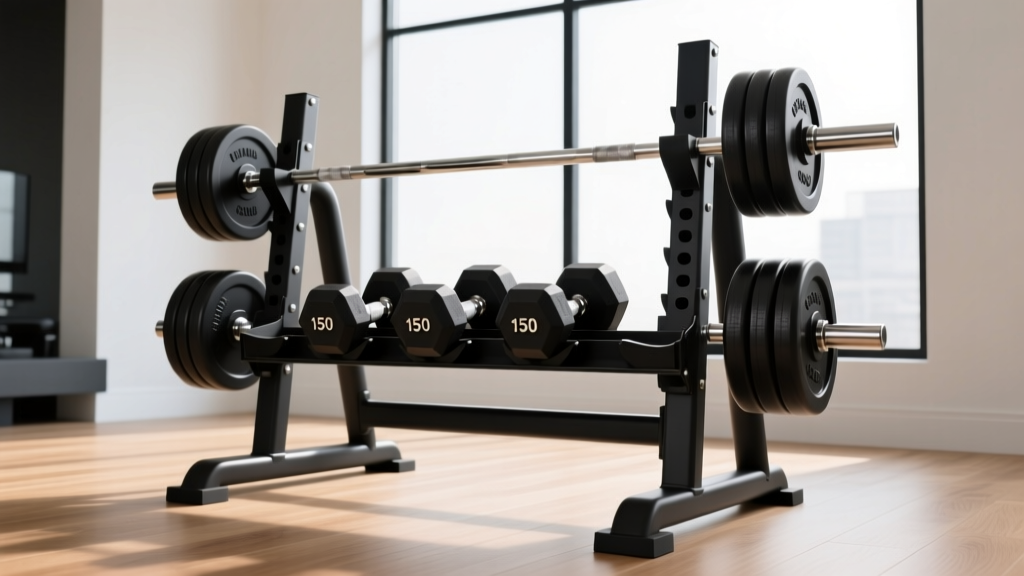
2026 Market Analysis: Racks for the 150 Pound Dumbbell
Explore 2026 market trends in heavy-duty dumbbell racks engineered to safely store and organize the massive 150 pound dumbbell for elite garage gyms.

The Ultra-Heavy Dumbbell Surge: Why Standard Racks Are Failing
The landscape of elite strength training has shifted dramatically over the last five years. Driven by the mainstreaming of strongman methodologies, high-level CrossFit programming, and the proliferation of luxury commercial garage gyms, the demand for ultra-heavy free weights has skyrocketed. At the absolute apex of this trend is the 150 pound dumbbell. Once considered a mythical implement reserved for elite bodybuilders and niche strongman competitors, the 150 pound dumbbell is now a stocked staple in high-end performance facilities. However, this surge in demand has exposed a critical vulnerability in facility infrastructure: standard commercial dumbbell racks are catastrophically failing under the unique physical and dynamic demands of these massive implements.
According to facility design guidelines outlined by the National Strength and Conditioning Association (NSCA), equipment storage must account for both static loads and dynamic force multipliers. When a facility attempts to store a 150 pound dumbbell on a standard 11-gauge steel, three-tier rack, the results are often disastrous. Shelves bow, welds fracture, and the risk of catastrophic structural failure increases exponentially. This 2026 market analysis explores the engineering, ergonomic, and financial trends shaping the next generation of heavy-duty dumbbell racks and storage solutions designed specifically to accommodate the 150 pound dumbbell.
Data Highlight: The Dynamic Force Multiplier
A 150 pound dumbbell possesses a static weight of 150 lbs. However, when an athlete returns the weight to the rack from a height of just 12 inches, the dynamic force multiplier can generate upwards of 450 to 600 lbs of instantaneous sheer force on the rack shelf. Standard 12-gauge steel shelving yields (permanently bends) at approximately 350 lbs of localized point-load stress across a 36-inch span. This physical reality has forced manufacturers to completely redesign their heavy-duty storage lines for 2026.
Structural Engineering: What a 150 Pound Dumbbell Demands
Storing ultra-heavy dumbbells requires a fundamental departure from traditional rack manufacturing. The market has moved away from standard tubular steel shelving toward reinforced, gusseted cradle designs. Three specific engineering upgrades have become the industry baseline for any rack claiming to support weights in the 100 to 150+ pound range.
1. Steel Gauge and Weld Penetration
In 2026, 11-gauge (0.120-inch) steel is officially obsolete for the heavy tiers of commercial dumbbell racks. The market leaders have standardized on 7-gauge (0.1875-inch) or 3/16-inch solid steel for the primary load-bearing shelves. Furthermore, the method of attachment has shifted. Standard MIG spot-welds are being replaced by full-penetration TIG welds or reinforced bolt-through gussets. A bolt-through design utilizing Grade 8 hardware allows the rack to absorb micro-vibrations and dynamic shocks without fatiguing the weld seams over time.
2. UHMW Polyethylene Liners
Dropping a 150 pound dumbbell onto bare steel destroys both the implement and the rack. The 2026 standard mandates the use of Ultra-High Molecular Weight (UHMW) polyethylene liners. Unlike standard rubber mats that compress and tear under extreme point-loads, 0.5-inch thick UHMW plastic absorbs the kinetic energy of a dropped 150 pound dumbbell while protecting the knurling of the dumbbell handle. It also reduces acoustic reverberation in the facility by up to 40%.
3. Shelf Depth and Lip Retention
A standard 50-pound hex dumbbell is roughly 11 inches long. A 150 pound dumbbell, due to the massive diameter of its heads, often measures between 17 and 19 inches in total length. Standard 10-inch deep shelves are entirely inadequate, leaving the center of gravity dangerously close to the edge. The new market standard requires a minimum 14-inch shelf depth, paired with a 2-inch welded retention lip to prevent the dumbbell from rolling off the rack when bumped by adjacent athletes.
Ergonomic Shifts: The Death of the Bottom Tier
Perhaps the most significant trend in the 2026 storage market is the move away from traditional three-tier racks for ultra-heavy weights. From a biomechanical and liability standpoint, storing a 150 pound dumbbell on a bottom tier positioned 4 to 6 inches off the floor is a massive injury risk. Picking up 150 lbs from a dead-stop, compromised spinal position violates every principle of safe lifting mechanics.
"Facility managers are realizing that storing weights over 100 pounds on the bottom tier is a liability nightmare. We are seeing a massive shift toward two-tier 'saddle' racks and single-tier floor cradles for the ultra-heavy implements, keeping the pickup point between 18 and 24 inches off the ground."
— 2026 Commercial Fitness Equipment Market Report
This ergonomic realization has birthed the Heavy-Duty Saddle Rack category. Instead of flat shelves, these racks feature angled, UHMW-lined cradles that hold the dumbbell heads securely while leaving the handle exposed at an optimal 20-inch height for safe, neutral-spine extraction.
2026 Market Leaders: Commercial Rack Comparison Matrix
To understand the current landscape, we analyzed the top commercial storage solutions available in 2026 that are explicitly rated for the 150 pound dumbbell. As noted in commercial equipment reviews by BarBend, the gap between "commercial grade" and "ultra-heavy grade" has never been wider.
| Brand / Model | Steel Gauge | Max Tier Load | Shelf Depth | 2026 MSRP |
|---|---|---|---|---|
| Sorinex Diamond 2-Tier Saddle | 7-Gauge (Laser Cut) | 1,200 lbs | 16" (Cradle) | $2,150 |
| Rogue 3-Tier Heavy Duty | 7-Gauge Uprights / 3/16" Shelves | 800 lbs | 14" (Flat w/ Lip) | $1,345 |
| Eleiko Olympic Dumbbell Rack | 11-Gauge (Reinforced Tubular) | 600 lbs | 12" (Angled) | $2,890 |
| Rep Fitness PR-5000 Attachment | 11-Gauge | 300 lbs (Fails at 150lb pair) | 10" | $349 |
Note: Manufacturers like Rogue Fitness have adapted their traditional 3-tier lines by offering heavy-duty shelf upgrades specifically to combat the bending issues reported in earlier model years when loaded with 120+ lb dumbbells.
Spatial Footprint and Facility Integration
Integrating storage for a 150 pound dumbbell requires a complete rethinking of spatial planning. Because the heads of a 150 pound dumbbell can measure up to 7 inches in diameter, the center-to-center spacing between stored pairs must be increased from the industry standard 12 inches to a minimum of 16 to 18 inches.
Space-to-Weight Ratio Calculations
- Standard 5-50 lb Rack (3-Tier): Occupies 48 inches of wall space. Holds 3,300 lbs total.
- Ultra-Heavy 100-150 lb Rack (2-Tier Saddle): Occupies 60 inches of wall space. Holds 1,500 lbs total.
Facility designers must allocate nearly 25% more linear floor space for ultra-heavy storage zones. Furthermore, the clearance in front of the rack must be expanded. An athlete maneuvering a 150 pound dumbbell requires a minimum 6-foot radius of unobstructed flooring to safely clear the rack and begin their movement, dictating that these racks cannot be placed in high-traffic corridors or near doorways.
Price Analysis and ROI for Elite Facilities
The cost of upgrading to racks capable of handling the 150 pound dumbbell is substantial, but the return on investment is calculated through risk mitigation and equipment longevity. A standard commercial rack costs between $400 and $700. However, replacing a bowed shelf or repairing a fractured weld on a rack holding 150 lb implements can cost upwards of $300 per incident, not including the liability costs if an athlete is injured by a collapsing shelf.
Investing in a purpose-built, 7-gauge saddle rack (ranging from $1,500 to $2,500) eliminates structural maintenance costs for a minimum of 15 years. For commercial gym owners, the presence of a dedicated, heavy-duty 150 pound dumbbell station also serves as a powerful marketing tool. It signals to elite athletes, bodybuilders, and strongman competitors that the facility is uncompromising in its equipment standards, directly driving high-ticket membership acquisitions.
Future Outlook: Smart Racks and Automated Inventory
Looking toward the latter half of the decade, the integration of RFID tracking and smart-sensors into heavy-duty dumbbell racks is the next frontier. Because a 150 pound dumbbell represents a significant capital expense (often exceeding $450 per pair in urethane), facility managers are demanding storage solutions that log when the implement is removed and returned. Prototype racks featuring embedded load cells in the UHMW cradles are currently in beta testing, allowing gym management software to track utilization rates of ultra-heavy weights in real-time. Until these smart systems become commercially viable, the market remains firmly anchored in the principles of brute-force engineering: thicker steel, deeper shelves, and uncompromising ergonomic safety.
More gear to consider
All reviews
Power Rack vs Squat Rack vs Stand: Cable or Dumbbell Rear Delt Fly

Close Grip Dumbbell Bench Mistakes & Adjustable Weight Fixes

Budget Racks for Amazon Basics Neoprene Dumbbell Hand Weights

Dumbbell Rack Storage Maintenance: Surviving the Dumbbell Skier Swing

Loadable Dumbbell Care: Securing Dumbbell Weight for Squats
