
Power Rack vs Squat Rack vs Squat Stand for Your Nike Dumbbells Set
Compare power racks, squat racks, and squat stands to find the perfect home gym rig that integrates seamlessly with your Nike dumbbells set and barbell.

The Home Gym Ecosystem: Anchoring Your Gear
Building a functional home gym in 2026 requires more than just buying a barbell and a bench. Modern training methodologies heavily emphasize hybrid programming—supersetting heavy barbell compound lifts with high-rep metabolic conditioning or accessory work. This is where a high-quality Nike dumbbells set (such as their popular neoprene or hex-coated lines) becomes invaluable for joint prep, HIIT flows, and unilateral isolation. However, the foundation of this entire ecosystem is your lifting rig.
Choosing between a power rack, a squat rack (half rack), and a squat stand dictates not only your safety during heavy squats and bench presses but also how efficiently you can store and transition to your dumbbell work. In this head-to-head comparison, we break down the exact dimensions, failure modes, and accessory compatibilities of each rig type to help you make an informed, space-optimized decision.
Head-to-Head Comparison Matrix
Before diving into the engineering nuances, here is a high-level structural breakdown of the three main rig categories based on current 2026 market standards for 11-gauge steel models.
| Feature | Power Rack (Full Cage) | Squat Rack (Half Rack) | Squat Stand (Minimalist) |
|---|---|---|---|
| Average Footprint | 48" x 48" (Standard) | 48" x 24" (Open Front) | 24" x 24" (Base Dependent) |
| Price Range (11-Gauge) | $699 – $1,200+ | $450 – $850 | $250 – $450 |
| Upright Profile | 3"x3" or 3"x2" | 3"x3" or 2"x3" | 2"x2" or 3"x3" |
| Safety Mechanism | Enclosed spotter straps/pins | Forward-extended spotter arms | Rearward-extended spotter arms |
| Dumbbell Storage | Excellent (Internal trays/peg) | Good (Front-mounted trays) | Poor (Requires separate rack) |
Power Racks: The Ultimate Enclosure
A full power rack (or cage) features four main uprights connected by crossmembers, creating an enclosed lifting environment. Models like the Rep Fitness PR-4000 (approx. $799) or the Rogue R-3 Power Rack ($1,050+) are industry benchmarks.
The Safety Advantage
According to safety guidelines outlined by the National Strength and Conditioning Association (NSCA), lifting without a spotter requires redundant safety mechanisms. A power rack allows you to set spotter straps or pin-pipes on all four corners. If you fail a bench press, the bar rests securely on the pins inside the cage, completely eliminating the risk of the rack tipping forward—a common failure mode in open-front designs.
Edge Cases and Spatial Constraints
The primary drawback is the footprint and ceiling height. Most standard power racks are 90 inches tall, requiring a minimum ceiling clearance of 92 to 94 inches to accommodate pull-ups and overhead presses. Furthermore, performing wide-arc dumbbell movements (like chest flyes or heavy shoulder presses with your Nike dumbbells set) inside a standard 48-inch wide cage can result in clipping the uprights if you have a broad wingspan.
Expert Tip: If you opt for a power rack but frequently use dumbbells, invest in a model with a 30-inch depth option or attach a flat dumbbell tray to the exterior uprights to keep your workout flow uninterrupted.Squat Racks (Half Racks): The Open-Front Compromise
Half racks, such as the Rogue SML-2C Monster Lite Squat Stand ($745) or the Titan T-2 Series ($399), utilize two main front uprights and two rear stabilizing feet. They offer a compelling middle ground for garage gyms.
Dumbbell Integration and Ergonomics
Because the front is completely open, half racks are vastly superior for dumbbell bench pressing and shoulder work. You can sit on an adjustable bench and press your Nike dumbbells set without the psychological or physical barrier of steel uprights inches from your elbows. Additionally, half racks frequently support front-mounted flat shelving attachments, making it incredibly easy to store and grab dumbbells mid-superset.
The Tipping Hazard (Failure Mode)
As highlighted in extensive stability testing by Garage Gym Reviews, half racks are inherently front-heavy when loaded with a barbell. If a lifter fails a squat and dumps the bar forward onto the extended spotter arms, the kinetic energy can lift the rear stabilizers off the floor. Rule of thumb: Unless a half rack is bolted directly into concrete or heavily counterweighted with plate storage on the rear uprights, it is a tipping hazard during maximal effort failures.
Squat Stands: Minimalist but Unforgiving
Squat stands (e.g., Rogue S-Base 2.0 at $395 or Titan X-2) consist of two independent vertical posts with extended rear feet and spotter arms. They are the most budget-friendly and space-efficient option, but they demand strict technical proficiency.
The Re-Racking Danger
The most critical failure mode of a squat stand occurs during the re-rack. If you aggressively push the barbell backward into the J-cups, the forward momentum can easily tip the entire stand backward, especially if the base is not anchored. Squat stands are strictly recommended only for experienced lifters who practice controlled re-racking and utilize spotter arms set just below their active range of motion.
Storage Limitations
Squat stands offer virtually zero integrated storage. You cannot easily attach heavy dumbbell trays to the uprights without compromising the center of gravity. If your programming relies heavily on transitioning from barbell squats to goblet squats or lunges with your Nike dumbbells set, you will need to purchase a separate, freestanding dumbbell rack, which ultimately negates the space-saving benefit of the squat stands.
Integrating Your Nike Dumbbells Set into the Rack Ecosystem
Not all dumbbells are created equal, and their physical design dictates how they interact with your rig. Nike’s fitness dumbbells—often featuring neoprene coatings, ergonomic grips, or compact hex heads—are designed for high-repetition functional fitness and aerobic conditioning.
- Avoid Vertical Peg Storage: Standard rack weight storage pegs are designed for Olympic plates or solid iron hex dumbbells with long, smooth handles. Neoprene or uniquely shaped handles on fitness-oriented dumbbell sets often tear or fail to sit flush on standard 1-inch or 2-inch pegs.
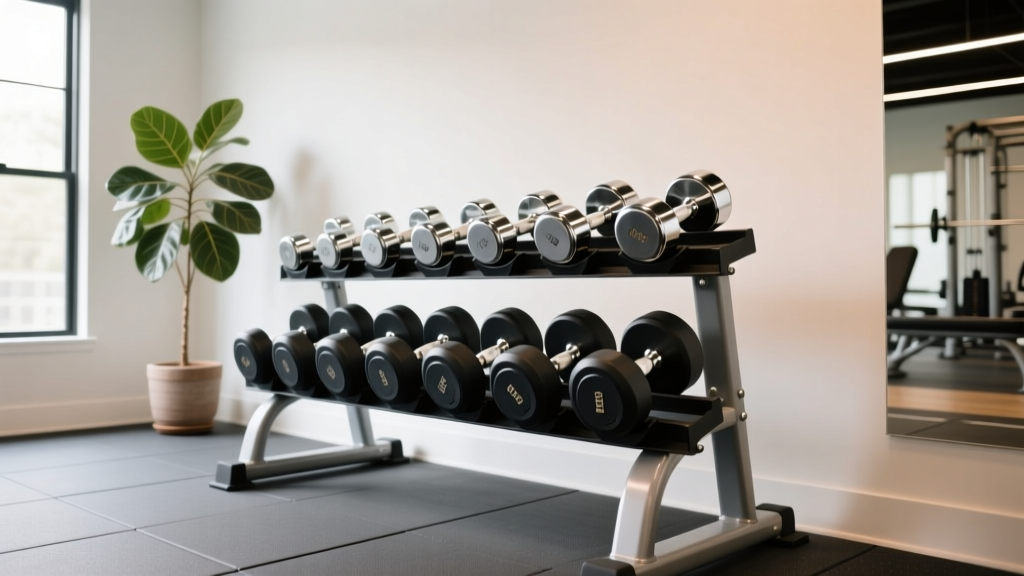
- Opt for Flat Tray Attachments: Look for rigs that support 3-tier flat dumbbell trays (like the Titan Monster Lite Dumbbell Tray). This allows you to lay the dumbbells flat, preserving the coating and allowing for rapid weight changes during drop sets.
- Bench Clearance: When setting up an adjustable bench inside your rig for dumbbell incline presses, ensure the rack's crossmembers do not interfere with the bench's rear support leg. Half racks completely eliminate this geometric puzzle.
"The best home gym rig isn't just about barbell capacity; it's about the friction of transition. If your rack setup forces you to walk across the garage to grab your dumbbells, you're losing the intensity of your superset. Plan your storage attachments around your secondary gear."
Final Verdict: Which Should You Buy?
Your choice ultimately hinges on three variables: ceiling height, budget, and training style.
- Choose the Power Rack if: You have 93+ inch ceilings, prioritize maximum safety for solo heavy lifting, and want an all-in-one storage solution for your barbell plates and Nike dumbbells set via integrated shelving.
- Choose the Squat Rack (Half Rack) if: You have low ceilings (under 88 inches), frequently perform dumbbell bench presses or Olympic lifts that require an open front, and are willing to bolt the rig down or use rear plate storage for counterbalance.
- Choose the Squat Stand if: You are on a strict sub-$400 budget, have minimal square footage, and possess the technical discipline to safely control barbell re-racks without relying on an enclosed cage.
By matching your rig to your specific spatial constraints and accessory gear, you ensure that your home gym remains a safe, efficient environment for years of progressive overload.
More gear to consider
All reviews
Top Dumbbell Racks for Circuit Training With Dumbbells in 2026
Dumbbell Rack Maintenance: Storing Your 35 Pounds Dumbbell Safely
Best Neoprene Dumbbells for Deadlift Form: 2026 Head-to-Head

Best Neoprene Dumbbells for Push Exercises With Dumbbells (2026)

Select a Weight: Dumbbells & Bumper vs Iron Plate Value
