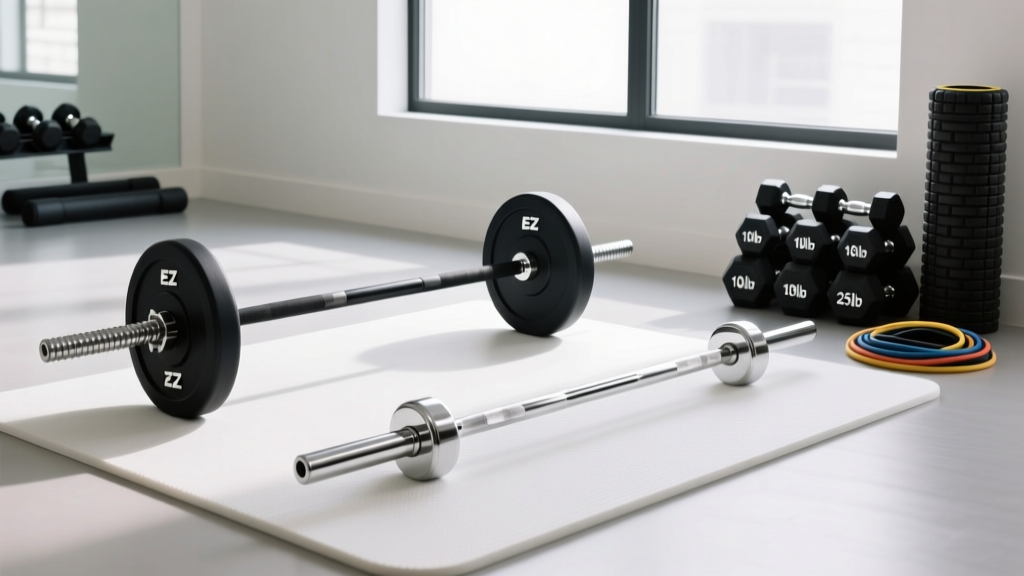
EZ Bar vs Straight Bar: Upgrading Your Dumbbell Workout Split
Is an EZ curl bar or straight bar the better budget investment for your dumbbell workout split? We break down costs, biomechanics, and long-term value.

The Home Gym Steel Dilemma: Beyond the Dumbbell Workout Split
When you first build a home gym, a well-structured dumbbell workout split is the undisputed king of efficiency. Adjustable dumbbells or a basic hex set allow for unilateral work, deep stretches, and a massive exercise library. However, as your biceps and triceps adapt to progressive overload, you will inevitably hit a mechanical and financial ceiling. Loading 80-pound dumbbells for strict curls becomes a balancing act of momentum rather than pure isolation, and the cost of buying heavier fixed dumbbells scales exponentially.
This is the exact juncture where lifters look to integrate a barbell into their arm days. But this introduces a classic budget and biomechanics debate: Should you invest in a traditional straight bar or an EZ curl bar? In this 2026 value analysis, we break down the capital expenditure, metallurgical failure modes, and joint-health ROI of both options to help you decide which bar actually deserves a rack in your home gym.
Capital Expenditure: EZ Curl Bar vs. Straight Bar Pricing Matrix
To understand the true value, we must look beyond the sticker price and analyze the cost-per-use and longevity of the steel. As of early 2026, global steel tariffs and shipping logistics have pushed the baseline price of entry-level Olympic bars up by roughly 12-15% compared to a few years ago. Below is a breakdown of the market tiers.
| Budget Tier | Straight Bar Model | Est. Price | EZ Curl Bar Model | Est. Price | Value Winner |
|---|---|---|---|---|---|
| Entry-Level | CAP Barbell OB-85 (45lb) | $129 | CAP Super Curl Bar (35lb) | $99 | EZ Bar |
| Mid-Tier | Titan Fitness Ohio Bar Clone | $185 | Titan Fitness EZ Curl Bar | $109 | EZ Bar |
| Premium | Rogue Ohio Bar (Stainless) | $395 | Rogue Curl Bar (Cerakote) | $245 | EZ Bar |
Hidden Costs: Shipping and Plate Compatibility
A frequently overlooked factor in budget analysis is freight. A standard 7-foot straight barbell weighs 45 lbs and measures over 86 inches in length, often triggering oversize shipping surcharges from retailers. An EZ curl bar typically weighs between 25 and 35 lbs and ships in a compact 4-foot box, almost always qualifying for standard free shipping thresholds. Furthermore, if your current dumbbell workout split relies on 1-inch standard plates, finding a high-quality 1-inch EZ bar is nearly impossible in the modern market, forcing an upgrade to 2-inch Olympic plates—a secondary budget consideration.
Biomechanical ROI: Joint Health as a Long-Term Investment
In fitness equipment, the highest hidden cost is physical therapy. The primary argument for the EZ curl bar revolves around wrist and elbow kinematics. According to kinesiology data cataloged by ExRx.net, the angled grips of an EZ bar place the forearms in a semi-supinated (neutral) position.
The Biomechanical Reality: A straight bar forces the wrists into full supination and places a valgus stress on the elbow joint. Over a 12-week hypertrophy block, heavy straight-bar curling is a leading culprit of medial epicondylitis (golfer's elbow) and distal bicep tendon strain.
If an injury forces you to take six weeks off from your upper body days, the "value" of your straight bar drops to zero. The EZ bar’s cambered shaft allows for a more natural carrying angle of the humerus, preserving your connective tissue and ensuring you can consistently execute your programming without forced deloads.
Failure Modes: Where Cheap Bars Lose Their Value
Not all steel is created equal. When budget shoppers buy the cheapest straight bar available, they often encounter catastrophic failure modes that ruin the investment within 18 months.
⚠️ Warning: The 150lb Bend Threshold
Entry-level straight bars (often rated below 150,000 PSI tensile strength) are designed for floor presses and light squats. When you load 135+ lbs onto the sleeves for strict curls, the torque applied to the center of the shaft can cause permanent plastic deformation (bending). Once a straight bar bends, it will never spin smoothly in the sleeves again. Conversely, because an EZ curl bar is significantly shorter and features multiple bends engineered to distribute torque, it is highly resistant to permanent bending under isolation loads, even at lower tensile strengths.
Knurling and Sleeve Spin
Premium straight bars like the Rogue Curl Bar utilize composite bushings that allow the sleeves to spin independently of the shaft. During a heavy curl, the natural rotation of your wrists creates rotational force. If your barbell sleeves do not spin (common in cheap, solid-pin straight bars), that rotational force transfers directly into your wrists and elbows. Investing in a bar with proper bushings is non-negotiable for long-term joint value.
Periodizing Your Dumbbell Workout Split with Barbell Isolation
You do not need to abandon your dumbbells to see the value of a barbell. The most cost-effective approach is a hybrid model. Here is how to integrate an EZ or straight bar into a 4-day Upper/Lower or Push/Pull dumbbell workout split to maximize hypertrophy while managing fatigue.
- Heavy Mechanical Tension (Barbell): Use the EZ bar for the first bicep exercise of your Pull day. Perform 3 sets of 6-8 reps of strict EZ bar curls. The stability of the bar allows you to overload the muscle belly with 20-30% more weight than you could safely handle with dumbbells.
- Unilateral Stretch & Peak Contraction (Dumbbells): Follow up with Incline Dumbbell Curls (3 sets of 10-12 reps). The dumbbells allow for a deeper stretch at the bottom of the movement and the freedom to supinate the wrist at the top, targeting the short head of the bicep.
- Triceps Overload (Barbell): Swap heavy dumbbell skull crushers (which often cause elbow flare and pain) for EZ bar lying triceps extensions. The neutral grip of the EZ bar dramatically reduces elbow shear force while allowing for massive weight progression.
According to comprehensive equipment roundups by BarBend, the modern EZ curl bar has largely replaced the straight bar in commercial and home gyms specifically for this hybrid isolation capability, noting that the "angled grips provide a necessary reprieve for lifters grinding through high-volume arm splits."
The Final Verdict: Which Bar Wins the Value Analysis?
If your goal is pure powerlifting specificity (squats, bench, deadlifts), a straight bar is a mandatory purchase. But if you are analyzing this strictly through the lens of arm hypertrophy, joint preservation, and budget efficiency to supplement a dumbbell workout split, the EZ Curl Bar is the undisputed value champion.
The ROI Summary:
1. Lower Initial Cost: Mid-tier EZ bars are generally $50 to $100 cheaper than their straight bar counterparts.
2. Zero Freight Surcharges: Compact packaging saves you $30-$50 on shipping.
3. Injury Prevention: The semi-supinated grip mitigates wrist and elbow tendonitis, keeping you in the gym and protecting your most valuable asset—your physical health.
4. Space Efficiency: An EZ bar can be stored vertically in a corner or tucked under a bed, whereas a 7-foot straight bar requires dedicated wall hooks or a massive power rack.
For the home gym lifter looking to break through an arm-building plateau without spending $400 on a premium stainless steel straight bar, a $110 mid-tier EZ curl bar paired with a set of Olympic bumper plates is the smartest capital allocation you can make this year.
More gear to consider
All reviews
Power Rack vs Squat Stand Setup for Single Arm Dumbbell Presses

Olympic vs Standard Weight Plates for Dumbbell Hammer Curls

Dumbbell Row Form Guide: Standard vs Olympic Plates

ZIVA Dumbbell Rack Solutions: 2026 Storage Market Trends

Loadable Dumbbell Care: Securing Dumbbell Weight for Squats
