Power Rack vs Squat Stand: Leg Workout With Dumbbells and Barbells
Compare power racks, half racks, and squat stands to optimize your leg workout with dumbbells and barbells. Expert specs, safety tips, and 2026 pricing.

The Foundation of Heavy Leg Days: Choosing Your Rack
When building a garage gym, the structural centerpiece dictates the ceiling of your training. If your primary goal is executing a comprehensive leg workout with dumbbells and barbells, you are immediately confronted with a spatial and financial puzzle: Do you invest in a fully enclosed power rack, a hybrid half rack, or a minimalist squat stand? As of 2026, the home fitness equipment market has matured, offering highly specialized variations of each. However, choosing the wrong footprint or safety mechanism can severely limit your exercise selection, compromise your safety during heavy barbell squats, or clutter the floor space needed for dynamic dumbbell movements.
This head-to-head comparison breaks down the engineering, safety profiles, and real-world applications of the three dominant rack categories, helping you match the exact hardware to your biomechanical and spatial needs.
Defining the Contenders: Power Rack vs. Squat Rack vs. Squat Stand
Before diving into specific models, it is crucial to understand the structural taxonomy of squatting equipment. While marketing terms often blur together, the engineering distinctions are stark.
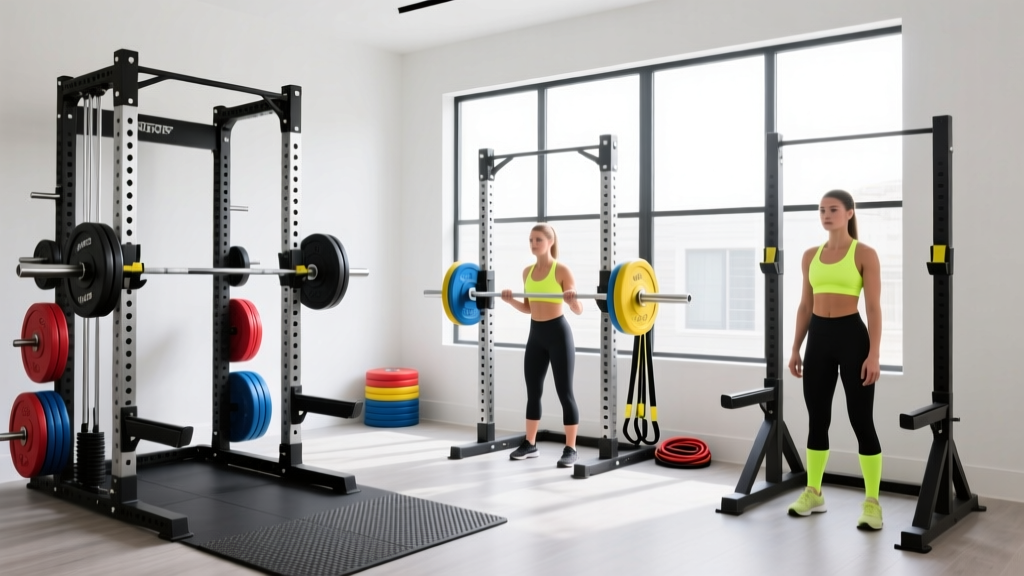
- Power Rack (Full Cage): Features four main uprights connected by crossmembers, creating an enclosed 'cage.' It offers maximum stability, 360-degree attachment compatibility, and interior safety mechanisms.
- Squat Rack (Half Rack): Typically utilizes two main front uprights with a rear stabilizing frame and weight storage horns. It provides an open-front feel for Olympic lifting or dumbbell work while maintaining a bolted-down, tip-proof base.
- Squat Stand: Consists of two independent, freestanding uprights (or two A-frame bases). It is highly space-efficient and portable but relies heavily on user caution and proper loading to prevent tipping.
2026 Market Leaders: Head-to-Head Spec Comparison
To ground this comparison in reality, we are pitting three industry-standard models against each other. These represent the benchmark for 11-gauge and 14-gauge steel construction in the current market.
| Feature | REP Fitness PR-4000 (Power Rack) | Rogue HR-3000 (Half Rack) | Titan T-2 Short (Squat Stand) |
|---|---|---|---|
| Upright Profile | 3x3' 11-Gauge Steel | 3x3' 11-Gauge Steel | 2x2' 14-Gauge Steel |
| Hole Spacing & Size | 5/8' holes, 1' Westside bench zone | 5/8' holes, 1' Westside bench zone | 1' holes, 2' standard spacing |
| Inside Width | 49' (Fits standard 7' barbells) | 49' (Fits standard 7' barbells) | Adjustable (Typically set to 48') |
| Weight Capacity | 1,000 lbs | 1,000+ lbs | 600 lbs |
| Base Footprint | 48' x 48' (Standard) | 48' x 49' (Including storage) | 24' x 24' (Per stand) |
| Approx. Base Price | $899 | $695 | $199 |
Optimizing Your Leg Workout with Dumbbells and Barbells
According to the kinesiology databases at ExRx.net, lower body hypertrophy and strength require a diverse range of motion, loading vectors, and stabilization demands. Your rack must facilitate both heavy, stable barbell loading and expansive, dynamic dumbbell movements.
Barbell Movements: Squats, Rack Pulls, and Good Mornings
For heavy barbell back squats and front squats, the Power Rack is the undisputed king. The enclosed cage allows you to set safety straps or pin-pipes exactly at your bottom-depth fail point. If you miss a 405 lb back squat, the barbell safely rests on the straps, protecting your cervical spine and sternum. The Half Rack also excels here, utilizing extended spotter arms. However, Squat Stands present a distinct failure mode: if you fail a rep and dump the bar forward onto the spotter arms, the kinetic energy can tip the lightweight A-frame bases forward, especially if they are not bolted into concrete.
Dumbbell Movements: Lunges, Step-Ups, and Goblet Squats
A rigorous leg workout with dumbbells and barbells requires significant floor space. Walking lunges, Bulgarian split squats, and lateral step-ups demand a clear perimeter.
Expert Spatial Tip: If you opt for a Power Rack, choose a model with a depth of at least 48 inches and utilize weight storage horns on the rear uprights. This keeps your 50 lb to 100 lb hex or urethane dumbbells off the floor, eliminating tripping hazards during walking lunges. Half Racks naturally integrate this rear storage, making them a hybrid favorite for mixed-modality leg days.Safety Mechanisms and Edge-Case Failure Modes
When pushing close to your 1-Rep Max, equipment failure is not an option. USA Weightlifting guidelines emphasize that structural integrity and proper spotting mechanisms are paramount for athlete safety. Here is how the hardware holds up under stress.
Strap Safeties vs. Pin and Pipe Safeties
The REP PR-4000 and Rogue HR-3000 support heavy-duty nylon or Dyneema safety straps. Straps are vastly superior for barbell work because they absorb the shock of a dropped bar without damaging the knurling or bending the barbell sleeves. Conversely, budget Squat Stands like the Titan T-2 often rely on steel pin-and-pipe safeties. Dropping a loaded barbell onto steel pipes from a height of 4 inches can permanently bend an Olympic barbell and chip the rack's powder coat, leading to rust oxidation over time.
The J-Cup Liner Factor
Premium power racks and half racks feature UHMW (Ultra-High Molecular Weight) plastic liners on the J-cups. This protects the barbell's knurling during the re-racking phase of a heavy squat. Many entry-level squat stands use bare steel J-cups; repeated re-racking of a 300 lb barbell will grind away the zinc or chrome finish on your barbell within months.
Space, Budget, and Installation Realities
Your decision matrix must account for the physical constraints of your training environment.
'The most common mistake home gym owners make is measuring the ceiling height without accounting for the pull-up bar clearance and the lifter's height at the top of a barbell overhead press or high-bar squat.' — Garage Gym Engineering Standards
Footprint and Ceiling Constraints
- Power Rack: Requires a minimum 8x8 foot dedicated zone. Standard heights are 84' or 90'. If your ceiling is 8 feet (96'), a 90' rack leaves only 6 inches for pull-ups, which is insufficient. You must opt for a 'Short' 72' power rack, which limits tall lifters during overhead movements.
- Half Rack: Extends further back due to weight storage and spotter arms but leaves the top open, eliminating ceiling clearance issues entirely.
- Squat Stand: Can be pushed into a corner when not in use. Ideal for multi-use spaces like shared garages or living areas, but requires the user to manually move 50+ lb steel bases every session.
Expert Verdict: Which Rack Fits Your Garage?
Selecting the right equipment for your leg workout with dumbbells and barbells ultimately hinges on your budget, space, and risk tolerance.
Choose the Power Rack (REP PR-4000) If:
You prioritize absolute safety for solo heavy barbell squatting, plan to use modular attachments (lat pulldowns, belt squat mechanisms), and have a dedicated, high-ceiling room. The 49-inch interior width perfectly accommodates standard Olympic barbells and provides the lateral clearance needed to safely bail out of a failed dumbbell Bulgarian split squat if necessary.
Choose the Half Rack (Rogue HR-3000) If:
You want the safety of a bolted-down frame and integrated dumbbell weight storage, but prefer an open-top design for muscle-ups, tall lifters, or low-ceiling basements. It is the ultimate hybrid for athletes who mix heavy barbell strength work with dynamic, CrossFit-style conditioning.
Choose the Squat Stand (Titan T-2) If:
You are on a strict sub-$250 budget, train in a multi-use space, and primarily use dumbbells for your leg workouts, utilizing the barbell only for moderate-weight squats where you are confident in your ability to re-rack safely. Always bolt squat stands to a concrete slab or heavily sandbag the rear base plates to mitigate forward-tipping failure modes.
Ultimately, the rack is the silent partner in your training. Invest in the steel gauge, safety mechanisms, and spatial footprint that align with your long-term strength goals, ensuring every rep is performed with maximum intent and zero compromise on safety.
More gear to consider
All reviews
Loadable Dumbbells for Dumbbell Around the Worlds: Value Analysis
Smart Storage for Strength Training at Home With Dumbbells

Olympic vs Standard Plates: Gear for the Dumbbell Forward Lunge

Cast Iron vs Competition Kettlebells: Upgrading Dumbbell Exercises That Target Triceps

Power Rack vs Squat Rack vs Stand: Space for Crunch Dumbbells