
Power Rack vs Squat Rack vs Squat Stand: Alternated Dumbbell Shoulder Press Guide
Compare power racks, squat racks, and stands. Troubleshoot setup mistakes for heavy lifts and the alternated dumbbell shoulder press in your home gym.

The Home Gym Rack Dilemma: Space, Safety, and Versatility in 2026
When outfitting a home gym, most lifters fixate on barbell movements. You measure ceiling height for pull-ups and floor space for deadlifts, ultimately choosing between a power rack, a squat rack, or a pair of squat stands. However, a critical blind spot emerges once the equipment arrives: dumbbell clearance and upper-body versatility. According to comprehensive home gym analyses by Garage Gym Reviews, over 40% of home gym owners report regretting their rack footprint due to interference during heavy dumbbell exercises.
This is especially true for unilateral and alternating overhead movements. The alternated dumbbell shoulder press is a staple for building asymmetrical core stability and deltoid mass, but it requires significant lateral space, overhead clearance, and precise bench placement. In this troubleshooting guide, we break down the structural differences between power racks, squat racks, and squat stands, and reveal the common setup mistakes that ruin heavy dumbbell pressing.
Power Rack vs Squat Rack vs Squat Stand: The 2026 Buyer’s Matrix
Before troubleshooting exercise mechanics, you must understand the physical boundaries of your rig. Pricing and steel availability have shifted in 2026, making heavy-duty 11-gauge steel rigs more expensive but necessary for safety. Below is a comparison matrix based on current market leaders.
| Feature | Power Rack (e.g., Rogue RM-6) | Squat Rack / Half Rack (e.g., Titan T-3) | Squat Stand (e.g., Rep PR-1100) |
|---|---|---|---|
| Average 2026 Price | $2,100 - $2,800+ | $800 - $1,200 | $250 - $450 |
| Interior Width | 49 inches (Standard) | 43 - 48 inches | 48 - 52 inches (Open) |
| Overhead Clearance | Restricted by Crossmembers / Pull-up Bar | Restricted by Multi-grip Bar | Unrestricted (Open Top) |
| Safety Spotter Integration d> | Full 360-degree pin/strap safeties | Front-facing flip-down or pin safeties | External bolt-on spotter arms only |
| Dumbbell Press Suitability | High (if bench is centered) | Medium (upright interference risk) | High clearance, low safety for failure |
Source reference: Rogue Fitness RM-6 Specifications
Troubleshooting the Alternated Dumbbell Shoulder Press in Confined Racks
The alternated dumbbell shoulder press involves pressing one dumbbell overhead while the other remains in a static, isometric rack position at shoulder height. This movement demands anti-rotational core strength and significant lateral space. Here are the most common mistakes lifters make when attempting this inside a rack, and how to fix them.
Mistake 1: The Lateral Clearance Collision
The Problem: A standard power rack has an interior width of 49 inches. If your shoulder width is 18 inches, you have roughly 15.5 inches of space on each side. However, a pair of 80lb Rogue Urethane dumbbells feature a handle length of 12.5 inches and a bell diameter of 5.5 inches. When holding the static arm in the rack position, the dumbbell bell will physically scrape or collide with the rack's uprights or laser-cut numbering holes.
The Fix: Do not sit dead-center in the rack. Stagger your adjustable bench slightly toward the pressing side (approx. 4-6 inches off-center). This grants the static arm enough clearance to hover inside the rack footprint without metal-on-metal contact. Alternatively, utilize a Squat Stand with an open footprint, which eliminates lateral uprights entirely.
Mistake 2: Bench Ladder Interference
The Problem: To perform the alternated dumbbell shoulder press safely, your adjustable bench should be set between 80 and 85 degrees. At this near-vertical angle, the rear support ladder of benches like the Rogue AB-3 protrudes directly behind your shoulder blades and elbows. When lowering the static dumbbell, the handle strikes the bench's steel ladder mechanism, disrupting your eccentric control and risking a torn rotator cuff.
The Fix: Lower the bench to exactly 75 degrees. According to the ACE Fitness Exercise Library, a slight incline (75-80 degrees) still heavily targets the anterior deltoids while allowing the elbows to drop slightly forward of the coronal plane, clearing the bench's rear support ladder and reducing shoulder impingement risk.
Mistake 3: Ignoring Spotter Arm Geometry on Squat Stands
The Problem: Squat stands offer the best overhead clearance for pressing, but they are notoriously dangerous for heavy dumbbell work if a rep fails. Lifters often attach 18-inch spotter arms to the front of the stands, but when doing an alternated press, a failed rep usually drops laterally or backward, completely missing the front-facing spotter arms.
The Fix: If you are using squat stands for heavy dumbbell pressing, you must invest in extended 24-inch or 30-inch spotter arms (such as the Titan T-2 extended safeties) and angle them slightly inward. Better yet, upgrade to a Half Rack (Squat Rack) with integrated side-safeties or a full Power Rack with internal safety straps set just below your wrist height when the arm is fully extended overhead.
⚠️ CRITICAL TROUBLESHOOTING ALERT: Overhead Crossmember CollisionsIf you are using a standard 90-inch Power Rack in a garage with a 96-inch ceiling, the top crossmember sits at 88 inches. When pressing 100lb dumbbells, the top of the dumbbell will reach roughly 86-87 inches above the floor. You have less than two inches of clearance. Solution: You must either drop the J-cups and bench to the lowest possible setting, or switch to a "short" 84-inch rack configuration with a bolt-on pull-up bar that extends outward rather than inward.
Step-by-Step Rack Configuration for Unilateral Pressing
To safely execute the alternated dumbbell shoulder press inside a Power Rack or Squat Rack, follow this precise setup protocol:
- Select the Right Safeties: Use nylon safety straps rather than steel pin-and-pipe safeties. Straps are quieter and won't destroy your dumbbell handles if you drop them during a failed lateral press.
- Set Strap Height: Sit on the bench with a dumbbell in the locked-out overhead position. Lower the dumbbell until your elbow is at 90 degrees. Set the safety straps exactly 2 inches below this lowest point.
- Position the Bench: Slide the bench into the rack. Offset the bench 4 inches toward your dominant pressing side to accommodate the static arm's lateral footprint.
- Clear the J-Cups: Remove the J-cups from the uprights if they are at head-height. Leaving empty J-cups on the uprights creates a hazard where the dumbbell bells can hook onto the plastic liners during the eccentric phase.
Expert Callout: When to Ditch the Rack for Dumbbell Work
"While a power rack is the undisputed king of barbell safety, it is fundamentally a cage. When working with heavy dumbbells (80lbs+ per hand) for alternating or unilateral movements, the cage becomes a liability. The best 2026 home gym setups utilize a Power Rack for squats and rack pulls, but keep a pair of heavy-duty, standalone adjustable benches and squat stands in the open floor space specifically for heavy dumbbell pressing. This hybrid approach eliminates clearance anxiety and allows for natural torso shifting during the alternated dumbbell shoulder press."
Frequently Asked Questions
Can I do the alternated dumbbell shoulder press on a flat bench?
Technically, yes, but it shifts the biomechanical focus heavily onto the upper chest (clavicular head) rather than the medial and anterior deltoids. For pure shoulder development, an incline of 75 to 85 degrees is required. Ensure your rack has the vertical clearance to accommodate this steep angle.
Which rack type is best for a low-ceiling garage gym?
For ceilings under 90 inches, avoid standard Power Racks. Opt for a Squat Stand (which has no top crossmember) or a specialized "Short" Power Rack (typically 72 to 84 inches tall). Squat stands are vastly superior for overhead dumbbell pressing in low-ceiling environments, provided you use extended spotter arms.
Why does my static arm fatigue before my pressing arm?
The alternated dumbbell shoulder press requires the non-working arm to maintain an isometric contraction at shoulder height. This demands immense scapular stability. If your static arm fails first, it indicates a weakness in your serratus anterior and lower trapezius. Incorporate scapular push-ups and face pulls into your accessory work to build isometric endurance.
More gear to consider
All reviews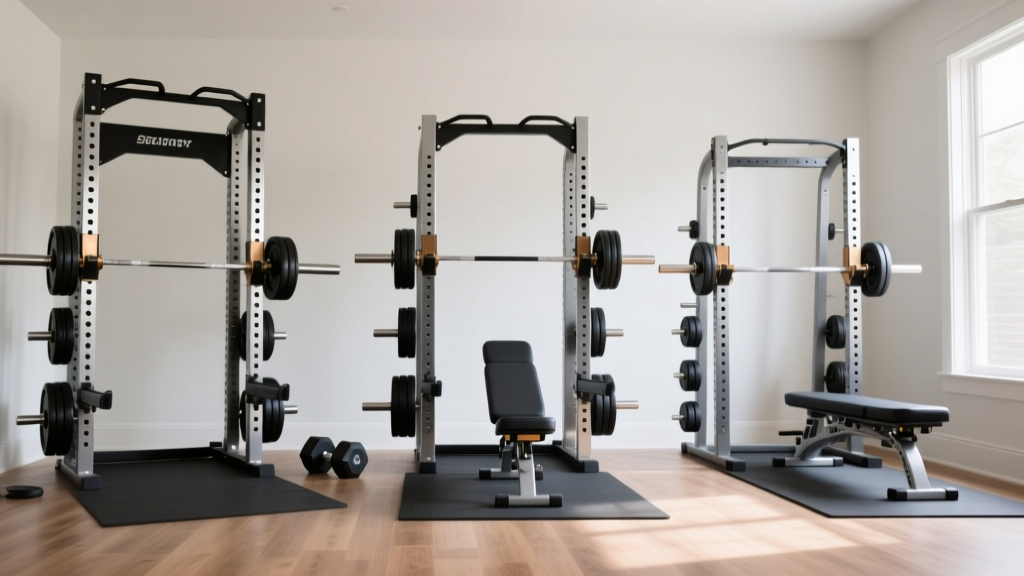
Power Rack vs Squat Rack vs Stand: Dumbbell Chest Workouts at Home
Barbell Collar Clamp Types & Chest Crossover With Dumbbells

Best Dumbbell Racks of 2026: Storing Your Lying Leg Curl Dumbbell

Loadable Dumbbell Care: Surviving the Leg Press with Dumbbells

Bumper vs Iron Plate Care & Incline Dumbbell Skull Crusher Longevity
